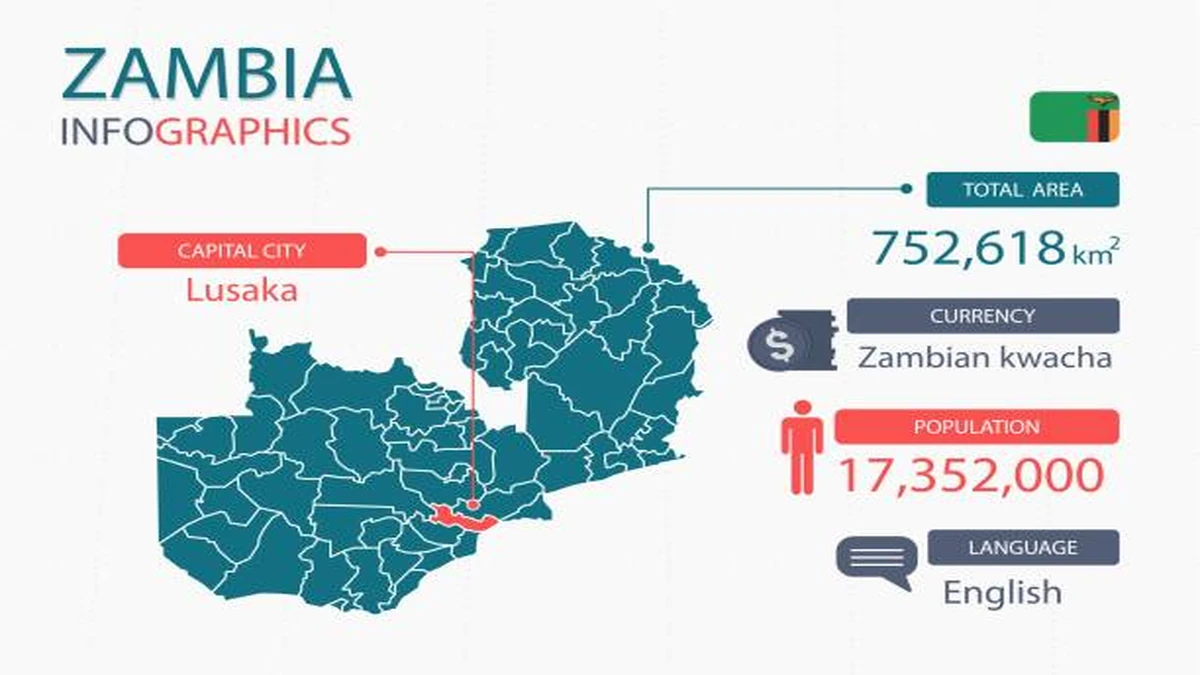
Zambia’s population has more than doubled since the year 2000 — and it’s still climbing fast. If you’ve landed here trying to pin down an actual number, you’re not alone; a lot of the figures floating around online contradict each other because they come from different sources and different reference dates.
As of 2026, Zambia population is estimated at approximately 22.5 million people, making it the 63rd most populous country in the world. The figure comes from United Nations projections built on Zambia’s 2022 national census, which counted just over 19.6 million residents. Growth has continued at roughly 2.8% to 3% a year since then, driven almost entirely by births outpacing deaths.
How Many People Live in Zambia in 2026?
Here’s where the confusion usually starts. Zambia’s own government statistics body, the Zambia Statistics Agency (ZamStats), conducted the country’s sixth national census in August and September 2022 — its first fully digital census — and recorded a population of 19,610,769. Everything you see labeled “2026” is a projection, not a fresh headcount, built forward from that census using UN growth models.
Different trackers land on slightly different numbers because they update at different times and use slightly different methodologies. Worldometer and World Population Review, both working from UN World Population Prospects data, put the mid-2026 figure at around 22.5 million. Other trackers using live daily interpolation show numbers a few hundred thousand lower or higher depending on the exact day you check.
The practical takeaway: treat “22.5 million” as a solid working estimate, not a precise headcount. The next real census — Zambia’s seventh — will be the actual reset point, expected around 2032 under the country’s ten-year census cycle.
Quick takeaway: Zambia’s population sits at roughly 22.5 million in 2026. That’s a projection from the 2022 census (19.6 million), not a new count.
Zambia’s Population Growth Rate, Explained
Zambia’s population grows by roughly 600,000 to 660,000 people a year — that works out to somewhere between 1,600 and 1,900 new people every single day. Almost all of that growth comes from natural increase (births minus deaths), not migration.
Three numbers explain why:
- Birth rate: Around 34–35 births per 1,000 people annually — one of the higher rates globally.
- Death rate: Roughly 6 deaths per 1,000 people, low enough that natural increase stays strongly positive.
- Net migration: Close to zero, sometimes slightly negative — Zambia isn’t a major net destination or source of migration compared to countries with civil conflict or large diaspora pull factors.
The result is an annual growth rate of about 2.8%–3%, among the fastest in the world. For comparison, the global average sits closer to 0.9%. That gap is the whole story of why Zambia’s population pyramid looks the way it does: wide at the base, narrow at the top.
What’s actually driving the high birth rate is Zambia’s fertility rate, which we’ll get into below — but the short version is limited access to family planning and contraception in rural areas, low female education rates in some regions, and cultural norms around family size that are shifting, but slowly.
Population by Year: Zambia’s Growth Since 1969
Zambia’s censuses tell a clear story of accelerating growth:
| Year | Population | Annual Growth Rate |
|---|---|---|
| 1969 | 4,056,955 | — |
| 1980 | 5,661,801 | +3.08% |
| 1990 | 7,383,097 | +2.69% |
| 2000 | 9,855,591 | +2.93% |
| 2010 | 13,092,666 | +2.88% |
| 2022 | 19,610,769 | +3.46% |
| 2026 (est.) | ~22,500,000 | ~2.8% |
Notice the growth rate never really slowed. Most countries see fertility decline meaningfully as they urbanize and industrialize; Zambia’s decline has been much more gradual, which is why it’s added over 15 million people in just over 50 years.
Age Structure and Median Age
Zambia is an extremely young country. The median age is around 18 to 19 years old, compared to a global median of roughly 31. Put another way: half the population hasn’t hit their late teens yet.
This shows up clearly in the population pyramid — a classic “expansive” shape with a wide base of children and teenagers narrowing sharply toward older age groups. Roughly 46% of Zambians are of working age (15–64), while a large share of the remainder are children under 15, and only a small fraction are 65 or older.
That youth-heavy structure has real consequences: high demand for schools and entry-level jobs, a growing labor force over the next two decades, but also a high dependency ratio — meaning each working-age adult effectively supports more dependents than in an older-population country.
Life Expectancy and Health Indicators
Life expectancy at birth in Zambia is around 66.5 years — about 64 years for men and close to 69 for women — still noticeably below the global average of roughly 74 years, though it’s climbed substantially from where it stood two decades ago, when the HIV/AIDS epidemic hit life expectancy hard.
Infant mortality remains a significant factor in the country’s demographic profile, at roughly 36 deaths per 1,000 live births — high relative to global averages, though it has fallen steadily as maternal healthcare access has expanded, particularly in urban areas.
Quick takeaway: Rising life expectancy plus a still-high birth rate is exactly the combination that produces fast population growth — more people are being born, and more of them are surviving into adulthood.
Urban vs. Rural: Where Zambians Live
Zambia is one of the more urbanized countries in sub-Saharan Africa, though estimates vary by source — somewhere between 44% and 47% of the population lives in urban areas as of the mid-2020s, and that share is rising by close to a percentage point a year.
Urban growth concentrates heavily along two corridors: the capital region around Lusaka, and the Copperbelt Province in the north, historically built around copper mining towns like Kitwe and Ndola. Rural Zambia, by contrast, remains sparsely populated relative to its land area — the country’s overall population density is only about 30 people per square kilometer, low by global standards, but that average masks huge variation between crowded urban centers and vast, thinly populated rural provinces.
Zambia’s Largest Cities by Population
Lusaka
Lusaka is Zambia’s capital and by far its largest city, with an urban population estimated around 2.4 million and a wider metro area closer to 3 million — over 10% of the entire country living in one metropolitan area. It’s the only Zambian city to cross the 1-million mark, and it functions as the country’s political, commercial, and transport hub, sitting at the junction of Zambia’s four main highway routes.
Kitwe
Kitwe, in the Copperbelt, is Zambia’s second-largest city with a population in the 700,000–730,000 range. It’s one of the country’s key industrial and commercial centers, historically tied to copper mining.
Ndola
Ndola, also in the Copperbelt, ranks third at roughly 630,000–700,000 residents, depending on the source and boundary definition used. Like Kitwe, its growth has tracked the fortunes of the copper industry.
Livingstone and Other Centers
Beyond the top three, cities like Livingstone (near Victoria Falls, in the south), Chipata (in the east), and Kabwe round out Zambia’s mid-sized urban centers. Seven Zambian cities now have populations over 100,000 — a sign of broadening urbanization beyond just the capital and Copperbelt.
Ethnic Groups and Population Diversity
Zambia is ethnically diverse, home to nearly 70 different Bantu-speaking ethnic groups, though nine main ethnolinguistic groups account for the large majority of the population: Bemba, Nyanja-Chewa, Tonga, Lunda, Luvale, Kaonde, Nkoya, Lozi, and Tumbuka. Bemba speakers form the single largest group, at roughly a fifth of the population.
Each group has historically concentrated in a particular region, but Lusaka and the Copperbelt cities have become genuinely mixed, with all major ethnic groups represented in significant numbers. Zambia also has small but economically notable expatriate and Asian communities, concentrated mainly in Lusaka and the Copperbelt.
The 2022 Census: What It Found
Zambia’s 2022 census wasn’t just a routine headcount — it was the country’s first-ever digitally conducted census, run by ZamStats with roughly 45,000 enumerators and supervisors over a four-week enumeration period in August–September 2022.
Beyond the topline population figure of 19,610,769, the census recorded a near-even gender split (about 10 million women to 9.6 million men), and confirmed Lusaka Province as the most populous province, at just over 3.09 million residents, with Muchinga Province the least populous at around 922,000. The census had actually been due in 2020 and was delayed twice — first to 2021, then again — due to funding and procurement issues, which is a useful data point if you’re trying to understand why some “current” figures you’ll see cited elsewhere are really extrapolations rather than fresh counts.
Future Population Projections
If current growth trends hold, UN medium-variant projections put Zambia’s population at roughly 30 million by the mid-2030s, and some longer-range models — which carry much wider uncertainty — suggest a trajectory toward 60 million or more by the end of the century, assuming fertility declines gradually rather than sharply, as it has elsewhere in Africa.
Those far-future numbers should be read with real caution. Small changes in fertility assumptions compound enormously over 70+ years, and Zambia’s own fertility decline has been slower than models from a decade ago predicted. The near-term projection — around 30 million by the mid-2030s — is on much firmer ground.
READ MORE: Ismailia Population 2026: Current Numbers, Growth, and What’s Behind Them
How Zambia Compares Regionally
Zambia’s growth rate outpaces most of Southern Africa. Neighboring countries like Zimbabwe and Botswana have slower growth and lower fertility rates, while Zambia’s trajectory looks more like that of countries further north and east in sub-Saharan Africa, where fertility decline has lagged urbanization.
Zambia’s population density — about 30 people per km² — is also notably lower than many of its neighbors, a reflection of the country’s large land area (743,390 km², similar in size to France and Germany combined) relative to its population.
FAQ Section
What is the current population of Zambia?
As of 2026, Zambia’s population is estimated at approximately 22.5 million people, based on UN projections built on the 2022 national census count of 19,610,769.
Is Zambia’s population growing or shrinking?
Growing, quickly. Zambia’s population increases by roughly 2.8%–3% a year, adding around 600,000–660,000 people annually — driven almost entirely by births outnumbering deaths rather than migration.
What is the largest city in Zambia?
Lusaka, the capital, is Zambia’s largest city, with an urban population of about 2.4 million and a metro area approaching 3 million people — over 10% of the country’s total population.
What percentage of Zambia’s population lives in urban areas?
Roughly 44%–47% of Zambians live in urban areas as of the mid-2020s, concentrated mainly around Lusaka and the Copperbelt Province cities of Kitwe and Ndola.
Why does Zambia have such a young population?
Zambia’s median age is only around 18–19 years because of a persistently high birth rate combined with rising life expectancy — more children are born each year, and more of them survive into adulthood, keeping the population pyramid heavily weighted toward younger ages.
How many people were counted in Zambia’s last census?
Zambia’s 2022 census — its sixth since independence and first fully digital census — counted 19,610,769 people, conducted by the Zambia Statistics Agency between August and September 2022.
What is Zambia’s population density?
About 30 people per square kilometer, which is relatively low globally, though it varies enormously between dense urban centers like Lusaka and thinly populated rural provinces.
What will Zambia’s population be in the future?
UN medium-variant projections put Zambia at roughly 30 million by the mid-2030s. Longer-range estimates toward the end of the century carry much greater uncertainty and depend heavily on how quickly fertility rates decline.