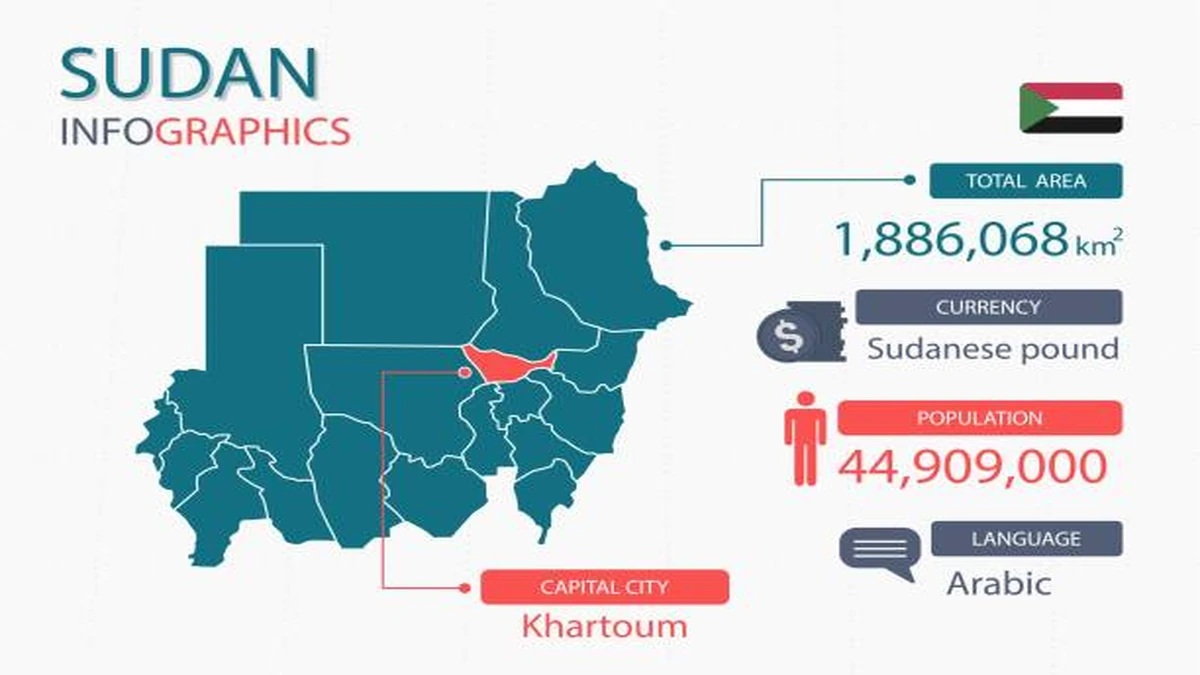
Sudan’s population number looks simple on paper — a single figure next to a flag icon. But behind that number sits the world’s largest displacement crisis, a civil war heading into its fourth year, and city populations that have shifted by the millions since 2023. Get the context wrong, and the number means almost nothing.
As of 2026, Sudan population is estimated at approximately 53.3 million, making it the 29th most populous country in the world and the 8th most populous in Africa. The population is still growing on paper, driven by high birth rates, but that growth sits alongside roughly 9 million people internally displaced by the ongoing conflict.
How Many People Live in Sudan in 2026
The United Nations’ World Population Prospects (2024 Revision) puts Sudan’s mid-2026 population at 53,282,719, up from 51.66 million a year earlier. Worldometer’s live counter, drawn from the same UN dataset, shows a running figure in the low-53-million range as of late July 2026.
You’ll notice the exact figure shifts depending on which tracker you check — StatisticsTimes, Countrymeters, and PopulationToday each land somewhere between 49.7 million and 53.3 million. That’s not sloppy data. It reflects three different things: which reference date the source uses, whether it counts Sudanese displaced abroad as still “in” Sudan, and how recently each model was updated against the war’s fast-moving displacement figures. For a country in active conflict, a de facto headcount (who’s physically present) and a de jure headcount (citizens on the books) can diverge by millions.
Quick takeaway: Use 53.3 million as your reference figure for 2026 — it’s the UN-based, most widely cited estimate — but treat any Sudan population number as a moving target right now, not a fixed census result.
Sudan Population Growth Rate and Trends
Sudan’s population has grown consistently for decades, even through periods of internal conflict:
| Year | Population | Annual Growth |
|---|---|---|
| 2022 | ~46.9 million | — |
| 2023 | 48,109,006 | 2.63% |
| 2024 | 49,358,228 | 2.60% |
| 2025 | 50,614,633 | 2.55% |
| 2026 | 53,282,719 | ~3.0% |
The growth rate itself — around 3% annually — is one of the higher rates globally, driven by a high fertility rate and a young population base rather than immigration. Sudan adds roughly 4,400 people net per day: about 4,638 births and 905 deaths, with a small amount of net immigration in the official model. That headline growth rate is a demographic average, though — it doesn’t capture the localized population collapse happening in war-affected states like Khartoum and Darfur, where residents have fled by the millions, or the surges in states that have absorbed the displaced.
Sudan Age, Gender, and Median Age Structure
Sudan has a young, fast-growing population typical of countries with high fertility and historically limited access to healthcare and family planning:
- Median age: 18.8 years (compared to a global average of roughly 31)
- Life expectancy: approximately 66.9 years at birth
- Population pyramid shape: broad-based and rapidly narrowing with age — a classic “expanding” pyramid, meaning each younger cohort is larger than the one before it
A median age under 19 means roughly half the country is still a child or teenager. That has direct implications for humanitarian planning: UN agencies have noted that a majority of Sudan’s internally displaced population is under 18, which puts enormous pressure on emergency education and child protection services during the conflict.
Ethnic Groups and Religion in Sudan
Sudan is one of the most ethnically diverse countries in Africa, home to more than 500 distinct ethnic groups and hundreds of languages and dialects.
- Largest ethnic group: Sudanese Arab, roughly 70% of the population
- Other major groups: Nubians, Beja, Fur, Nuba, and dozens of smaller groups concentrated in Darfur, Kordofan, and the eastern states
- Religion: Sunni Islam is the dominant faith, at roughly 91% of the population, with smaller Christian and traditional-faith communities, particularly in border regions
This diversity matters for understanding the current conflict — much of the fighting and displacement in Darfur and Kordofan has fallen along ethnic and tribal lines, which is part of why certain regions show far sharper population declines than the national average suggests.
Sudan’s Civil War and the Displacement Crisis (What Most Population Data Leaves Out)
This is the part most population-statistics pages skip entirely, and it’s the single most important thing to understand about Sudan’s population right now.
Since fighting broke out between the Sudanese Armed Forces (SAF) and the Rapid Support Forces (RSF) in April 2023, Sudan has become the site of the world’s largest displacement crisis — larger than Syria, Ukraine, or the DRC in raw numbers of people uprooted.
The numbers, and why they don’t match across sources:
- Displacement peaked in January 2025 at roughly 11.58 million internally displaced people (IDPs) nationwide, according to IOM’s Displacement Tracking Matrix (DTM).
- By 2026, that figure had fallen — but not because people went home safely. IOM DTM data from mid-2026 puts IDPs remaining inside Sudan at roughly 8.9 million, a decline driven partly by return movements and partly by continued outflows across borders.
- The Internal Displacement Monitoring Centre’s 2026 Global Report counted 9.1 million people displaced inside Sudan at the end of 2025, with 62% of them concentrated in Darfur alone — enough to make Sudan the world’s largest internal displacement crisis for a third year running.
- On top of internal displacement, roughly 3.2 to 4 million people have fled across Sudan’s borders into Chad, Egypt, South Sudan, Ethiopia, Libya, the Central African Republic, and Uganda as refugees and asylum seekers.
- Nearly 4 million people have returned to their areas of origin as of 2026, though returns are frequently into cities with destroyed infrastructure and little functioning healthcare, water, or schooling — Khartoum alone has absorbed over a million returnees.
Why this matters for the population figure: when displacement and return are both happening in the millions simultaneously, “how many people live in Sudan” and “where do they live” become two different questions. A population tracker that only updates annually can’t capture events like the RSF’s capture of El Fasher in North Darfur in late 2025, which alone triggered well over 100,000 new displacements in a matter of weeks.
Quick takeaway: Sudan’s national population total is still rising on paper, but treat any state-level or city-level figure — especially for Khartoum, Darfur, and Kordofan — as provisional. These numbers can shift by hundreds of thousands within a single reporting cycle.
Largest Cities in Sudan by Population
Sudan’s urban population is concentrated overwhelmingly around the “Triangular Capital” — Khartoum, Omdurman, and Khartoum North — though the war has significantly disrupted life in all three.
| Rank | City | Estimated Population | Notes |
|---|---|---|---|
| 1 | Omdurman | ~2.9 million | Largest city; cultural capital; occupied by RSF April 2023–May 2025 |
| 2 | Khartoum | ~2.3 million (city); 5.2–7.1 million (metro) | National capital; heavily damaged by fighting since 2023 |
| 3 | Khartoum North (Bahri) | ~1.6–2.6 million | Industrial hub across the Nile from Khartoum |
| 4 | Nyala | ~565,000 | Capital of South Darfur |
| 5 | Port Sudan | ~489,000 | Main Red Sea seaport; became a de facto seat of government during the war |
| 6 | Kassala | ~419,000 | Near the Eritrean border |
| 7 | El Obeid | ~345,000 | Capital of North Kordofan |
| 8 | Wad Madani | ~345,000 | Agricultural hub on the Blue Nile |
| 9 | Al-Fashir (El Fasher) | ~263,000 | Capital of North Darfur; captured by RSF in late 2025 amid mass displacement |
| 10 | Geneina | ~252,000 | Capital of West Darfur |
Together, Khartoum, Omdurman, and Khartoum North form Greater Khartoum, home to well over 5 million people even after years of wartime exodus — though a substantial share of that population fled the metro area between 2023 and 2025, with returns only partially offsetting the loss.
Urban vs. Rural Population in Sudan
Roughly a third of Sudan’s population lives in urban areas — estimates range from about 28% to 35% depending on the source and whether displaced populations in urban camps are counted as “urban.” The remaining two-thirds live in rural and semi-rural communities, concentrated along the Nile corridor and in agricultural regions like Al Jazirah and Kordofan.
Urbanization is rising slowly over time, but the war has scrambled the usual pattern: instead of gradual rural-to-city migration, Sudan has seen sudden, conflict-driven population swings in both directions — cities emptying out during active fighting, then partially refilling once an area stabilizes.
Sudan Population Density and Land Area
Sudan is a large, sparsely populated country by land area. With roughly 1,765,048 km² of territory — including significant Sahara Desert terrain in the north — Sudan’s population density works out to about 30 people per km², well below the global average. Population is heavily concentrated along the Nile River and its tributaries, where water access supports agriculture and settlement; large stretches of the western and northern desert remain nearly empty.
READ MORE: Uzbekistan Population 2026: Current Numbers, Growth, and Key Trends
Sudan Population Projections
Assuming the medium-fertility UN projection holds and the conflict eventually stabilizes, Sudan’s population is projected to keep growing through mid-century, potentially approaching 60 million by 2030 and well over 80 million by 2050, driven by its young age structure and high fertility rate. These projections come with more uncertainty than usual for a country of Sudan’s size, since sustained conflict, famine conditions already declared in parts of Darfur, and large-scale emigration could all meaningfully slow that trajectory if the war continues.
Frequently Asked Questions
What is Sudan’s population in 2026?
Sudan’s population is estimated at approximately 53.3 million as of 2026, based on UN World Population Prospects data, making it the 29th most populous country globally.
Is Sudan’s population growing or shrinking?
Nationally, Sudan’s population is still growing — around 3% per year — due to high birth rates. However, large regions like Darfur and Khartoum have seen sharp local population declines from war-driven displacement.
How many people have been displaced by Sudan’s civil war?
Displacement peaked at 11.58 million internally displaced people in January 2025. As of 2026, roughly 8.9–9.1 million remain internally displaced, with an additional 3.2–4 million having fled to neighboring countries as refugees.
What is Sudan’s largest city?
Omdurman is Sudan’s largest city by population, at approximately 2.9 million, narrowly ahead of the capital, Khartoum.
What percentage of Sudan’s population is urban?
Roughly 28–35% of Sudan’s population lives in urban areas, with the rest in rural and agricultural regions, primarily along the Nile.
What is the median age in Sudan?
Sudan’s median age is 18.8 years, reflecting a young, fast-growing population with high fertility rates.
Which countries host the most Sudanese refugees?
Egypt, Chad, and South Sudan host the largest numbers of people who have fled Sudan since the war began in April 2023.
Will Sudan’s population keep growing?
UN medium-fertility projections suggest continued growth toward 2050, but the outcome depends heavily on how and when the current conflict resolves.
Data sourced from UN World Population Prospects (2024 Revision), Worldometer, IOM Displacement Tracking Matrix, IDMC Global Report on Internal Displacement 2026, and UNHCR reporting as of July 2026. Displacement figures change frequently; check IOM DTM and IDMC directly for the most current crisis data.