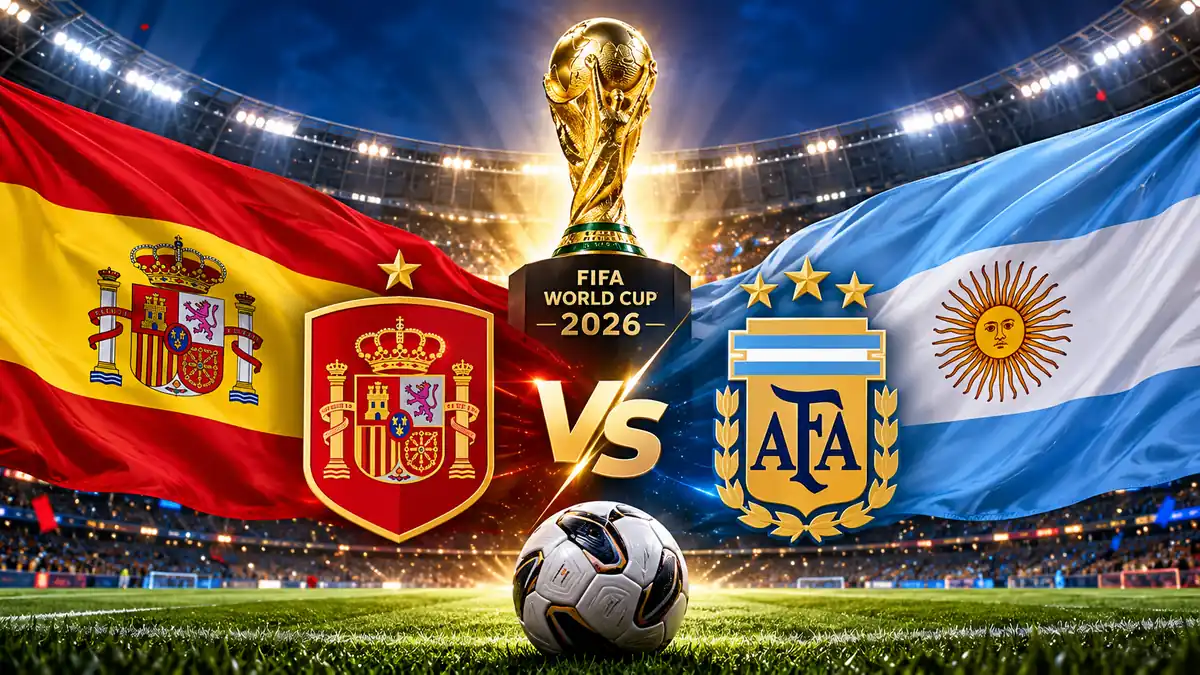
The spain vs argentina clash delivered one of international football’s biggest possible matchups: the European champions against the defending world champions, with the FIFA World Cup trophy at stake.
Spain defeated Argentina 1-0 after extra time in the 2026 FIFA World Cup final on July 19, 2026. Substitute Ferran Torres scored the decisive goal in the 106th minute at New York New Jersey Stadium, giving Spain their second men’s World Cup title. Argentina finished normal time with ten players after Enzo Fernández was sent off. FIFA
spain vs argentina Final Score and Match Details
Spain entered the final looking for their first World Cup title since 2010. Argentina arrived as defending champions after lifting the trophy in Qatar in 2022.
Despite the enormous attacking talent on both sides, the match remained scoreless throughout regulation time. Spain controlled most of the possession and created nearly all the significant opportunities, while Argentina defended deep and relied heavily on goalkeeper Emiliano Martínez.
| Match detail | Information |
|---|---|
| Competition | FIFA World Cup 2026 Final |
| Match | Spain vs Argentina |
| Date | July 19, 2026 |
| Venue | New York New Jersey Stadium |
| Score after 90 minutes | 0-0 |
| Final score | Spain 1-0 Argentina (AET) |
| Goalscorer | Ferran Torres, 106′ |
| Red card | Enzo Fernández |
| Winner | Spain |
FIFA’s official match report confirms that Spain became world champions for the second time, with Torres’ extra-time strike separating the teams. FIFA
How Spain Controlled the World Cup Final
The 1-0 scoreline does not fully describe the balance of the match.
Spain controlled possession, territory and chance creation for long periods. Argentina remained compact and attempted to prevent players such as Lamine Yamal, Dani Olmo and Mikel Oyarzabal from finding clear shooting opportunities.
Spain’s first meaningful chance came early. Olmo found Yamal on the right side of the penalty area, and the winger’s low effort forced Martínez into a save.
That pattern continued.
Spain circulated possession patiently rather than forcing the final pass. Argentina defended with numbers behind the ball and looked for opportunities to transition through Lionel Messi and their other attacking players.
Those counterattacking opportunities rarely materialized.
By half-time, Spain had recorded three attempts while Argentina had yet to produce one. Spain also held approximately 65 percent of possession during the opening period. Al Jazeera
Argentina’s Defensive Approach
Lionel Scaloni’s side spent significant periods without possession.
The strategy initially worked in one important sense: Spain could not score.
Argentina protected central areas, reduced the space between their midfield and defensive lines, and forced Spain to keep recycling possession.
But there was a trade-off.
With Argentina defending so deep, Messi and the forwards frequently became isolated. When possession was recovered, Spain were often positioned well enough to stop the counterattack before it developed.
Argentina consequently offered very little attacking threat.
Emiliano Martínez Kept Argentina in the Match
One of the central figures in the spain vs argentina final was Emiliano Martínez.
Spain’s pressure increased as the match progressed, but the Argentina goalkeeper repeatedly prevented the European champions from taking the lead.
FIFA documented opportunities for several Spanish players, including Yamal, Oyarzabal, Pau Cubarsí, Pedri and Nico Williams. Martínez continued producing saves as Spain searched for the breakthrough. FIFA
The goalkeeper’s performance became particularly significant because Argentina were creating almost nothing at the opposite end.
Spain could control the ball and reach dangerous positions, but Martínez gave Argentina a chance of taking the final into extra time—and potentially penalties.
That possibility remained alive until very late.
Defensive Injuries Made Argentina’s Task Harder
Argentina’s defensive plan was complicated by injuries.
Lisandro Martínez had to leave shortly before half-time, with veteran Nicolás Otamendi replacing him. Cristian Romero was then replaced by Facundo Medina in the second half. FIFA
Changing both starting centre-backs during a World Cup final is difficult under any circumstances.
Against a Spain team continually moving the ball from side to side, it created another challenge: substitutes had to immediately understand pressing triggers, defensive spacing and the movement of Spain’s attackers.
Argentina nevertheless kept the score at 0-0.
Enzo Fernández Red Card Changed the Situation
One of the biggest moments arrived in second-half stoppage time.
Enzo Fernández received his second yellow card following a challenge on Pau Cubarsí and was sent off. Argentina therefore had to enter extra time with ten players. FIFA
It was an especially damaging dismissal because Spain already controlled the match territorially.
With an extra player, Luis de la Fuente’s side could stretch Argentina even further.
Argentina now needed to protect the penalty area while somehow maintaining enough attacking presence to threaten Spain on the counterattack.
That became increasingly difficult.
Ferran Torres Scores the Winning Goal
The breakthrough finally arrived in the 106th minute.
Pedro Porro delivered the ball toward the far post. Nico Williams won the aerial contest and headed it back into a dangerous central position.
Ferran Torres was waiting.
The substitute struck first time and sent the ball beyond Martínez to make it Spain 1-0 Argentina. FIFA named Torres its player of the match. FIFA
It was a goal that demonstrated the value of Spain’s squad depth.
Torres had not started the final. Neither had Williams. Yet two substitutes combined to produce the decisive moment on football’s biggest stage.
Argentina finally had no option but to attack.
Spain, however, survived the remaining minutes and secured the trophy.
spain vs argentina Match Stats
The statistics illustrate just how much control Spain exercised.
Sky Sports recorded Spain with 65.1% possession, compared with Argentina’s 34.9%. Spain attempted 20 shots, while Argentina managed only two. Even more strikingly, Spain recorded 12 shots on target and Argentina zero. Sky Sports
| Statistic | Spain | Argentina |
|---|---|---|
| Possession | 65.1% | 34.9% |
| Total shots | 20 | 2 |
| Shots on target | 12 | 0 |
| Corners | 9 | 4 |
| Accurate passes | 763 | 357 |
| Passing accuracy | 89.4% | 76.9% |
Argentina became the first team in the available World Cup final records dating from 1966 to complete normal time without attempting a shot. Opta Analyst
That statistic captures perhaps the biggest tactical story of the final.
Spain did not simply have more possession. They largely prevented Argentina from turning defensive recoveries into meaningful attacks.
Why Spain’s Possession Was So Effective
Possession statistics can sometimes be misleading. A team can dominate the ball without creating much.
That was not the case here.
Spain used possession to continually move Argentina’s defensive block.
When central routes were closed, Spain circulated the ball toward the wings. When Argentina shifted across, space could emerge between defenders or around the opposite flank.
Yamal provided width and one-on-one ability. Olmo operated between lines, while Spain’s midfielders helped maintain pressure by recovering second balls and restarting attacks.
The result was sustained territorial control.
Spain’s passing accuracy of 89.4 percent also mattered because misplaced passes are often what create counterattacking opportunities.
By protecting the ball, Spain reduced the number of transitions available to Argentina.
Spain’s Width Created Problems
Width was another important component.
Argentina could remain compact centrally, but doing so left Spain opportunities toward the outside of their defensive shape.
Spain repeatedly looked to progress through wide areas before delivering the ball back toward the penalty area.
The winning goal ultimately came through exactly this type of situation: Porro supplied the cross, Williams attacked the far-post area, and Torres occupied the central scoring position.
How Spain Limited Lionel Messi
Any tactical plan against Argentina naturally had to account for Lionel Messi.
Completely man-marking him could have distorted Spain’s defensive structure, so maintaining control around him was equally important.
Spain’s possession helped accomplish that.
Messi is most dangerous when Argentina can recover possession and quickly find him before the opposing defence is organized. Spain minimized those moments by retaining the ball and maintaining players behind their attacks.
Argentina’s deeper defensive position also meant Messi frequently received possession farther from Spain’s penalty area than he would have preferred.
Spain therefore reduced his influence not through one individual matchup but through broader control of possession, territory and transitions.
Lamine Yamal’s Influence
At the other end, Lamine Yamal remained one of Spain’s most dangerous outlets.
His early attempt tested Martínez, and his positioning on the right forced Argentina to continually account for his ability to cut inside or attack outside.
He also created an opportunity for Torres during the second half and forced Martínez into another save from a late free kick. FIFA
Yamal did not score the winning goal, but his presence helped stretch Argentina’s defensive structure.
That is an important distinction when evaluating attacking performances. A winger’s influence is not limited to goals and assists; positioning can create space for teammates elsewhere.
Spain’s Substitutions Made the Difference
World Cup finals frequently become tests of squad depth.
By the second half, fatigue changes everything. Defensive reactions slow, spaces become larger and fresh attackers can exploit situations that were unavailable earlier.
De la Fuente introduced players including Pedri, Ferran Torres, Nico Williams and Mikel Merino.
Torres ultimately scored the winner, while Williams provided the headed assist that created it.
The substitutions allowed Spain to maintain attacking intensity rather than simply continuing with tired players.
Argentina’s substitutions, meanwhile, were partly dictated by injuries and the need to maintain their defensive structure.
That difference became increasingly significant as the match entered extra time.
Spain vs Argentina Head-to-Head History
The 2026 final added a major new chapter to a surprisingly limited competitive history between the countries.
Before the final, their only previous World Cup meeting had occurred in 1966, when Argentina defeated Spain 2-1.
FIFA’s updated historical record states that, after the 2026 final, Spain had seven victories, Argentina six and the teams had drawn twice across 15 meetings. FIFA
Their history has included friendlies as well as major competitive matches, but none carried the significance of the 2026 encounter.
For the first time, Spain and Argentina faced each other with the World Cup itself on the line.
What the Victory Meant for Spain
Spain’s first men’s World Cup championship came in South Africa in 2010, when Andrés Iniesta scored the extra-time winner against the Netherlands.
Sixteen years later, Spain again required extra time and again won a World Cup final 1-0.
This time, Torres supplied the historic goal.
The victory gave Spain its second FIFA World Cup title. It also followed the country’s UEFA Euro 2024 triumph, extending an exceptional period for the national team. FIFA
FIFA also noted that Spain extended its run without a defeat in regulation time to 38 matches, a national record. FIFA
What the Defeat Meant for Argentina
Argentina arrived in the final attempting to become world champions in consecutive tournaments.
The team had won the 2022 World Cup in Qatar and remained one of international football’s strongest sides.
The 2026 final was different from Argentina’s previous major successes, however.
Scaloni’s team could defend effectively, and Martínez produced a major goalkeeping performance, but Argentina struggled to progress possession into dangerous areas.
After the match, Scaloni acknowledged that Spain had been the better side while emphasizing what Argentina had achieved by reaching another World Cup final. FIFA
For Messi, the occasion was historically significant as well. FIFA reported that he became only the second player, after Brazil’s Cafu, to appear in three men’s World Cup finals: 2014, 2022 and 2026. FIFA
The Finalissima That Never Happened
An unusual piece of context makes the World Cup meeting even more interesting.
Spain and Argentina had originally been scheduled to meet earlier in 2026 in the Finalissima, the competition matching the reigning European and South American champions.
Spain qualified after winning UEFA Euro 2024, while Argentina earned its place by winning the 2024 Copa América. The fixture had been announced for March 27 at Lusail Stadium in Qatar. UEFA.com
Instead, the teams’ defining 2026 meeting ultimately came on an even bigger stage: the World Cup final.
Key Takeaways From spain vs argentina
The final score was narrow, but Spain’s advantage across the match was much clearer than 1-0 suggests.
Spain controlled possession, restricted Argentina to two total attempts and did not concede a single shot on target. Martínez’s saves kept Argentina alive through regulation time, but Fernández’s dismissal increased the pressure heading into extra time.
Then Spain’s depth decided the contest.
Porro’s delivery, Williams’ header and Torres’ 106th-minute finish finally converted sustained pressure into the goal Spain needed.
The spain vs argentina 2026 World Cup final therefore ended with Spain winning 1-0 after extra time, claiming their second men’s FIFA World Cup title and adding another historic chapter to one of international football’s most intriguing matchups. FIFA