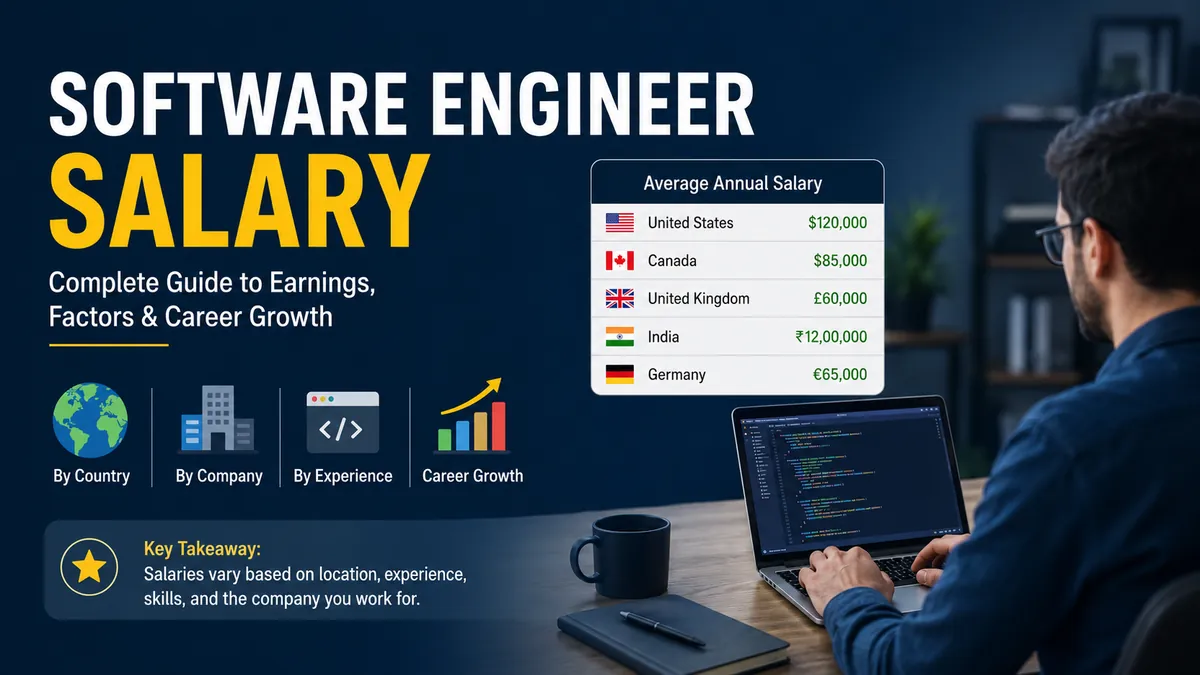
A software engineering career can pay well, but a single “average salary” rarely tells the whole story. Two engineers with the same job title can have dramatically different compensation because of experience, location, specialization, employer, and stock awards.
In the United States, a software engineer salary typically centers around $135,000–$148,000 in base or annual pay, depending on the dataset used. The U.S. Bureau of Labor Statistics reports a $135,980 median annual wage for software developers in May 2025, while current job-market datasets show averages around $135,000–$148,000. Total compensation at major technology companies can be considerably higher.
This guide explains what software engineers earn in 2026, why salary estimates vary, how experience and location affect pay, and why base salary is only one part of compensation.
Average software engineer salary in 2026
There is no single official salary figure covering everyone called a “software engineer.” Different salary platforms measure different populations and compensation components.
As of August 2026, Indeed reports an average U.S. software engineer base salary of $135,623 per year, based on approximately 39,400 salaries from job postings over the previous 36 months. Its reported range extends from about $80,144 to $229,507.
ZipRecruiter reports a higher average of $147,524 per year, equivalent to roughly $70.92 per hour. Its majority range runs from approximately $120,000 at the 25th percentile to $173,000 at the 75th percentile.
The U.S. Bureau of Labor Statistics provides another useful benchmark. Its Occupational Outlook Handbook reports a $135,980 median annual wage for software developers in May 2025. The lowest 10% earned below $82,460, while the highest 10% earned more than $214,670.
| Salary source | Reported pay | What it represents |
|---|---|---|
| BLS | $135,980 | Median annual wage, May 2025 |
| Indeed | $135,623 | Average base salary, August 2026 |
| ZipRecruiter | $147,524 | Average annual pay, August 2026 |
| Levels.fyi | $195,000 | Median total compensation, August 2026 |
The differences aren’t necessarily contradictions. BLS occupational wage data, job-posting estimates, self-reported compensation, and total-compensation datasets measure pay differently.
Average salary vs. median salary
This distinction matters when researching engineering pay.
An average is calculated by adding salaries together and dividing by the number of observations. A relatively small number of extremely high earners can pull the average upward.
A median represents the midpoint: half of workers earn less and half earn more.
For a profession where compensation can range from entry-level salaries to packages worth several hundred thousand dollars, the median can often provide a clearer picture of the typical worker.
Why Levels.fyi reports much higher numbers
Levels.fyi reports a median U.S. software engineer total compensation of approximately $195,000, with a 25th percentile around $138,000 and a 75th percentile around $280,000 as of August 31, 2026.
The key phrase is total compensation.
Levels.fyi breaks compensation into components such as:
- Base salary
- Annual or performance bonus
- Equity and restricted stock units (RSUs)
- Other compensation
Its data also has substantial representation from technology companies where equity awards are common.
A $160,000 base salary with $70,000 of annualized stock and a $20,000 bonus, for example, produces $250,000 in total compensation.
Quick Takeaway: When comparing software engineering salaries, first determine whether the number represents base salary, annual cash compensation, or total compensation. Comparing a base-salary figure with a stock-inclusive compensation figure can create a misleading gap.
software engineer salary by experience level
Years of experience are among the strongest predictors of earnings, but experience alone doesn’t determine an engineer’s level.
Companies may classify engineers as junior, mid-level, senior, staff, principal, distinguished, or use internal level codes. Responsibilities and technical impact usually become more important as engineers move upward.
Entry-level and junior software engineer salary
An entry-level software engineer generally has limited professional experience and works with guidance from more experienced engineers.
Typical responsibilities include:
- Writing and testing production code
- Fixing bugs
- Participating in code reviews
- Learning an existing codebase
- Building smaller features
- Using Git and development workflows
- Writing unit and integration tests
- Working with APIs and databases
Junior salaries frequently fall below national software developer averages because national figures include experienced engineers.
However, an entry-level engineer at a large technology company in a high-cost market can earn more than an experienced engineer working for a smaller employer elsewhere.
Education also affects the starting point. The BLS lists a bachelor’s degree as the typical entry-level education for software developers, although actual hiring practices vary and some developers enter through alternative routes.
Mid-level software engineer salary
Mid-level engineers typically work with greater independence.
Instead of simply implementing clearly defined tasks, they may design features, make architectural decisions within a service, review other developers’ code, troubleshoot production problems, and help junior team members.
Their value increasingly comes from their ability to solve problems rather than simply write code.
A mid-level engineer with expertise in a high-demand technology can therefore command substantially more than another developer with the same number of years in the industry.
Senior software engineer salary
Senior engineers are normally expected to own complex technical problems and make decisions that affect larger portions of a product or system.
Common responsibilities include:
- Designing scalable systems
- Leading major projects
- Reviewing architecture
- Mentoring engineers
- Handling difficult production incidents
- Improving engineering processes
- Coordinating with product and business teams
- Making technical trade-offs
Senior software engineer compensation often rises significantly at companies that include bonuses and equity.
This is also where job titles become less useful for salary comparison. A “Senior Software Engineer” at one employer may have responsibilities equivalent to a mid-level engineer at another.
Staff and principal software engineers
Staff and principal engineers usually operate beyond individual projects.
A staff engineer may establish technical direction across several teams, solve organization-wide engineering problems, influence architecture, and coordinate major technical initiatives.
Principal engineers can have even broader impact.
At this level, compensation is heavily influenced by the employer and equity structure. High-paying technology companies can offer total packages far above broad occupational salary averages.
The most useful comparison is therefore:
level + location + company + specialty + total compensation
rather than job title alone.
What determines a software engineer salary?
Experience explains part of the difference between salaries, but several variables work together.
1. Location
Software engineering salaries vary substantially by city and region.
Technology hubs historically pay higher nominal salaries because they combine expensive labor markets with concentrations of technology companies and specialized workers.
Levels.fyi’s August 2026 U.S. data lists median total compensation around:
| Location | Reported median total compensation |
|---|---|
| San Francisco Bay Area | $287,000 |
| Greater Seattle Area | $256,800 |
| New York City Area | $200,000 |
These figures represent the compensation profiles captured by Levels.fyi and shouldn’t be interpreted as guaranteed salaries for every engineer in those locations.
Cost of living also matters.
A $180,000 salary in San Francisco and a $150,000 salary in a lower-cost city don’t necessarily produce the same disposable income. Housing, state and local taxes, transportation, insurance, and other expenses can materially change purchasing power.
2. Industry
The industry employing the engineer can influence compensation almost as much as the technology itself.
According to BLS data for May 2025, median annual wages for software developers in selected industries included:
| Industry | Median annual wage |
|---|---|
| Software publishers | $164,550 |
| Manufacturing | $136,330 |
| Management of companies and enterprises | $135,680 |
| Finance and insurance | $135,460 |
| Computer systems design and related services | $132,050 |
Software publishing stood noticeably above several other major industries.
An engineer building financial infrastructure, cloud software, AI systems, enterprise platforms, or specialized developer tools may therefore encounter very different compensation markets.
3. Company size and compensation philosophy
A startup, government contractor, bank, consulting firm, software publisher, and major technology corporation may all hire “software engineers,” yet structure pay differently.
One company might offer:
$155,000 base + small bonus
Another might offer:
$145,000 base + $15,000 bonus + $60,000 annualized equity
The second offer has a lower base salary but substantially higher target total compensation.
This is why experienced candidates evaluate the complete compensation package rather than comparing base salaries alone.
4. Technical specialization
Not every engineering specialty has the same labor market.
Areas that require scarce expertise or directly support valuable infrastructure can command higher compensation.
Examples include:
- Artificial intelligence
- Machine learning
- Distributed systems
- Cloud infrastructure
- Cybersecurity
- Data engineering
- Backend engineering
- Site reliability engineering
- Mobile development
- Embedded systems
- DevOps and platform engineering
Levels.fyi, for example, lists Machine Learning Engineer among its higher-paying software engineering-related titles, with a reported U.S. median total compensation of about $280,000 in August 2026.
That doesn’t mean learning machine learning automatically produces a $280,000 salary. Employer mix, location, level, and the type of professionals represented in the dataset matter.
5. Technical skills
Programming languages alone rarely determine compensation.
Knowing Python, Java, JavaScript, TypeScript, C++, Go, C#, or Rust can help qualify someone for particular jobs, but employers generally pay for the problems an engineer can solve with those tools.
Higher-value capabilities may include:
- System design
- Cloud architecture
- Database design
- Distributed computing
- Performance optimization
- API architecture
- Security engineering
- Kubernetes and containerization
- AWS, Microsoft Azure, or Google Cloud
- Machine learning infrastructure
- CI/CD automation
The strongest compensation gains often come when technical depth is combined with the ability to design, communicate, and deliver complex systems.
6. Scope and impact
Two engineers can have eight years of experience and still operate at very different levels.
One may maintain a narrow application. Another may design infrastructure serving millions of users, coordinate several teams, mentor engineers, and make architectural decisions with significant financial consequences.
Employers—particularly large technology companies—often reward scope, complexity, and impact, not simply years since graduation.
software engineer salary by compensation type
One of the easiest salary-research mistakes is treating “salary” and “compensation” as interchangeable.
They aren’t always the same.
Base salary
Base salary is the fixed cash amount an employee receives before variable compensation.
If an offer states a $150,000 annual base, that is generally the most predictable component.
Cash bonus
Bonuses may depend on individual performance, company performance, or both.
Suppose an engineer receives:
- $150,000 base salary
- 10% target annual bonus
The target cash bonus would be $15,000, producing $165,000 in target annual cash compensation.
Actual bonus payments can be higher or lower.
Indeed’s August 2026 U.S. salary page, for example, reports an average software engineer base salary of $135,623 and lists a $5,000 cash bonus figure.
Equity and RSUs
Equity can transform compensation at public technology companies.
Restricted stock units, commonly called RSUs, are company shares that typically vest according to a schedule.
Consider this simplified package:
| Compensation component | Annual value |
|---|---|
| Base salary | $170,000 |
| Target bonus | $17,000 |
| Annualized RSUs | $80,000 |
| Target total compensation | $267,000 |
The engineer’s salary is $170,000, but target total compensation is $267,000.
Actual equity value can change with the company’s stock price and vesting terms.
Stock options
Private startups may use stock options rather than publicly traded RSUs.
Options can potentially become valuable if the company succeeds, but they should not automatically be valued like cash.
Employees need to understand:
- Strike price
- Number of options
- Vesting schedule
- Exercise window
- Current preferred/common share valuation
- Dilution
- Liquidity prospects
- Tax consequences
A startup package with a large theoretical equity value can ultimately be worth far less—or much more—than originally expected.
Signing bonuses and benefits
Compensation can also include:
- Signing bonus
- Retirement contributions or 401(k) match
- Health insurance
- Paid time off
- Parental leave
- Education reimbursement
- Home-office allowance
- Commuter benefits
Signing bonuses deserve special attention because they may inflate first-year compensation without repeating in later years.
Quick Takeaway: Compare recurring compensation separately from one-time payments. A $20,000 signing bonus makes the first year attractive, but it shouldn’t be treated as permanent annual income.
How much do software engineers make per hour?
Converting annual salaries into hourly equivalents can help compare full-time positions with contract work.
ZipRecruiter’s $147,524 annual average translates to approximately $70.92 per hour using its calculation.
BLS Occupational Employment and Wage Statistics data for May 2025 reported a mean hourly wage of $71.20 and mean annual wage of $148,100 for software developers.
But a salaried engineer and an independent contractor shouldn’t compare hourly figures dollar for dollar.
A salaried employee may receive health insurance, paid leave, retirement benefits, bonuses, equity, and employer-paid payroll taxes. Contractors may need to cover more of these costs themselves and may have periods without billable work.
That is one reason contract hourly rates can appear considerably higher than equivalent employee hourly wages.
How software engineering compares with related careers
“Software engineer,” “software developer,” and “computer programmer” are sometimes used interchangeably in everyday conversation, but occupational datasets may classify them differently.
The distinction matters when comparing salaries.
BLS reports the following figures:
| Occupation | Pay benchmark |
|---|---|
| Software developers | $135,980 median annual wage |
| Software QA analysts and testers | $104,300 median annual wage |
| Computer programmers | $100,390 median annual wage |
| Computer occupations overall | $109,470 median annual wage |
The first three figures are May 2025 medians reported in the respective BLS occupational profiles.
Software engineer vs. software developer
Many employers use these titles interchangeably.
“Software engineer” sometimes implies greater emphasis on engineering principles, architecture, scalability, and system design, while “software developer” may emphasize building applications.
There is no universal industry rule, however.
When evaluating a position, the job description, responsibilities, level, and compensation band tell you more than the title.
Software engineer vs. computer programmer
A computer programmer traditionally focuses more narrowly on writing, modifying, and testing code.
Software engineering generally encompasses a broader lifecycle that can include requirements, architecture, development, testing, deployment, reliability, and maintenance.
BLS also treats software developers and computer programmers as separate occupational categories. Its May 2025 median wage for computer programmers was $100,390, below the $135,980 median for software developers.
Software engineer vs. QA engineer
Software quality assurance analysts and testers focus on identifying defects and evaluating applications or systems.
BLS reports a May 2025 median annual wage of $104,300 for software QA analysts and testers.
Automation-heavy quality engineering roles may overlap substantially with software development, so individual salaries can depart significantly from broad occupational medians.
Which software engineering jobs pay the most?
High compensation tends to appear where technical scarcity, business value, and organizational impact overlap.
Machine learning and AI engineering
Machine learning engineers build systems that train, deploy, evaluate, and operate machine-learning models.
The role may require expertise in Python, statistics, data processing, distributed computing, GPU infrastructure, model evaluation, and machine-learning frameworks.
Competition for experienced AI talent has made this one of the more lucrative areas of software engineering at certain employers.
Infrastructure and distributed systems
Engineers who build cloud platforms, databases, storage systems, networking infrastructure, and distributed systems solve problems where failures can affect huge numbers of customers.
The work often requires deep understanding of:
- Scalability
- Concurrency
- Networking
- Databases
- Reliability
- Operating systems
- Performance
Strong expertise in these areas can command premium compensation.
Security engineering
Security engineers help protect applications, infrastructure, identities, and sensitive information.
As organizations face increasingly sophisticated threats and stricter security requirements, engineers who combine strong software-development ability with cybersecurity knowledge can be valuable.
Staff and principal engineering
The highest-paid engineers aren’t necessarily managers.
Many technology companies maintain an individual contributor (IC) career track, allowing highly experienced engineers to progress to staff, principal, or higher levels without becoming people managers.
At these levels, an engineer’s influence may span multiple teams or entire technical organizations.
Where do software engineers earn the most?
Geography remains a major compensation variable even as remote work has made hiring more distributed.
Major U.S. technology markets include the San Francisco Bay Area, Seattle, New York City, Boston, Los Angeles, and Austin.
Current Levels.fyi data places the San Francisco Bay Area and Greater Seattle Area among the highest-paying U.S. locations for software engineering total compensation.
However, higher nominal pay isn’t the same as higher financial well-being.
Consider cost of living
Suppose Engineer A earns $200,000 in a very expensive city while Engineer B earns $160,000 in a lower-cost region.
Engineer A earns 25% more, but housing costs could potentially be 50% or 100% higher.
A useful salary comparison considers:
after-tax compensation − housing − transportation − recurring living costs
Remote employees should also check the employer’s geographic compensation policy. Some companies maintain national salary bands, while others adjust pay based on an employee’s location.
How much can top software engineers earn?
This is where broad salary averages become especially misleading.
BLS reports that the highest 10% of software developers earned more than $214,670 annually in May 2025.
At major technology companies, total compensation can go considerably beyond that because BLS wage figures and technology-industry total-compensation datasets aren’t measuring exactly the same thing.
Levels.fyi’s August 2026 U.S. dataset reports:
- $195,000 median total compensation
- $138,000 at the 25th percentile
- $280,000 at the 75th percentile
- roughly $392,000 at the 90th percentile
It also reports exceptionally high packages at selected companies and senior levels.
Those figures shouldn’t be treated as representative starting salaries. They demonstrate the enormous range that exists once equity, employer, specialization, and seniority enter the calculation.
Do you need a degree to earn a high software engineer salary?
A college degree remains a common route into software development.
The BLS lists a bachelor’s degree as the typical entry-level education for software developers and notes that some employers prefer candidates with a master’s degree.
But “typical” doesn’t mean universally mandatory.
Hiring practices vary among employers, and candidates can also develop skills through:
- Self-directed learning
- Coding bootcamps
- Associate-degree programs
- Open-source contributions
- Freelance projects
- Professional certifications
- Internal career transitions
Once someone has substantial professional experience, demonstrated engineering ability and work history may become more influential than the exact educational path.
For specialized research-heavy areas—particularly some machine learning, artificial intelligence, graphics, and research roles—advanced degrees can still carry substantial value.
What skills can increase software engineering earning potential?
Chasing whichever programming language appears highest on a salary chart is rarely the best long-term strategy.
A more durable approach is to become capable of solving increasingly difficult and valuable problems.
Build strong fundamentals
High-level engineering work depends on fundamentals such as:
- Data structures
- Algorithms
- Networking
- Databases
- Operating systems
- Software architecture
- Testing
- Security
- System design
Frameworks change. These foundations remain useful.
Learn system design
System-design knowledge becomes increasingly valuable as engineers progress toward senior and staff roles.
Engineers should understand concepts such as:
- Horizontal and vertical scaling
- Caching
- Load balancing
- Database replication
- Sharding
- Message queues
- Event-driven systems
- Consistency and availability
- Fault tolerance
- Observability
These skills allow an engineer to move from implementing individual features to designing entire systems.
Develop cloud expertise
Modern applications frequently run on platforms such as Amazon Web Services (AWS), Microsoft Azure, and Google Cloud Platform (GCP).
Understanding compute, storage, databases, networking, containers, Kubernetes, serverless architecture, security, and infrastructure automation can expand the range of roles an engineer can handle.
Improve communication
At senior levels, technical communication has direct economic value.
An engineer who can explain architectural trade-offs, write clear design documents, lead technical discussions, mentor colleagues, and coordinate across teams can take responsibility for larger projects.
That increased scope often supports progression into higher engineering levels.
How to evaluate a software engineer job offer
Looking only at the headline salary can cause candidates to misjudge an offer.
Use a consistent process instead.
- Record the base salary. This is the most predictable part of compensation.
- Identify the target bonus. Check whether it is guaranteed, discretionary, or performance-based.
- Calculate annualized equity. Review vesting schedules rather than simply dividing the headline grant without checking its terms.
- Separate recurring and one-time compensation. Signing bonuses usually don’t repeat.
- Value major benefits. Health coverage, retirement contributions, paid leave, and other benefits have economic value.
- Check refresh grants. Some technology companies issue additional equity awards after employees join.
- Compare equivalent levels. Don’t compare a senior role at one company with a staff-level role elsewhere.
- Adjust for location and taxes. Gross compensation doesn’t reveal purchasing power.
- Consider career value. Technical scope, mentorship, promotion opportunities, and valuable experience can influence future earnings.
For equity-heavy offers, calculate compensation under several stock-price scenarios instead of assuming the current share price will remain unchanged.
Common mistakes when comparing software engineer salaries
Salary websites provide useful benchmarks, but their numbers need context.
Treating every salary website as equivalent
BLS, Indeed, ZipRecruiter, and Levels.fyi use different methodologies and populations.
A difference between their numbers doesn’t automatically mean one is wrong.
Ask what the number measures.
Ignoring total compensation
This mistake can understate compensation at large technology companies.
A $180,000 base salary plus $150,000 of annualized equity isn’t economically equivalent to a $180,000 cash-only package.
Treating stock as guaranteed cash
The opposite mistake is equally problematic.
Stock prices fluctuate. Private-company equity may never become liquid. Vesting conditions matter.
Equity has value, but it also carries risk.
Comparing titles instead of levels
Job titles aren’t standardized.
A senior engineer at Company A might perform work equivalent to a Software Engineer II at Company B or a staff engineer at a smaller organization.
Compare responsibilities and scope.
Ignoring working hours
Compensation should also be considered alongside workload.
A $250,000 package requiring consistently extreme working hours may not be preferable to a lower-paying position with sustainable hours, depending on the individual’s priorities.
Is software engineering still a high-paying career?
Yes. Current federal wage data place software development well above the overall U.S. wage level.
The BLS reports a $135,980 median annual wage for software developers, compared with $50,980 for all occupations in May 2025.
Demand also remains significant.
The BLS projects employment of software developers, quality assurance analysts, and testers to grow 10% from 2025 to 2035, much faster than the 3% average for all occupations. About 106,100 openings per year are projected across these occupations over the decade.
AI is changing what software engineers do rather than making salary comparisons irrelevant. Engineers increasingly work with AI-assisted coding, automated testing, cloud services, machine-learning systems, and higher-level development tools.
The economic value is shifting toward people who can understand systems, verify generated code, solve ambiguous technical problems, make architectural decisions, and connect engineering work to real product requirements.
software engineer salary: The numbers that matter
A useful answer to “How much does a software engineer make?” depends on what you’re measuring.
Current U.S. data puts broad software engineering and development pay around the mid-$100,000s: Indeed reports a $135,623 average base salary, ZipRecruiter reports $147,524 in average annual pay, and the BLS reports a $135,980 median wage for software developers.
At equity-heavy technology companies, the picture changes. Levels.fyi reports U.S. median total compensation around $195,000, with substantially higher packages among experienced engineers and top-paying employers.
So the most meaningful software engineer salary benchmark isn’t one national number. Compare your experience level, location, specialty, employer, base salary, bonus, equity, benefits, and job scope together.
That gives you a much more realistic picture of what a software engineering position is actually worth.