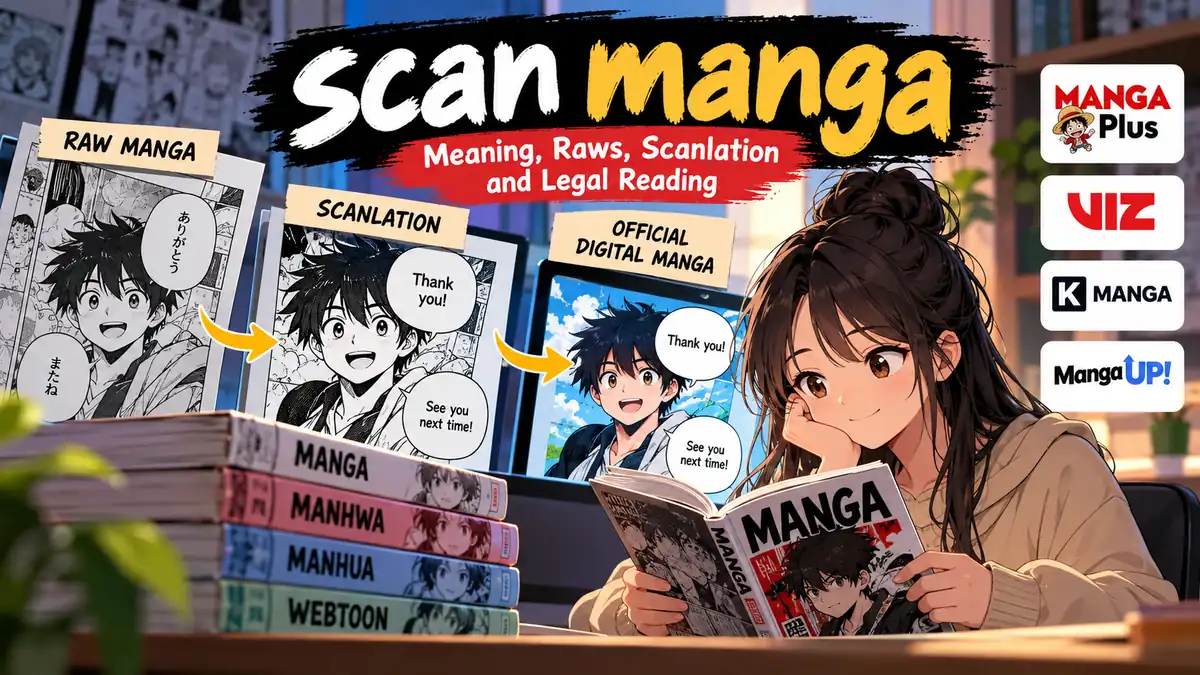
Search for scan manga and you will encounter a confusing mix of raw Japanese pages, fan-translated chapters, scanlations, scan VF releases, manga readers, and official digital editions. These terms overlap, but they do not mean exactly the same thing.
scan manga generally refers to manga pages reproduced as digital images. A raw keeps the original language, while a scanlation is a fan-made version that has been translated, cleaned, edited, and typeset. Official digital manga, meanwhile, is distributed with authorization from the publisher or copyright holder.
Understanding those differences helps you identify what you are actually reading, judge translation and image quality, and distinguish unofficial scans from licensed releases.
What Does scan manga Mean?
At its simplest, a manga scan is a digital reproduction of a manga page or chapter.
Traditionally, this involved taking pages from a physical manga magazine or tankōbon—a collected manga volume—and converting them into image files with a scanner. The resulting pages could be stored, viewed on a computer, or edited for translation.
The term has become less precise as manga publishing has moved online.
Today, a page described casually as a “manga scan” might originate from a printed book, an original digital release, an ebook, an unauthorized copy, a raw chapter, a fan translation, or even an official digital edition.
That means the word scan alone does not tell you whether a chapter is official, translated, or legally distributed.
The terminology also differs between communities. English-speaking readers commonly use phrases such as manga scans, raw manga, manga raws, and scanlations. In French-speaking communities, terms such as scan manga, scan VF, and scantrad are particularly common. Modes de Vie
scan manga vs. Raw vs. Scanlation
These terms are often treated as interchangeable, but there are useful distinctions.
| Term | What it means |
|---|---|
| Manga scan | A digital reproduction of a manga page |
| Raw manga | Manga in its original language before translation |
| Scanlation | A fan-made translated and edited version |
| Scanlator | Someone who participates in producing scanlations |
| Scan VF | A French-language manga scan or translation |
| Scantrad | French terminology associated with translated scans |
| Digital manga | Manga distributed electronically rather than solely in print |
| Official translation | A licensed translation authorized by the rights holder |
| Simulpub | An authorized translated release published at or near the original release |
What Is Raw Manga?
A raw is source material in its original language.
For Japanese manga, that usually means Japanese pages without an English or other foreign-language translation. However, “raw” does not necessarily mean a physical page was scanned.
Someone can purchase an official Japanese ebook and still refer to its untranslated content as raw manga.
Raw also does not mean copyright-free. It describes the language or source state of the material, not permission to redistribute it.
What Is Scanlation?
Scanlation combines the words scan and translation.
It describes fan-created translations in which comic pages are digitized or otherwise obtained, translated, edited, and prepared for readers in another language. Academic descriptions similarly characterize scanlation as fan-led scanning, translation, editing, and online distribution. IB Digital
A scanlation may therefore involve much more work than simply running text through a translator.
How scan manga and Scanlation Work
A polished translated manga page can look simple when finished, but traditional scanlation involves several distinct jobs.
1. Obtaining the Source
The workflow begins with source material.
Historically, scanlation groups often worked from Japanese magazines or printed volumes. Modern workflows may instead start with digital source material.
The quality of that source has a major effect on the final result. Low-resolution images, compression, shadows, crooked pages, or missing artwork create problems later in the process.
2. Scanning or Digitizing
Printed pages are converted into digital image files.
Older workflows relied heavily on flatbed scanners. Depending on the project, pages might need straightening, cropping, contrast correction, or other adjustments before editing begins.
Digital-first source material changes this stage because there may be no physical page to scan at all.
This is one reason the phrase scan manga has become broader than its literal technical meaning.
3. Cleaning
Cleaning prepares a page for translation and lettering.
An editor may correct scanning artifacts, adjust black and white levels, remove dust or shadows, straighten pages, and erase original dialogue from speech bubbles.
Cleaning becomes considerably harder when text overlaps detailed artwork.
4. Redrawing
Sometimes removing the original text also removes part of the drawing beneath it.
A redrawer reconstructs those missing portions so that the translated text can be inserted without leaving obvious gaps.
This work can range from rebuilding a simple background line to recreating complex textures or illustrations.
5. Translation
A translator interprets dialogue, narration, signs, captions, honorifics, jokes, cultural references, and sometimes Japanese sound effects.
Good manga translation requires more than substituting individual words.
Japanese frequently relies on context, implied subjects, levels of politeness, wordplay, and character-specific speech patterns. A technically literal translation can therefore sound unnatural or even change a character’s personality.
6. Proofreading and Editing
Translated dialogue is reviewed for mistakes and readability.
A proofreader may check grammar, spelling, names, terminology, continuity, punctuation, and whether the translation makes sense within the surrounding panels.
For ongoing series, consistency matters. A character’s name, attack, location, or fictional concept should not suddenly receive a different translation several chapters later.
7. Typesetting
Typesetting places translated text into speech bubbles, captions, signs, and other parts of the artwork.
Font choice, line breaks, alignment, text size, emphasis, and spacing all influence readability.
Strong typesetting should feel integrated into the artwork rather than pasted over it.
8. Quality Checking
Before a finished chapter is released, a quality checker may inspect it for missing dialogue, mistranslations, spelling errors, damaged artwork, inconsistent fonts, awkward line breaks, or pages placed in the wrong order.
Traditional fan teams divided these tasks among several people. Modern OCR and AI-assisted translation software can automate parts of text detection, cleaning, translation, and typesetting, but human review remains valuable—especially for context, names, jokes, sound effects, and stylized lettering. Manga Translate
Are scan manga and Scanlation the Same Thing?
No.
This distinction is easy to remember:
Scan = digitized page.
Raw = original-language material.
Scanlation = fan-translated and edited version.
Official digital manga = publisher-authorized electronic edition.
A Japanese page digitized from a magazine can be a manga scan without being a scanlation. Once a fan team translates and edits that material into another language, the resulting version is normally described as a scanlation.
Likewise, an official digital manga chapter does not automatically become a “scanlation” simply because you read it as digital images on a phone.
Why Did Manga Scanlation Become Popular?
Scanlation developed largely because international access to manga once looked very different.
Japanese readers could follow new series through weekly or monthly magazines while overseas fans sometimes waited months or years for licensed translations. Less commercially prominent series might never receive an international release.
Fan communities attempted to fill that gap.
Groups formed around particular manga, divided the translation and editing workload, and distributed finished chapters through early internet communities.
Scanlations also introduced readers to titles that were difficult to discover outside Japan.
But the publishing environment has changed considerably.
Official publishers now release digital manga internationally, and simulpub publishing can make translated chapters available on or near their Japanese release dates.
For example, MANGA Plus by SHUEISHA says it offers an official service and releases numerous comics alongside their Japanese publication. MANGA Plus by SHUEISHA
Manga, Manhwa, Manhua and Webtoons
Searching for scan manga may also produce Korean and Chinese comics.
They belong to related but distinct traditions.
Manga
Manga refers to Japanese comics.
Many Japanese manga titles use black-and-white artwork and are traditionally read from right to left, although manga covers a huge variety of formats, genres, and artistic styles.
Manhwa
Manhwa refers to Korean comics.
Modern digital manhwa is strongly associated with full-color, vertically scrolling series designed for smartphones, although Korean comics are not limited to that format.
Manhua
Manhua generally refers to Chinese-language comics, particularly works originating from China and other Chinese-speaking regions.
Webtoons
A webtoon is primarily a digital comics format.
The format is strongly associated with South Korea and commonly uses long, vertically scrolling pages optimized for mobile screens.
Some online comic websites mix manga, manhwa, manhua, and webtoons in one catalog. That can lead readers to call all of them “manga scans,” even though the terms describe different origins or formats.
What Is Scan VF?
Readers searching in French frequently encounter scan VF.
“VF” means version française, or French version. In manga communities, scan VF generally refers to manga chapters available with French text.
You may also see scantrad, a term associated with fan-translated manga scans.
The underlying workflow is broadly similar to English scanlation: source pages are obtained, dialogue is translated, original text may be removed, and French lettering is inserted into the page.
The same distinction still applies: a French digital manga can be officially licensed, while a fan-created scan VF may not be.
Does scan manga Mean Free Manga?
Not necessarily.
“Scan” describes the format or origin of the digital page, not its price.
Likewise, free does not automatically mean unauthorized.
Publishers increasingly provide selected chapters free of charge through legitimate services. Some platforms combine free chapters with subscriptions, points, purchases, or limited reading systems.
For example, MANGA Plus describes itself as an official service and says its proceeds support artists. MANGA Plus by SHUEISHA
So rather than asking only whether a chapter costs money, ask:
Who is distributing it, and do they have permission from the rights holder?
That is a much more useful indicator.
Is scan manga Legal?
This is where terminology becomes particularly important.
Creating a private digital copy, distributing copyrighted pages, translating someone else’s work, and operating a website containing unauthorized manga are not necessarily treated identically under copyright law. Rules can also vary by jurisdiction.
However, publicly distributing manga scans or fan translations without permission can infringe the copyright holder’s rights.
The fact that a fan translation is offered for free does not automatically make its distribution lawful.
Enforcement is not merely theoretical. In 2026, Japan’s Content Overseas Distribution Association reported a criminal investigation involving BATO.TO and said publishers including KADOKAWA, Kodansha, Shueisha, Shogakukan, and Square Enix had works available there without authorization. CODA specifically described unauthorized translated manga produced through scanlation as a source of widespread infringement. CODA
For readers, the simplest approach is to use publisher-authorized platforms whenever they are available.
Why Translation Quality Varies So Much
One manga scanlation can read almost professionally while another can be confusing.
Several factors explain the difference.
Translator ability matters. Understanding conversational Japanese is not the same as translating fiction naturally.
Context matters. Dialogue may depend on previous chapters, cultural references, honorifics, character relationships, or visual information.
Source quality matters. A blurry or compressed page can make small kanji and furigana difficult to recognize.
Editing matters. Even an accurate translation can become hard to read when lettering is cramped or poorly positioned.
Multiple translations can introduce errors. Translating Japanese into another language and then using that translation as the source for English can gradually change nuances.
Modern machine translation introduces another variable.
OCR and AI can accelerate text recognition and provide useful first-pass translations, but manga presents unusual challenges: vertical text, handwritten dialogue, stylized fonts, overlapping artwork, sound effects, unusual speech patterns, and text whose meaning depends heavily on the images.
Human review therefore remains important when accuracy matters.
What Is Simulpub Manga?
Simulpub means simultaneous or near-simultaneous publication.
Instead of waiting months for an overseas edition, readers can receive an authorized translated chapter around the time the original appears in Japan.
This model directly addresses one of the historical motivations for scanlation: long international release delays.
Square Enix’s official Manga UP! FAQ, for example, defines simulpub as publishing current content alongside its country of origin and says its service provides official translations. Manga UP!
VIZ likewise says selected titles receive chapters on the same day as Japan. VIZ
The exact catalog and availability can still vary by country and publisher.
Where Can You Read Manga Legally?
The best service depends on the title and your region, because manga licenses are divided among different publishers and territories.
Several major official options illustrate how digital access now works.
MANGA Plus by SHUEISHA offers official access to Shueisha manga and publishes numerous chapters alongside their Japanese releases. Its FAQ identifies the platform as an official service. MANGA Plus by SHUEISHA
VIZ Manga and Shonen Jump provide free chapters and subscription libraries, including same-day Japanese releases for selected series. Availability depends on territory. VIZ
K MANGA by Kodansha is Kodansha’s authorized digital manga service and carries titles from the publisher’s catalog. K MANGA
Manga UP! by Square Enix is Square Enix’s official digital manga platform. Its global service provides official English translations and includes simulpub releases. Manga UP!
When a particular series is missing, search the manga title together with its publisher. Licensing arrangements and geographic availability change, so the authorized platform for one series may be completely different from another.
How to Tell Whether a Manga Website Is Official
A professional-looking website is not proof that it is authorized.
Start by looking for clear information about the publisher or licensing company. Official services normally identify the company responsible for distribution and provide terms of service, copyright notices, privacy information, and support channels.
Then check whether the manga’s actual publisher recognizes the service.
A catalog containing an enormous number of titles from competing publishers can deserve closer scrutiny, particularly if newly released chapters are all available free without explaining licensing.
Another useful clue is how the service describes its relationship with creators.
MANGA Plus, for example, explicitly identifies itself as an official Shueisha service and says proceeds are passed to artists. MANGA Plus by SHUEISHA
No single visual clue is perfect. Publisher confirmation remains stronger evidence than website appearance.
Does Reading Official Manga Really Matter?
Official access changes where money and engagement flow.
Licensed platforms operate through agreements with publishers and rights holders. Revenue can come from subscriptions, advertisements, chapter purchases, digital volumes, or other legitimate distribution models.
There are practical benefits for readers too.
Official releases generally provide consistent translation terminology, properly prepared source artwork, predictable release schedules, and fewer questions about whether files have been modified or reposted by unknown third parties.
That does not mean every official translation will satisfy every reader. Translation is interpretive, and fans may disagree with localization choices.
The important difference is authorization.
How Digital Manga Has Changed scan manga Culture
The original scanlation environment developed when geographic access was one of manga’s biggest barriers.
Digital publishing has weakened that barrier.
Readers can now discover a Japanese chapter and, for some series, read an official translation almost immediately. Smartphones have replaced desktop image folders for many readers, while dedicated manga apps can synchronize progress and deliver new chapters automatically.
AI is changing production workflows as well.
Current manga-translation software can combine OCR, automated text removal, machine translation, and typesetting assistance. Manga Translate
Yet automation does not eliminate the difficult parts of translation.
A machine still has to deal with visual context, cultural nuance, jokes, character voice, ambiguous Japanese, unusual typography, and sound effects. Those are exactly the areas where careful human editing can make the difference between understandable dialogue and a convincing translation.
Common Misunderstandings About Manga Scans
One common assumption is that raw manga means pirated manga. It does not. An untranslated Japanese ebook purchased from an authorized store is still raw manga.
Another is that all online manga is scanlation. Official digital chapters can be created and distributed electronically without any fan scanning or translation.
A third is that free manga must be unofficial. Publisher-backed services sometimes make chapters free as part of their distribution model.
And perhaps the biggest misconception is that scanlation simply means translation.
Translation is only one stage. Traditional scanlation can involve sourcing, scanning, cleaning, redrawing, translating, proofreading, typesetting, and quality checking before readers ever see the finished page.
scan manga: The Key Difference to Remember
The phrase scan manga describes a broad part of digital manga culture, but it should not automatically be treated as another word for piracy, raw manga, or scanlation.
A manga scan is fundamentally a digital reproduction of manga pages. A raw remains in its original language. A scanlation is a fan-translated and edited version. An official digital edition is distributed with authorization from the publisher or copyright holder.
Those distinctions matter more today because the gap between Japanese publication and international access has narrowed dramatically. Official services from Shueisha, VIZ Media, Kodansha, and Square Enix now provide large digital catalogs, with some titles released simultaneously or close to their Japanese publication dates. MANGA Plus by SHUEISHA
So when you encounter a scan manga online, don’t rely on the word scan to determine what it is. Check its source, language, translation status, publisher, and authorization. Those details tell you far more about the material—and whether there is an official way to read and support the work.