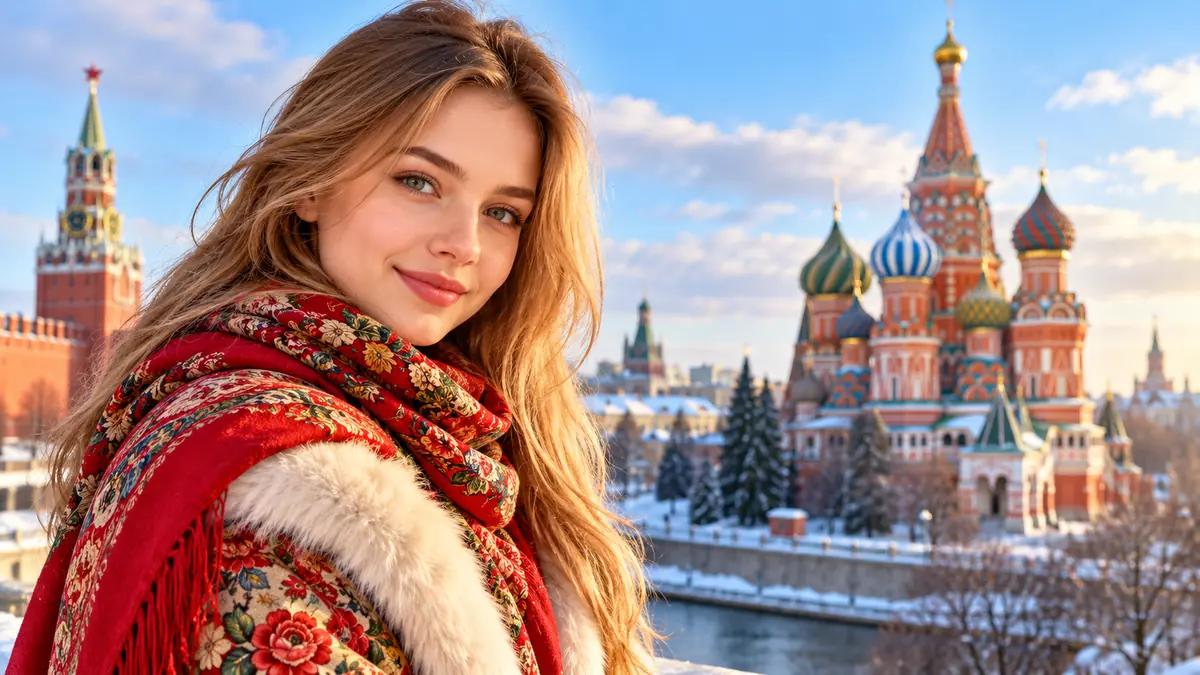
Search for russian girl online and you will find a curious mix of cultural information, fashion imagery, social-media content, dating discussions, memes, and stereotypes. The problem is that these portrayals can make millions of very different people look like one cultural “type.”
A russian girl simply refers to a girl or, informally, a young woman from Russia or someone connected with Russian heritage. It does not describe a particular appearance, personality, lifestyle, or set of beliefs. Russia’s regional, ethnic, linguistic, religious, and social diversity makes individual experiences far more varied than popular stereotypes suggest.
Understanding the term therefore requires separating nationality from ethnicity, culture from stereotype, and everyday life from the simplified image often presented online.
What Does russian girl Mean?
In everyday English, russian girl normally means a female person from Russia. When referring to an adult, however, “Russian woman” is generally more precise, especially in formal writing.
The Russian language also distinguishes between different meanings. Common translations include русская девушка (russkaya devushka) for a Russian young woman or girl and русская девочка (russkaya devochka) when referring specifically to a female child.
There is another distinction that English-language discussions sometimes overlook: being Russian can refer to nationality, ethnicity, language, ancestry, or cultural identity.
| Term | General meaning |
|---|---|
| Russian citizen | A citizen of the Russian Federation |
| Ethnic Russian | A person belonging to or descended from the ethnic Russian population |
| Russian-speaking | Someone who speaks Russian, regardless of citizenship |
| Russian heritage | Family, cultural, linguistic, or ancestral connections with Russia |
| Russian diaspora | People of Russian origin or heritage living outside Russia |
These categories frequently overlap, but they are not interchangeable.
Someone can be a Russian citizen without being ethnically Russian. Likewise, a Russian-speaking person living elsewhere should not automatically be assumed to be a citizen of Russia.
There Is No Single Russian Girl Identity
One of the biggest mistakes in discussions about Russian girls and women is treating Russia as culturally uniform.
It is not.
Russia extends across Eastern Europe and northern Asia. Someone growing up in Moscow may have experiences very different from someone living in Siberia, the Russian Far East, the North Caucasus, or a small rural community. Current pages ranking for the term similarly emphasize that regional background, ethnicity, language, education, religion, and family circumstances can all shape individual identity.
That diversity affects food, traditions, accents, lifestyles, religious practices, educational opportunities, fashion, and even attitudes toward family and work.
Nationality and Ethnicity Are Different
This distinction is especially useful when discussing Russia.
Calling someone “Russian” can sometimes refer to citizenship and sometimes to ethnic identity. Those meanings should not automatically be treated as identical.
Russia is home to numerous ethnic and cultural communities. Consequently, there is no reliable physical appearance that identifies every Russian girl.
Hair color, eye color, facial features, skin tone, height, and body type vary from person to person.
The familiar internet image of a tall, fair-haired, blue-eyed Russian woman represents a stereotype rather than a definition of Russian identity.
Russian Language and Everyday Communication
Russian is central to the cultural lives of many people in Russia and Russian-speaking communities abroad.
It uses the Cyrillic alphabet rather than the Latin alphabet used for English. For English speakers, Russian can initially look unfamiliar because of its alphabet, grammatical cases, verb forms, and gendered nouns.
A few basic words illustrate the language:
| Russian | Transliteration | English |
|---|---|---|
| Привет | Privet | Hi |
| Спасибо | Spasibo | Thank you |
| Пожалуйста | Pozhaluysta | Please / You’re welcome |
| Девушка | Devushka | Girl / young woman |
| Девочка | Devochka | Girl / little girl |
| Семья | Semya | Family |
The distinction between devushka and devochka is particularly relevant to the keyword. Translation resources show both expressions appearing as equivalents of “Russian girl,” depending on whether the speaker means a young woman or a female child.
Names also play an interesting role in Russian communication.
Russian names commonly include a given name, a patronymic derived from a parent’s name, and a family name. Informal situations may involve shortened or affectionate versions of given names.
These linguistic conventions reflect relationships and levels of familiarity, so translating Russian forms of address literally into English can sometimes miss their social meaning.
Family and Social Life in Russia
Family can be an important part of Russian social life, but there is no universal Russian family model.
Households vary according to generation, income, region, religion, personal beliefs, and individual circumstances. Urbanization and social change have also influenced how younger generations approach education, relationships, careers, marriage, and independence.
This is why statements such as “Russian girls always value X” or “Russian women expect Y” should be treated cautiously.
They turn cultural tendencies—or sometimes merely internet clichés—into supposed personality rules.
A person raised in central Moscow may have a very different daily routine from someone living in a smaller Siberian city. A university student may have priorities different from a working professional, while younger and older generations may approach social traditions differently.
Culture provides context. It does not determine an individual’s personality.
Education, Careers and Modern Life
Another outdated stereotype presents Russian women primarily through marriage, beauty, or domestic life.
That picture is incomplete.
The lives of modern Russian girls and women can include education, careers, entrepreneurship, creative work, science, technology, sports, family responsibilities, travel, and countless other interests.
Historical discussions of Russian women also show that women’s relationship with paid work has long been more complicated than simplistic portrayals suggest. Research on Russian women’s work, for example, describes women contributing to household economies and working outside the home across different historical periods.
Modern experiences are equally difficult to reduce to one pattern.
Some young women prioritize university and professional development. Others may focus heavily on family. Many combine both, while others follow entirely different paths.
The useful principle is simple: nationality does not predict ambition.
Fashion and Beauty: Culture Versus Stereotype
One of the most persistent associations surrounding russian girl searches involves appearance.
Online imagery sometimes presents Russian women through glamorous clothing, makeup, luxury fashion, high heels, or carefully styled photographs.
Those images are not entirely disconnected from cultural conversations about femininity, but they cannot represent everyone.
Academic research examining Russian-speaking migrant women has documented how ideas about “looking Russian” can become attached to particular clothing, makeup, and fashion choices. Importantly, that research examines such perceptions as social and cultural constructions rather than proof of a universal Russian appearance.
Fashion preferences vary just as they do elsewhere.
A student commuting to university, an office worker in Moscow, someone living through a Siberian winter, and a fashion influencer producing content for social media may dress completely differently.
Can You Identify a Russian Girl by Appearance?
Not reliably.
There is no facial feature, hairstyle, clothing style, or body type that proves someone’s nationality.
Trying to determine nationality solely from physical appearance can easily produce incorrect assumptions.
Clothing can sometimes reflect climate, local fashion, economic circumstances, occupation, age, or personal taste. None of these characteristics functions as a nationality test.
Russian Girl Stereotypes and Why They Persist
Internet discussions often attach predictable stereotypes to Russian women.
Some portray them as exceptionally beautiful. Others describe them as cold, highly traditional, materialistic, mysterious, glamorous, family-oriented, or eager to marry foreigners.
The problem is not merely whether an individual example exists. With millions of people, examples can be found for almost any personality trait.
The problem is turning individual experiences into universal rules.
Some online dating content makes extremely broad claims about how Russian women supposedly behave on dates or what they expect from men. Other sources specifically caution that familiar myths—including assumptions about personality or motivations—are outdated or unreliable.
“Russian Girls Never Smile”
This is one of the best-known cultural clichés.
Different societies can have different conventions about smiling at strangers, customer-service interactions, or public expressions of friendliness. But cultural communication patterns should not be interpreted as fixed personality traits.
A person who smiles less frequently at strangers is not necessarily unhappy, unfriendly, or emotionally distant.
Context matters.
“All Russian Girls Look Like Models”
This stereotype is largely reinforced by selective media.
Fashion photography, entertainment, dating websites, and social platforms naturally amplify visually striking images. Those images are not a representative sample of an entire population.
Russian women have the same enormous variation in appearance found among other large populations.
“Russian Girls All Want Foreign Husbands”
This is another generalization frequently associated with online dating content.
Relationship preferences are personal.
Economic circumstances, travel, migration, language skills, education, international communities, and dating apps can create relationships between people from different countries, but none of this establishes a universal preference among Russian women.
Dating a Russian Girl: Individuality Matters More Than Rules
People searching for russian girl sometimes actually want information about relationships.
The safest starting point is not a list of supposedly Russian dating rules. It is ordinary interpersonal respect.
If you meet someone from Russia, learn about her preferences instead of assuming nationality tells you what she expects.
Practical principles are straightforward:
- Communicate clearly rather than relying on cultural assumptions.
- Ask about individual preferences when appropriate.
- Show genuine curiosity about someone’s background without turning it into an interrogation.
- Avoid jokes based on nationality or gender stereotypes.
- Do not assume someone’s political beliefs from nationality.
- Treat expectations about paying, gifts, affection, marriage, or gender roles as personal matters rather than fixed cultural laws.
There may be cultural differences between two people from different countries, but discovering them through conversation is more reliable than following an internet checklist.
Russian Girls on Social Media
Social media has significantly influenced international perceptions of Russian women.
Instagram-style photography, TikTok videos, YouTube channels, fashion accounts, travel creators, gaming communities, and other platforms expose audiences to Russian-speaking creators who might previously have had little international visibility.
But social media introduces a selection problem.
Algorithms reward visually engaging or emotionally provocative content. Ordinary daily life receives much less attention than glamorous fashion, controversial opinions, luxury lifestyles, humor, or dramatic relationship stories.
As a result, someone who learns about Russian culture mainly through viral content may develop a distorted picture.
A carefully curated social-media profile should not be treated as evidence of how Russian women generally live.
Russian Girls Outside Russia
Russian identity also extends beyond the country’s borders.
Russian-speaking and Russian-heritage communities exist in many countries, and migration can produce layered identities.
Someone may simultaneously identify with Russian language or heritage and with the country where she was born or currently lives.
Research involving post-Soviet immigrant communities illustrates how identity can change through migration, language acquisition, peer relationships, and adaptation to another society.
This makes terms such as “Russian-speaking,” “Russian-born,” “ethnic Russian,” and “Russian citizen” useful when greater precision is necessary.
Simply labeling everyone “Russian” can erase meaningful differences.
How History Shaped Women’s Experiences
Modern Russian identity did not develop in isolation.
Imperial Russia, the Russian Revolution, the Soviet period, the dissolution of the Soviet Union, and subsequent social and economic transformations all influenced women’s experiences.
Historical research shows why simplistic narratives about Russian women can be misleading. Women’s roles have involved combinations of paid employment, domestic responsibilities, education, family expectations, and changing social norms rather than one unchanging model.
Generational differences therefore matter.
The experiences of someone who grew up during the Soviet era cannot automatically be applied to a teenager or university student growing up decades later.
Likewise, experiences in large cities cannot simply be generalized to every region.
How to Talk About Russian Girls Respectfully
You do not need specialized etiquette to discuss someone from Russia.
Accuracy and ordinary respect are enough.
Use “girl” when discussing a child or when the context naturally involves young people. For an adult, “Russian woman” is generally more precise in formal English.
Avoid assuming that nationality reveals someone’s:
- personality;
- attractiveness;
- political beliefs;
- religion;
- financial situation;
- dating preferences;
- family goals;
- education;
- career ambitions;
- willingness to migrate.
Cultural background can influence a person’s experiences without defining the person.
That distinction is especially valuable online, where simplified labels spread quickly.
What Online Content Often Gets Wrong
Search results around russian girl frequently blur several different subjects: nationality, physical appearance, dating, fashion, language, and culture.
That encourages readers to mistake correlation for identity.
A better approach is to ask what kind of information you actually want.
If you want to understand Russian culture, study history, language, regional differences, literature, traditions, and contemporary life.
If you are learning Russian, focus on vocabulary, grammar, pronunciation, and real conversations.
If you have met a Russian woman, learn about her as an individual rather than trying to decode her through nationality.
If you are interested in dating, normal relationship skills—communication, boundaries, compatibility, honesty, and mutual respect—remain more useful than stereotypes.
The Bottom Line
The phrase russian girl has a simple literal meaning but a surprisingly complicated online identity.
At its core, it refers to a girl or, informally, a young woman from Russia or with Russian cultural connections. Translation sources likewise distinguish between terms for a young woman and a female child, while cultural sources emphasize the diversity hidden behind the label.
What the phrase cannot tell you is equally important.
It cannot reliably tell you how someone looks, dresses, thinks, dates, works, communicates, or plans her future. Russia’s geographic and social diversity—and the individuality of the people themselves—makes those sweeping conclusions unreliable.
Understanding a russian girl therefore begins with culture and context, but it should end with individuality. Learn about Russian language, history, traditions, and regional differences when they are relevant, while remembering that no nationality is a personality type.