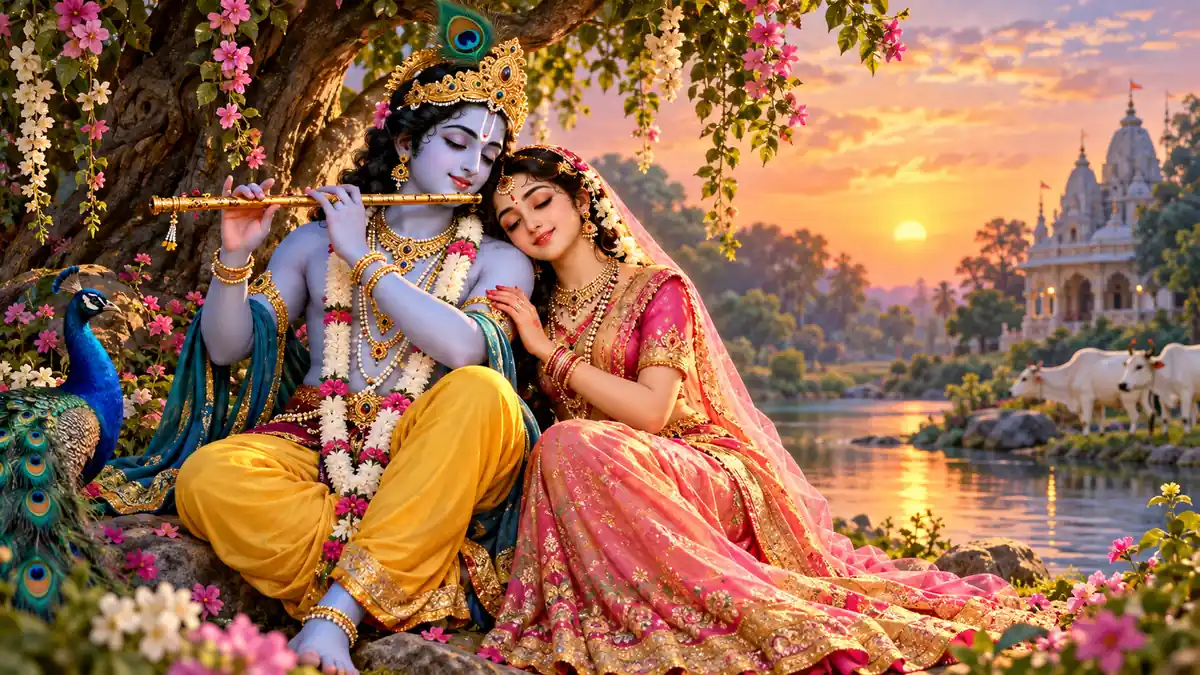
The image of Radha beside Krishna, often with Krishna holding his flute beneath flowering trees, is one of the most recognizable expressions of devotion in Hindu culture. Yet the meaning of radha krishna goes much deeper than a beautiful love story.
Radha Krishna represent divine love, devotion, longing, and the intimate relationship between the human soul and the Divine. Krishna is understood as the divine beloved, while Radha embodies profound, selfless devotion. Their union and separation became powerful symbols of bhakti—the path of approaching God through loving devotion. Radhakrishna
Their story developed through centuries of sacred literature, poetry, theology, temple traditions, music, dance, and visual art. Different Vaishnava traditions do not interpret every detail in exactly the same way, which is important when discussing questions such as whether Radha and Krishna married or where Radha appears in early scripture.
Who Are Radha and Krishna?
Krishna is one of Hinduism’s most widely worshipped deities. Within Vaishnava traditions he is associated with Vishnu, while several Krishna-centered traditions worship Krishna himself as the Supreme Being.
His life is connected with places such as Mathura, Gokul, Vrindavan, Nandgaon, and Govardhan in the sacred region known as Braj. Mathura is traditionally revered as his birthplace, while Gokul and Vrindavan are closely associated with his childhood and youthful pastimes. Incredible India
Radha, often affectionately called Radha Rani, is Krishna’s supreme beloved and occupies an especially important place in Krishna devotional traditions. Barsana is traditionally associated with Radha and is one of the major centers of her worship. Akashvani News
Together, Radha and Krishna are commonly presented as the Divine Couple.
This pairing has several layers of meaning. At the simplest level, their story expresses extraordinary love. At a theological level, it can represent the inseparability of the divine and divine energy. At a devotional level, Radha becomes the supreme example of a heart completely directed toward Krishna.
That is why reducing Radha Krishna to an ordinary romantic couple misses much of their religious significance.
The Radha Krishna Love Story
The story of Radha and Krishna is rooted in the pastoral world of Braj.
Krishna’s childhood and youth are associated with cowherds, forests, the Yamuna River, music, dancing, and the gopis—the cowherd women whose devotion to him became an important theme in Krishna literature.
Among these devotees, later traditions give Radha a unique position.
Krishna’s flute is particularly important in the devotional imagination. Its call is more than music: poets and teachers have interpreted it as the Divine calling the soul away from distraction and toward God.
Radha and Krishna in Vrindavan
Vrindavan forms the emotional center of their story.
Here Krishna performs his youthful lila, or divine play. The landscape itself—forests, groves, riverbanks, ponds, and paths—became sacred through its association with these traditions.
The Rasa Lila, Krishna’s dance with the gopis, is among the best-known episodes connected with this devotional world. The Bhagavata Purana’s account of Krishna and the gopis became foundational for later bhakti traditions.
Later poetry increasingly placed Radha at the emotional center of Krishna’s divine love.
Love, Separation, and Longing
One reason the Radha Krishna story became so influential is that it does not simply celebrate being together.
It also explores viraha—love experienced through separation.
When Krishna is absent, Radha’s longing becomes spiritually significant. The devotee may similarly feel separated from God yet become more intensely conscious of the Divine because of that very absence.
This paradox became a major subject of devotional poetry and painting. The Metropolitan Museum of Art, for example, describes paintings inspired by the Gita Govinda in which Radha’s sorrow over Krishna’s absence becomes a means of expressing the devotee’s yearning for access to the divine. The Metropolitan Museum of Art
The lesson is subtle: separation does not necessarily destroy love. In bhakti, longing can deepen it.
What Does Radha Krishna Symbolize?
The most familiar interpretation of radha krishna is the relationship between the soul and God.
Krishna represents the divine beloved. Radha represents devotion directed toward that beloved with extraordinary intensity.
Their story therefore gives human emotional language to something abstract: the desire to know, love, and experience God.
Radha as the Devotee and Krishna as the Divine
One common devotional interpretation sees Radha as representing the individual soul and Krishna as representing the Supreme.
Under this interpretation, Radha’s longing becomes the soul’s longing for God.
Her devotion asks for no worldly reward. What matters is Krishna himself.
This helps explain why their love cannot be understood solely through the conventions of an ordinary human relationship. In devotional theology, romance provides the emotional vocabulary through which an intensely personal relationship with God can be expressed. The Indian Express
Radha as Krishna’s Shakti
Some Krishna traditions go further.
Radha is not merely considered an exceptional human devotee. She is understood as Krishna’s divine shakti, or spiritual potency.
In Gaudiya Vaishnava theology, she is particularly associated with hladini shakti, the divine potency of bliss and love. From this perspective, Radha and Krishna can be understood simultaneously as two and as inseparably one divine reality. Radhakrishna
This theological idea explains an apparent contradiction.
Radha loves Krishna completely, yet she is not ultimately separate from him.
The Meaning of Their Union
Their union can symbolize spiritual fulfillment—the meeting of the devotee and the Divine.
Their separation represents longing.
Their reunion represents the joy of divine realization.
For that reason, union and separation are not competing themes. Both communicate different dimensions of bhakti.
Where Does the Radha Krishna Story Come From?
There is no single ancient book containing one universally accepted biography of Radha and Krishna from beginning to end.
Their familiar story developed through multiple layers of Hindu literature and devotional tradition.
Understanding this prevents a common mistake: assuming every popular Radha Krishna story comes from the same scripture.
Bhagavata Purana
The Bhagavata Purana, especially its tenth book, is fundamental to Krishna devotion.
It contains celebrated accounts of Krishna’s childhood, his life among the cowherds, the gopis, and the Rasa Lila.
However, Radha is not explicitly named in the famous Rasa Lila narrative in the way readers of later literature might expect. Later Vaishnava commentators and traditions identify a particularly favored gopi with Radha. Hindu Mirror
That distinction matters because the literary prominence of Radha becomes much clearer in subsequent works.
Gita Govinda
A turning point came with Jayadeva’s Sanskrit poem Gita Govinda, composed in the 12th century.
Here Radha and Krishna’s love, estrangement, longing, and reconciliation move to the center of the narrative.
The work became enormously influential in Vaishnava devotion and later Indian art. The Metropolitan Museum of Art notes that the Gita Govinda helped establish a major foundation for later visual representations of Radha and Krishna. The Metropolitan Museum of Art
Its influence extended far beyond literature.
Painters illustrated it. Singers performed it. Dancers interpreted its emotional scenes. Devotional communities read its love poetry spiritually.
Later Texts and Traditions
Radha Krishna theology continued to develop through works and traditions associated with texts such as the Brahma Vaivarta Purana, Garga Samhita, and Chaitanya Charitamrita, among others. Wikipedia
These sources do not always present every detail identically.
That variation is normal within a religious tradition that developed across centuries, languages, regions, poetic schools, and Vaishnava sampradayas.
Why Did Krishna Not Marry Radha?
This is probably the most frequently asked question about radha krishna, but it does not have one answer accepted by every tradition.
Popular retellings often say Radha and Krishna did not marry because their love was spiritual rather than dependent upon a conventional social relationship.
Some Gaudiya Vaishnava interpretations emphasize parakiya bhava, devotion expressed through a love unconstrained by ordinary marital identity.
Yet other traditions tell a different story.
The Garga Samhita, for example, contains a tradition of a divine wedding involving Radha and Krishna, while the Nimbarka tradition understands them as eternally united. The Bhagavata Purana, meanwhile, narrates Krishna’s later marriages at Dwarka without presenting a conventional Radha-Krishna marriage narrative. Radhakrishna
Therefore, saying simply that “Krishna never married Radha” presents one devotional understanding as though it were the only tradition.
A more accurate answer is that different Hindu traditions explain their relationship differently.
The shared point is more significant than the disagreement: Radha and Krishna’s bond is understood as transcending an ordinary social definition of love.
Why Is Radha’s Name Often Said Before Krishna’s?
Expressions such as Radha Krishna, “Radhe Krishna,” and “Radhe Radhe” demonstrate Radha’s extraordinary devotional status.
Placing Radha first can be understood as honoring devotion before approaching the Divine.
For many devotees, Radha is the supreme devotee—the personification of complete love for Krishna. In theological traditions that identify her with Krishna’s spiritual potency, her importance becomes even greater.
The phrase “Radha Krishna” consequently functions almost like a single devotional idea.
Radha points toward love.
Krishna is its divine object.
Together they express loving devotion in its fullest form.
The Sacred Geography of Radha Krishna
The Radha Krishna tradition is inseparable from Braj, the cultural and sacred region centered around Mathura and Vrindavan.
Important locations include:
| Place | Traditional association |
|---|---|
| Mathura | Birthplace of Krishna |
| Gokul | Krishna’s early childhood |
| Vrindavan | Krishna’s youthful lila, gopis and devotional traditions |
| Barsana | Strongly associated with Radha Rani |
| Nandgaon | Associated with Krishna’s foster family |
| Govardhan | Krishna’s lifting of Govardhan Hill |
| Yamuna River | Central sacred landscape in Krishna traditions |
Modern tourism and pilgrimage traditions continue to treat Mathura, Vrindavan, Gokul, Barsana, Nandgaon, and Govardhan as interconnected parts of Krishna’s sacred landscape. Incredible India
Vrindavan
Vrindavan is perhaps the best-known center of Radha Krishna devotion.
Its temples, bhajans, festivals, and pilgrimage traditions continually retell episodes associated with Krishna’s youth and divine love.
Temples connected with different traditions emphasize different forms of devotion, demonstrating that Radha Krishna worship is not a single uniform practice.
Barsana
Barsana is particularly associated with Radha.
The Shri Radha Rani Temple is an important pilgrimage destination, and the town plays a prominent role in celebrations connected with Radha and Krishna. Akashvani News
Barsana is also famous for Lathmar Holi, which connects the joyful playfulness of Holi with the traditional stories of Radha, Krishna, Barsana, and Nandgaon. Incredible India
Radha Krishna and the Meaning of Bhakti
To understand why their story became so powerful, it helps to understand bhakti.
Bhakti means loving devotion toward the Divine.
It can involve prayer, chanting, singing divine names, temple worship, remembering sacred stories, service, meditation, pilgrimage, or simply cultivating love for God.
Radha represents an especially intense model of this devotion.
She does not love Krishna because she expects wealth, status, protection, or recognition. Her devotion is portrayed as valuable in itself.
That makes her spiritually important.
Madhurya Bhava
Vaishnava devotional traditions describe different emotional relationships through which a person may approach God.
One important form is madhurya bhava—the mood of approaching God as the beloved.
The Radha Krishna tradition gives this devotional mood its most celebrated expression.
The language can sound romantic because it deliberately uses the intensity of human love to describe spiritual devotion. But its theological purpose goes beyond romance.
It asks a deeper question:
What would it mean to desire God with the intensity with which a person desires the one they love most?
Radha provides the devotional answer.
Viraha: Devotion Through Separation
Viraha means separation or the longing produced by absence.
Ordinarily, absence seems like the opposite of fulfillment.
Bhakti poetry turns that assumption around.
When Radha misses Krishna, every thought becomes centered on him. His physical absence can therefore produce overwhelming spiritual presence.
Artists repeatedly returned to this theme. In Gita Govinda paintings, landscapes, flowering trees, moonlight, riverbanks, and solitary figures visually communicate longing and anticipation. The Metropolitan Museum of Art
This is one reason Radha Krishna poetry can feel simultaneously joyful and sorrowful.
Both emotions point toward devotion.
Radha Krishna in Different Vaishnava Traditions
There is no single theological interpretation shared identically by all Vaishnavas.
Radha Krishna worship has important places in traditions including Gaudiya Vaishnavism, Nimbarka Sampradaya, Radha Vallabha traditions, and several other Krishna-centered communities. Wikipedia
Gaudiya Vaishnavism gives Radha an especially elevated theological position, interpreting her as Krishna’s supreme spiritual potency and the embodiment of divine love.
Other traditions develop distinctive understandings of their eternal relationship, forms of worship, sacred mantras, and theological identity.
These differences should not be treated simply as contradictions.
Hindu devotional traditions frequently preserve multiple interpretations of the same sacred figures. Each emphasizes particular dimensions of theology and religious experience.
Radha Krishna in Art
Radha and Krishna have provided Indian artists with an exceptionally rich visual language.
A typical composition might show Krishna with his bansuri, or flute, while Radha stands beside him. Other works depict forest meetings, conversations with Radha’s sakhi or female confidante, separation, reconciliation, the Yamuna, flowering groves, peacocks, lotus flowers, and scenes involving the gopis.
These elements are rarely decorative alone.
They establish emotional atmosphere.
Miniature Painting
Radha Krishna became particularly important subjects in Rajput and Pahari painting.
Artists translated poetic moods into visual form: a storm might communicate tension; an empty landscape could emphasize separation; spring flowers could suggest love and reunion.
Works based on the Gita Govinda became especially influential.
The Met preserves examples from different periods, including a circa 1665 Mewar painting of Krishna and Radha in a bower and later 18th-century Pahari works exploring longing, reunion, and divine presence. The Metropolitan Museum of Art
Why Is Krishna Usually Shown With a Flute?
Krishna’s flute is one of his most recognizable attributes.
Within devotional interpretation, its music represents irresistible divine attraction. The gopis hear Krishna and move toward him; symbolically, the soul hears the call of the Divine.
This is why a simple image of Krishna playing his flute while Radha listens can communicate an entire theology without words.
Radha Krishna in Music, Poetry, and Dance
Their influence extends well beyond temples and paintings.
For centuries, poets have used Radha’s longing and Krishna’s beauty to express spiritual experience. Devotional bhajans and kirtans continue this tradition through communal singing and repetition of divine names.
Dance traditions have also interpreted episodes associated with Krishna, Radha, the gopis, and Rasa Lila.
In these forms, facial expression, gesture, movement, music, poetry, costume, and storytelling work together.
The audience is not simply being told that Radha misses Krishna.
It is invited to experience the emotional quality of that longing.
This emphasis on rasa, or aesthetic-emotional experience, is crucial to understanding why Radha Krishna traditions have generated so much art.
Festivals Associated With Radha Krishna
Several Hindu festivals bring the stories and devotional traditions of Radha and Krishna into public celebration.
Janmashtami
Krishna Janmashtami celebrates Krishna’s birth.
Mathura and Vrindavan become major centers of celebration, with temples holding prayers, devotional singing, decorations, dramatic performances, and midnight observances. Incredible India
Radhashtami
Radhashtami celebrates Radha.
Barsana is an especially important center for the festival. Devotees gather for worship, fasting, prayers, and celebrations honoring Radha Rani. Akashvani News
Holi
Holi has a particularly strong association with Krishna traditions in Braj.
Barsana and Nandgaon are famous for Lathmar Holi, while Vrindavan hosts several distinctive forms of celebration involving colors, flowers, temple worship, music, and communal festivities. Incredible India
The playful dimension of Radha Krishna traditions becomes especially visible here.
What Can the Radha Krishna Story Teach?
Even outside detailed theological interpretation, several enduring themes explain why their story continues to resonate.
Love without possession: Radha’s love is remembered primarily for its intensity and devotion rather than ownership.
Devotion without bargaining: Bhakti at its highest is not presented as a transaction—”I worship, therefore give me something.” Radha’s devotion points toward loving the Divine for its own sake.
Longing can have spiritual value: Viraha suggests that absence may deepen remembrance rather than erase love.
The Divine can be approached personally: Radha Krishna devotion makes God emotionally accessible—as beloved, companion, source of beauty, and object of intimate devotion.
Love and surrender are different from passivity: Radha is frequently portrayed with a distinct personality and emotional voice. Her devotion does not erase her individuality.
These ideas explain why the story survives across very different settings—from Sanskrit poetry and temple theology to folk songs, classical paintings, dance, pilgrimage, and everyday devotional practice.
Understanding Radha Krishna Beyond the Love Story
Calling Radha and Krishna “eternal lovers” captures only one layer of a much larger tradition.
Their importance lies in how the language of love becomes the language of spirituality.
Radha represents a devotion so complete that separation intensifies rather than destroys it. Krishna represents the Divine toward whom that love flows. Their meetings communicate spiritual joy; their separation communicates longing; their reunion becomes an image of divine fulfillment.
The Gita Govinda was particularly influential in transforming these emotions into devotional literature and, later, into painting and performance. Museum scholarship describes its Radha-Krishna imagery as a vivid metaphor for Hindu bhakti and the soul’s longing for the divine. The Metropolitan Museum of Art
At the same time, the tradition is diverse. Questions such as whether Radha and Krishna were married, how Radha should be understood theologically, and how particular episodes should be interpreted receive different answers in different Vaishnava schools.
That diversity is part of the tradition rather than something that must be forced into one version.
The Enduring Meaning of radha krishna
The lasting power of radha krishna comes from the meeting of human emotion and spiritual meaning.
Their story contains joy, playfulness, attraction, separation, longing, surrender, reconciliation, and devotion. Those emotions are immediately recognizable, yet devotional traditions use them to describe something much larger: the relationship between the soul and the Divine.
From the sacred landscape of Braj to Jayadeva’s Gita Govinda, from temple worship to Pahari miniature paintings, Radha and Krishna have inspired centuries of religious and artistic expression. Their presence remains especially visible in Vrindavan, Mathura, Barsana, and other places where their stories continue to shape living traditions. Incredible India
To understand radha krishna, then, is not merely to learn an ancient love story. It is to understand why generations of devotees have used love itself—its joy, pain, longing, and selflessness—as one of the most powerful ways of speaking about God.