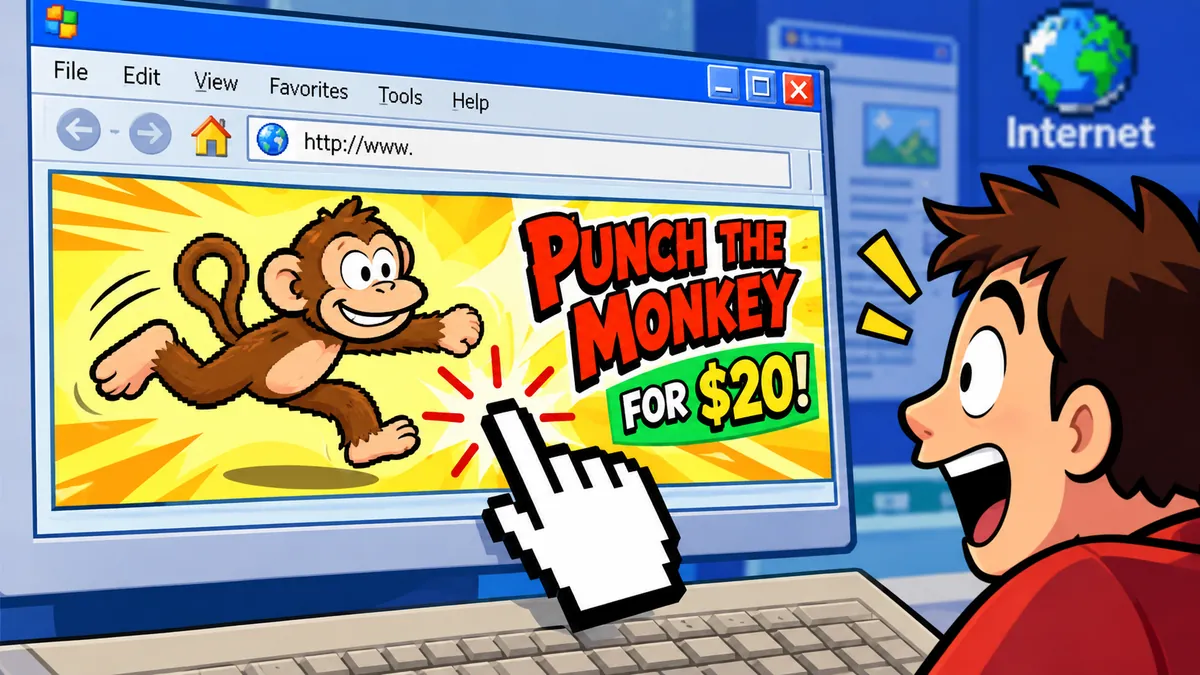
Long before social media feeds, autoplay videos, and personalized advertising, the web had a simpler way to grab attention: put an animated monkey inside a banner and challenge people to hit it.
Punch the monkey became one of the most recognizable examples of interactive online advertising around the turn of the millennium. The banner invited users to click a moving cartoon monkey, commonly pairing the challenge with a promise of winning money. Rather than functioning primarily as a standalone video game, the interaction was designed to generate clicks and send users to an advertiser’s website.
The concept seems primitive by modern standards, yet it illustrates an important stage in the evolution of digital advertising. Advertisers were learning that people were more likely to interact with something that felt like entertainment than with a static advertisement.
What Was Punch the Monkey?
Punch the monkey was an interactive banner advertisement associated with Treeloot.com during the early era of commercial web advertising. A cartoon monkey moved around the banner while visitors were challenged to hit or “punch” it by clicking at the right moment.
One widely documented version carried the incentive “Punch The Monkey For $20.” The Guardian described it in 2001 as an advertisement for Treeloot.com in which readers attempted to click a monkey moving from side to side across the banner.
That distinction matters because people sometimes remember Punch the Monkey as a conventional browser game.
It certainly looked and behaved like a tiny game, but its central purpose was advertising.
The interaction generally followed a simple sequence:
- An animated monkey appeared inside a banner.
- The monkey moved around to make clicking it slightly challenging.
- The user attempted to hit the moving target.
- Successful interaction led away from the page displaying the banner.
- The destination promoted a reward, offer, or further participation.
This combination of animation, challenge, curiosity, and reward made the advertisement difficult to ignore.
Where Did Punch the Monkey Come From?
Punch the monkey belongs to the late-1990s and early-2000s era when banner advertising was becoming a major part of the commercial internet.
Web publishers needed advertising revenue, while advertisers were experimenting with ways to persuade visitors to click their banners.
Simple static banners quickly faced a problem: users learned to ignore them.
Advertisers responded with increasingly noticeable designs. Flashing text, animations, fake buttons, contests, quizzes, and interactive elements became common.
Punch the Monkey fit naturally into this environment.
Instead of simply saying “visit our website,” the banner gave the visitor something to do.
A contemporary Guardian article identified Treeloot.com as the sponsored money-giveaway site behind the well-known “$20” version. A 2001 Suck.com article similarly described Treeloot’s “Punch the monkey to win twenty bucks” promotion as a notable example of banner advertising.
The advertisement therefore represented more than a strange internet game. It demonstrated an emerging principle of online marketing: interaction could be used to increase attention and click-through behavior.
How Did Punch the Monkey Work?
The mechanic was intentionally easy to understand.
A user did not need instructions, an account, a controller, or previous gaming experience. The moving monkey itself communicated the challenge.
You saw the target.
You moved the cursor.
You tried to hit it.
The simplicity reduced the amount of thought required before interacting with the advertisement.
The Moving Target
The monkey moved around the advertising area instead of remaining stationary.
That movement served two purposes.
First, animation naturally attracted attention on webpages that were otherwise dominated by text and relatively static graphics.
Second, movement transformed an ordinary click into a challenge.
Instead of clicking a button, visitors felt as though they were trying to accomplish something.
The Reward Hook
The other major ingredient was the reward.
The famous Treeloot promotion connected the challenge with the possibility of receiving $20. The Guardian reported that users attempting to claim the advertised reward encountered additional steps, and many abandoned the process before obtaining it.
This structure created a powerful sequence:
challenge → success → curiosity → reward → click
That basic psychological pattern remains recognizable in modern digital marketing, even though today’s advertisements look considerably more sophisticated.
Was Punch the Monkey Actually a Game?
The best description is a game-like interactive advertisement.
It borrowed mechanics from games but used those mechanics primarily to achieve an advertising objective.
Traditional games are generally designed around entertainment, progression, competition, storytelling, mastery, or some combination of those elements.
Punch the Monkey offered only a tiny interaction.
There was a moving target and an immediate objective, but the banner’s meaningful action occurred when the visitor clicked and was directed toward the advertiser.
That makes it an early example of what might now be described as gamified advertising.
| Feature | Punch the Monkey | Traditional Browser Game |
|---|---|---|
| Main purpose | Generate interaction/clicks | Entertainment |
| Gameplay | Extremely short | Usually longer |
| Controls | Mouse click | Mouse and/or keyboard |
| Progression | Minimal or none | Often levels or scores |
| Reward | Advertised prize/offer | Gameplay achievement |
| Destination | Advertiser’s site | Continued gameplay |
Calling it a mini-game is therefore reasonable as long as its advertising function is understood.
Why Did Punch the Monkey Become So Memorable?
Thousands of banner advertisements appeared during the early web era. Most disappeared without leaving much cultural memory.
Punch the Monkey was different.
Several characteristics helped it stand out.
It Was Immediately Understandable
No lengthy explanation was necessary.
The challenge could be understood almost instantly: hit the monkey.
That is valuable in advertising because users typically devote very little attention to individual advertisements.
Movement Demanded Attention
Animated banners stood out strongly against the comparatively simple webpages common at the time.
The monkey’s movement could attract the eye even when someone had no intention of clicking an advertisement.
It Turned Clicking Into a Challenge
Clicking an ordinary advertisement feels like responding to marketing.
Trying to hit a moving character feels like playing.
That subtle reframing helped turn an advertising action into entertainment.
Money Added Curiosity
The possibility of winning a reward gave visitors another reason to participate.
Even someone who was not particularly interested in the monkey could become curious about what happened after successfully hitting it.
Repetition Built Recognition
Banner campaigns could appear across many websites.
Repeated exposure meant users could encounter the same visual idea again and again until it became familiar.
Eventually, that familiarity contributed to both recognition and irritation.
Punch the Monkey and Early Clickbait
Modern users associate clickbait primarily with exaggerated headlines, thumbnails, social-media posts, and misleading calls to action.
The underlying principle existed much earlier.
Punch the Monkey presented users with an immediate curiosity gap:
What happens if I hit the monkey?
Adding a potential reward strengthened that curiosity.
The technique encouraged interaction before users necessarily understood what would happen after clicking.
The Guardian’s 2001 discussion placed Punch the Monkey alongside banner techniques designed to resemble buttons, polls, and other interactive webpage elements. The article argued that these methods could undermine users’ trust in advertising.
This is one reason Punch the Monkey is useful when studying internet history. It shows that the struggle between user attention and advertising incentives existed well before social networks and recommendation algorithms.
What Was Treeloot?
Treeloot.com was the website associated with the best-known Punch the Monkey banner campaign.
Its advertising used prize-oriented messaging to encourage visitors to leave the page they were viewing and enter Treeloot’s promotional environment.
The “$20” hook is especially important to the history of the campaign because it transformed a simple animated banner into a combination of challenge and financial incentive.
Contemporary commentary indicates that the campaign attracted considerable attention. Suck.com described Treeloot’s monkey banner as an especially successful example of the format while also noting how repeated exposure eventually reduced its novelty.
This illustrates a recurring advertising problem.
An unusual creative idea can perform well because people have never seen anything like it. Once competitors imitate the idea and audiences repeatedly encounter similar advertisements, the novelty disappears.
The attention mechanism eventually becomes background noise.
Why Interactive Banner Ads Became Popular
To understand Punch the Monkey, it helps to understand the broader banner-advertising environment.
Early internet advertising had relatively limited ways to capture attention.
Advertisers could change:
- graphics,
- animation,
- wording,
- placement,
- size,
- incentives,
- and interaction.
Interactive banners combined several of these techniques simultaneously.
Instead of displaying a message and hoping someone cared, advertisers could encourage visitors to perform an action.
This offered an obvious measurement advantage as well.
Clicks could be tracked.
Advertisers could compare creative approaches and determine which advertisements generated more interactions.
The industry’s focus on click-through rates created strong incentives to design banners that users found difficult to ignore.
By 2001, The Irish Times was already discussing declining banner click-through rates and cited the hopping Punch the Monkey banner as an example of increasingly aggressive methods used to attract attention.
Banner Blindness Changed Online Advertising
One reason aggressive banners appeared was a phenomenon commonly called banner blindness.
As internet users became familiar with standard advertising locations and designs, they learned to mentally filter them out.
A banner could technically be visible while receiving almost no conscious attention.
Advertisers responded by making ads:
- brighter,
- more animated,
- more interactive,
- more surprising,
- and more closely integrated with webpage elements.
Punch the Monkey temporarily broke through banner blindness by behaving differently from an ordinary advertisement.
But the solution contained its own problem.
Once animated and interactive advertising became common, users learned to ignore that too.
The attention arms race simply moved forward.
Was Punch the Monkey Malware or a Virus?
Punch the Monkey itself should not automatically be described as a computer virus.
The historically documented concept was an interactive banner advertisement that redirected visitors toward a promotional website.
That does not mean users should seek out unknown copies of old advertisements and execute outdated software today.
Early web content can depend on obsolete technologies, plugins, scripts, or archived files that modern browsers no longer support safely.
A useful distinction is:
Annoying or misleading advertising is not automatically malware.
Those categories can overlap, but they are not synonymous.
For anyone studying old internet advertisements, screenshots, reputable archives, contemporary journalism, and academic material are generally more useful than trying to execute unidentified legacy files.
Did Punch the Monkey Use Flash?
It is tempting to describe every animated early-web advertisement as a “Flash ad,” but that can oversimplify internet history.
Web advertisements from this period could use several technologies, including animated GIFs, Java applets, JavaScript, and Adobe Flash.
What matters to the Punch the Monkey story is less the exact implementation of every surviving variation and more the interaction model: a moving target inside an advertisement encouraged users to click.
Adobe Flash later became deeply associated with interactive web animation and browser games, but Flash support officially ended decades after these early advertising experiments began.
This technological transition is one reason many interactive web experiences from the era are now remembered primarily through screenshots, archived pages, videos, and personal memories rather than functioning originals.
Punch the Monkey vs. Modern Playable Ads
Punch the Monkey looks primitive compared with today’s interactive advertising, but the underlying idea is surprisingly familiar.
Modern mobile applications and games frequently use playable ads that allow someone to experience a simplified version of gameplay before installing an app.
Both approaches attempt to replace passive viewing with participation.
The major difference is sophistication.
Modern playable advertising can include:
- HTML5 graphics,
- touch controls,
- responsive layouts,
- sound,
- multiple gameplay stages,
- analytics,
- device targeting,
- and direct app-store integration.
Punch the Monkey reduced the concept to its most basic form: see a moving object and try to click it.
The technology evolved dramatically. The central advertising insight did not.
People often pay more attention when they can participate.
How Punch the Monkey Foreshadowed Gamification
Gamification involves applying game-like mechanics to activities that are not primarily games.
Common examples include points, badges, progress bars, challenges, streaks, leaderboards, and rewards.
Punch the Monkey used a much simpler version of the same idea.
The advertisement created:
a goal: hit the monkey.
a challenge: the monkey moves.
an action: click at the right moment.
a reward expectation: potentially receive money or another benefit.
Those elements created a miniature feedback loop.
Today, similar principles appear throughout apps, marketing campaigns, loyalty programs, educational platforms, fitness products, and ecommerce experiences.
Punch the Monkey therefore belongs to a broader history of designers discovering that small game mechanics can motivate behavior outside conventional games.
Why These Ads Eventually Lost Their Appeal
Attention-grabbing advertising techniques usually have a limited lifespan.
The first time users encounter a strange animated challenge, it can be interesting.
The twentieth time, it may become irritating.
This process is known as creative fatigue.
Users become familiar with the technique and stop responding.
Contemporary commentary on Punch the Monkey shows this transition clearly. Suck.com noted that the campaign’s appeal eventually declined as the advertisement and Treeloot became familiar to users.
Publishers also have reasons to avoid excessively intrusive advertising.
An advertisement might produce clicks while simultaneously:
- distracting readers,
- reducing trust,
- making pages look low quality,
- slowing websites,
- or encouraging visitors to leave.
Those trade-offs helped push digital advertising toward different formats and stronger quality controls.
A 2009 Los Angeles Times article used “punch-the-monkey ads” as shorthand for less sophisticated cost-per-action advertising and reported publisher concerns that low-quality ads could alienate users and damage brands.
Can You Still Play Punch the Monkey?
There is no single modern experience that should automatically be assumed to be the original historical Treeloot advertisement.
The phrase has continued to be reused.
For example, current app stores contain games named Punch The Monkey with mechanics involving tapping monkeys and keeping them in the air. Google Play lists a Dudenstein Games title under that name, while Apple’s App Store also carries a similarly described game.
There are also newer browser and mobile projects using the phrase in connection with a viral Japanese macaque named Punch. One browser game describes itself as an endless runner inspired by the real monkey, while another Google Play title describes itself as inspired by the viral Punch the Monkey trend. These are contemporary creations rather than evidence that the original Treeloot banner has returned.
Anyone searching for the historical experience should therefore distinguish between:
the original advertising phenomenon and modern games using the same or similar name.
Is Punch the Monkey Related to the PlayStation Game?
There is another source of confusion.
A PlayStation title called Punch the Monkey! Game Edition exists, but it should not automatically be treated as the Treeloot banner converted into a console game.
GameFAQs documents Punch the Monkey! Game Edition as a Japanese rhythm-action game released by Bandai/KAZe in 2000.
The shared wording can make search results confusing, particularly because both appeared around roughly the same era.
When researching the internet advertisement, terms such as Treeloot, banner ad, or win $20 help separate the historical web campaign from unrelated games carrying similar names.
What Punch the Monkey Teaches About Digital Advertising
The advertisement is more interesting when viewed as an early experiment in user behavior rather than simply an annoying relic.
It demonstrated several principles that remain relevant.
Interaction Can Beat Passive Exposure
Giving users something to do can attract more attention than simply displaying a message.
Curiosity Drives Clicks
Users want to discover what happens after completing a challenge.
That curiosity can be extremely powerful.
Rewards Increase Motivation
Adding money, prizes, points, or other incentives can make an otherwise trivial interaction feel worthwhile.
Novelty Does Not Last Forever
Successful advertising formats attract imitation.
Imitation creates saturation.
Saturation eventually makes users ignore the format.
Clicks Are Not the Same as Trust
A campaign can generate substantial interaction without necessarily creating a positive relationship with its audience.
That distinction became increasingly important as digital advertising matured.
The Legacy of Punch the Monkey
Punch the Monkey survives primarily because it represents a recognizable period of internet culture.
The early commercial web was experimental.
Advertising conventions were still being invented, publishers were figuring out sustainable business models, browsers were rapidly evolving, and advertisers were discovering what users would click.
Interactive banners existed somewhere between advertising and entertainment.
They could be colorful, irritating, amusing, deceptive, memorable, or several of those things simultaneously.
Punch the Monkey captured that environment unusually well.
Its basic premise was almost absurdly simple: make a monkey move around a small rectangle and challenge strangers to click it.
Yet that simple interaction anticipated ideas now associated with playable advertisements, gamification, engagement design, behavioral marketing, and interactive media.
Modern advertising technology is vastly more advanced, but advertisers are still solving essentially the same problem:
How do you earn someone’s attention long enough to make them interact?
For a generation of early internet users, punch the monkey was one unforgettable answer. It began as a game-like banner designed to generate clicks and became a small piece of web history—a reminder of the era when a bouncing cartoon monkey and the promise of $20 could compete for everyone’s attention.