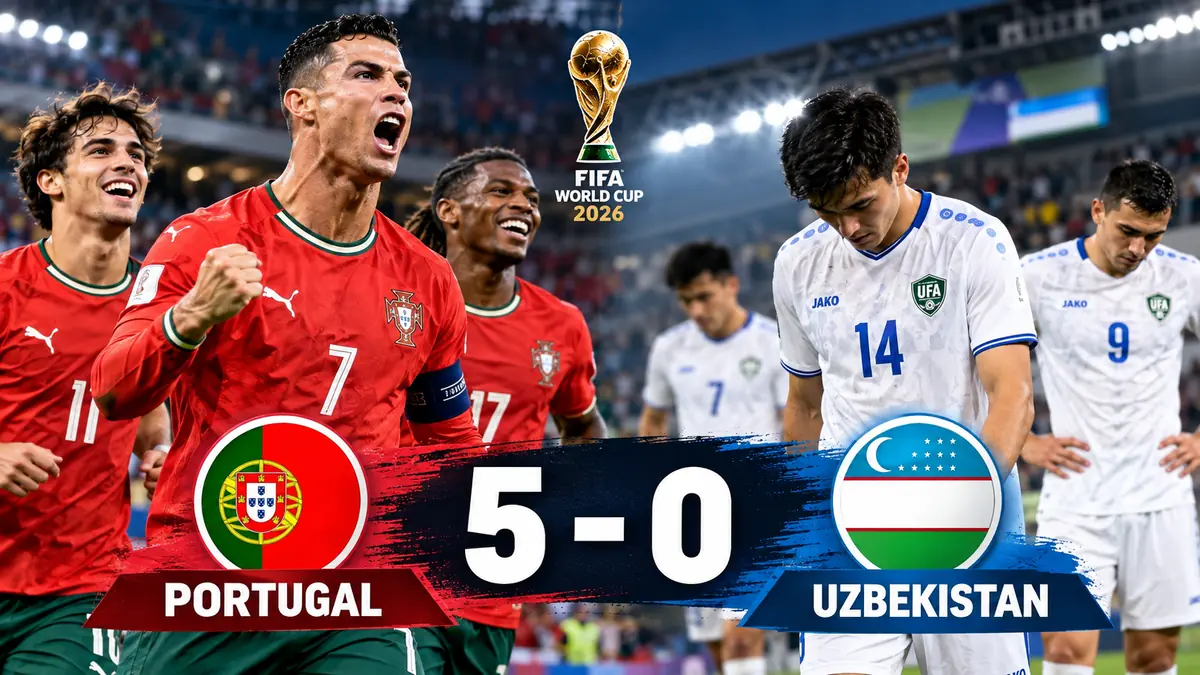
The portugal vs uzbekistan clash at the 2026 FIFA World Cup produced one of Portugal’s most convincing performances of the tournament. Portugal defeated Uzbekistan 5-0 in Houston on June 23, with Cristiano Ronaldo scoring twice as Roberto Martínez’s side responded emphatically to their frustrating opening draw against DR Congo.
Quick answer: Portugal beat Uzbekistan 5-0 in their Group K meeting at the 2026 FIFA World Cup. Cristiano Ronaldo scored in the 6th and 39th minutes, Nuno Mendes struck in the 17th, Abduvokhid Nematov scored an own goal in the 60th, and Rafael Leão completed the scoring in the 87th minute.
portugal vs uzbekistan Match Summary
The final score tells the story clearly: Portugal were too strong, too precise and too experienced for Uzbekistan.
| Match detail | Information |
|---|---|
| Competition | 2026 FIFA World Cup |
| Stage | Group K |
| Date | June 23, 2026 |
| Venue | Houston |
| Final score | Portugal 5-0 Uzbekistan |
| Half-time score | Portugal 3-0 Uzbekistan |
| Attendance | 68,777 |
| Portugal scorers | Ronaldo 6′, 39′; Mendes 17′; Leão 87′ |
| Other goal | Nematov own goal 60′ |
The fixture was the first competitive meeting between the two national teams. Before kickoff, Portugal were under pressure after opening their tournament with a 1-1 draw against DR Congo, while World Cup debutants Uzbekistan had suffered a 3-1 defeat against Colombia.
Portugal quickly removed any uncertainty.
Ronaldo opened the scoring after only six minutes. Nuno Mendes doubled the advantage with a superb free-kick in the 17th minute, and Ronaldo struck again before half-time to make it 3-0.
An own goal from Uzbekistan goalkeeper Abduvokhid Nematov extended Portugal’s lead after the break before substitute Rafael Leão completed the 5-0 victory late in the game.
Why Portugal Needed a Strong Performance
Portugal entered the World Cup as one of the tournament’s highly rated European teams, but their opening performance raised questions.
Against DR Congo, Portugal controlled possession yet struggled to turn that control into dangerous attacking opportunities. João Neves had given Portugal an early lead, but Yoane Wissa equalised before half-time.
Portugal ultimately settled for a 1-1 draw.
That result increased the importance of the Uzbekistan match. Roberto Martínez needed his team to show more attacking clarity rather than simply accumulating possession.
Uzbekistan faced even greater pressure.
Their historic first World Cup match ended in a 3-1 defeat against Colombia. Despite showing encouraging attacking moments, another loss would severely damage their chances of progressing.
The contrast made the second Group K fixture especially significant: Portugal were looking for reassurance, while Uzbekistan were trying to keep their maiden World Cup campaign alive.
How Portugal Took Control So Quickly
Portugal’s biggest improvement was their ability to turn possession into immediate pressure.
Instead of circulating the ball without consistently threatening the penalty area, they attacked Uzbekistan before their opponents could settle into a defensive rhythm.
Ronaldo Opens the Scoring
Cristiano Ronaldo scored in the sixth minute.
An early goal was particularly valuable because Uzbekistan’s best route into the contest was likely to involve staying compact, frustrating Portugal and creating opportunities through transitions.
That plan became much harder once Portugal went ahead.
Uzbekistan could no longer concentrate entirely on protecting space around their own penalty area. They eventually needed to take more risks, giving Portugal additional room to exploit.
Nuno Mendes Makes It 2-0
Portugal doubled their advantage in the 17th minute through Nuno Mendes.
The left-back’s free-kick gave Uzbekistan another problem. Portugal were not relying exclusively on their central attacking combinations; they could also threaten from set pieces and through their wide players.
At 2-0 inside 20 minutes, Portugal had already established firm control.
Ronaldo Scores Again Before Half-Time
Ronaldo added his second goal in the 39th minute.
Portugal therefore entered half-time leading 3-0, dramatically reducing Uzbekistan’s realistic chances of recovering.
The goal was also historically significant. Ronaldo became the first player to score at six different men’s FIFA World Cups, extending an international career that has spanned multiple generations of Portugal teams.
portugal vs uzbekistan Goals Timeline
The scoring unfolded as follows:
- 6′ – Cristiano Ronaldo: Portugal 1-0 Uzbekistan
- 17′ – Nuno Mendes: Portugal 2-0 Uzbekistan
- 39′ – Cristiano Ronaldo: Portugal 3-0 Uzbekistan
- 60′ – Abduvokhid Nematov own goal: Portugal 4-0 Uzbekistan
- 87′ – Rafael Leão: Portugal 5-0 Uzbekistan
Portugal effectively decided the match during the opening half.
The fourth goal arrived through Nematov’s own goal after the interval, while Leão provided another reminder of Portugal’s attacking depth by scoring as a substitute.
portugal vs uzbekistan Match Stats
The underlying numbers support the impression created by the scoreline.
| Statistic | Portugal | Uzbekistan |
|---|---|---|
| Possession | 65.9% | 34.1% |
| Shots | 17 | 7 |
| Shots on target | 9 | 2 |
| Corners | 3 | 2 |
| Accurate passes | 561 | 262 |
| Passing accuracy | 89.9% | 80.1% |
| Big chances missed | 5 | 0 |
Portugal controlled almost two-thirds of possession and produced 17 shots compared with Uzbekistan’s seven. More importantly, nine Portuguese attempts hit the target, whereas Uzbekistan managed only two.
The passing numbers are equally revealing.
Portugal completed 561 passes at 89.9% accuracy. Uzbekistan completed 262 at 80.1%.
Those statistics illustrate Portugal’s ability to dictate both the speed and location of the game.
Portugal’s Tactical Approach
Portugal lined up in a 4-2-3-1 structure with Diogo Costa in goal and Cristiano Ronaldo leading the attack.
João Cancelo, Rúben Dias, Renato Veiga and Nuno Mendes formed the defensive unit, while João Neves and Vitinha operated in midfield. Pedro Neto, Bruno Fernandes and João Félix supported Ronaldo further forward.
Several tactical features proved decisive.
Width Stretched Uzbekistan’s Defensive Shape
Portugal used their full-backs and wide attackers to make Uzbekistan defend across almost the entire width of the pitch.
That mattered because an organised defensive block becomes much harder to maintain when players are repeatedly forced to shift from one side to another.
Nuno Mendes was especially influential from the left, while Cancelo provided another technically strong option on the opposite side.
Midfield Control Limited Uzbekistan’s Counters
João Neves and Vitinha gave Portugal technical security in midfield.
Portugal wanted to attack, but they also needed protection against Uzbekistan’s transition threat. Maintaining control of second balls and quickly recycling possession helped prevent the White Wolves from building sustained counterattacks.
Bruno Fernandes Connected Midfield and Attack
Bruno Fernandes occupied spaces behind Ronaldo and offered Portugal another creative route through Uzbekistan’s defensive lines.
His movement meant Uzbekistan could not focus exclusively on Ronaldo.
Portugal could attack through central combinations, overlapping runs or switches toward the wings.
That variety was missing for periods against DR Congo but became far more visible in Houston.
Cristiano Ronaldo’s Impact
Any analysis of Portugal’s victory has to start with Ronaldo.
The Portugal captain scored twice inside the opening 39 minutes, putting the contest firmly in his team’s control.
Before the game, Ronaldo had gone 10 major-tournament appearances without scoring. The Uzbekistan match ended that run emphatically.
His performance was about more than the two goals.
Ronaldo remained Portugal’s central reference point, occupying Uzbekistan’s centre-backs and creating spaces that teammates could attack.
For Roberto Martínez, that balance is crucial.
Portugal possess significant attacking talent around Ronaldo, including Rafael Leão, João Félix, Pedro Neto, Francisco Conceição and Gonçalo Ramos. Their strongest version is therefore not one in which every attack has to end with Ronaldo, but one where his movement helps unlock opportunities throughout the forward line.
Against Uzbekistan, that structure worked.
Why Nuno Mendes Was So Important
Ronaldo naturally attracted the headlines, but Nuno Mendes provided another major contribution.
His 17th-minute goal gave Portugal a two-goal cushion and placed Uzbekistan under enormous pressure very early.
Modern full-backs frequently have responsibilities that extend well beyond defending. Mendes provides Portugal with pace, progression and width from the left side.
That creates a difficult choice for opponents.
If the defending winger tracks Mendes aggressively, space may open centrally. If the winger stays narrow, Mendes can advance into dangerous wide areas.
Against a deep defensive structure, that kind of width is particularly valuable.
What Went Wrong for Uzbekistan?
A 5-0 defeat can look like a complete tactical collapse, but Uzbekistan’s problems were more specific.
The biggest issue was conceding too early.
Against a technically superior opponent, the underdog usually benefits from keeping the game level for as long as possible. Every scoreless minute can increase frustration among the favourite while strengthening the defending team’s confidence.
Uzbekistan lost that advantage after six minutes.
By the 17th minute, they were two goals behind.
That forced them into a difficult strategic position. Remaining defensive offered little chance of recovering, but committing additional players forward created more space for Portugal.
Uzbekistan Could Not Create Enough Attacking Pressure
Uzbekistan finished with seven shots and only two on target.
Eldor Shomurodov, Abbosbek Fayzullaev and other attacking players needed opportunities in transition, but Portugal’s possession dominance limited how often those situations developed.
Uzbekistan therefore spent long periods reacting rather than imposing their own attacking game.
Portugal’s Experience Made the Difference
Uzbekistan were playing their first World Cup, while Portugal arrived with players accustomed to Champions League football and major international tournaments.
That difference showed after the early goals.
Portugal understood how to control the match once they were ahead. Uzbekistan had to chase a game against an opponent comfortable both with the ball and in attacking transition.
Uzbekistan’s Historic World Cup Campaign
The scoreline should not erase the significance of Uzbekistan’s presence at the tournament.
The 2026 competition marked their first appearance at a FIFA World Cup.
That achievement represented an important milestone for Uzbek football and gave players such as Eldor Shomurodov, Abdukodir Khusanov and Abbosbek Fayzullaev an opportunity to compete on football’s biggest international stage.
The challenge against Portugal also demonstrated the step up required at World Cup level.
Mistakes against elite opponents are often punished immediately. Uzbekistan experienced exactly that in Houston.
For a developing national team, however, matches against established sides can provide valuable tactical and competitive lessons that extend beyond one tournament result.
Portugal vs Uzbekistan Head-to-Head Record
Before the 2026 World Cup, Portugal and Uzbekistan had never played each other at senior international level.
That means the Houston match established their head-to-head record:
| Head-to-head statistic | Record |
|---|---|
| Matches | 1 |
| Portugal wins | 1 |
| Draws | 0 |
| Uzbekistan wins | 0 |
| Portugal goals | 5 |
| Uzbekistan goals | 0 |
Portugal therefore hold a 100% winning record in this very limited head-to-head series.
Historical comparisons should still be treated carefully. One match is far too small a sample to establish a meaningful long-term trend between the two countries.
How the Match Compared With Pre-Match Expectations
Portugal entered as overwhelming favourites.
Before kickoff, the Opta supercomputer gave Portugal an 83.1% probability of winning, compared with 11.0% for a draw and only 6.0% for an Uzbekistan victory.
The final score was even more decisive than those expectations suggested.
One concern before the match was Portugal’s attacking efficiency. They had dominated possession against DR Congo without producing enough clear chances.
Against Uzbekistan, that changed dramatically.
Seventeen shots, nine efforts on target and five goals represented a much more effective attacking performance.
The Key Difference Between Portugal and Uzbekistan
Portugal’s superiority came from more than individual star power.
They combined several advantages:
- Greater technical quality in possession
- More experience at major tournaments
- Better control of central midfield
- Dangerous attacking width
- Stronger squad depth
- Greater finishing threat
- More options from the bench
Uzbekistan’s best opportunity was to stay compact and turn the game into a low-scoring contest.
Ronaldo’s sixth-minute goal prevented that plan from developing.
Once Portugal established an early advantage, their technical quality became increasingly difficult to contain.
What Portugal Can Learn From the Victory
A 5-0 win is impressive, but major tournaments require teams to repeat strong performances against different tactical challenges.
Portugal’s most encouraging development was not simply scoring five goals. It was their ability to create attacks through several different routes.
Ronaldo supplied central finishing.
Mendes contributed from full-back and set pieces.
Fernandes helped connect midfield and attack.
Leão demonstrated the quality available from the bench.
That diversity makes Portugal much harder to defend against than a team relying on one attacking pattern.
The caution is that Uzbekistan allowed Portugal considerably more control than stronger knockout-stage opponents may provide.
Portugal therefore still needed to prove that the same attacking fluency could survive against teams capable of pressing aggressively and controlling possession themselves.
What Uzbekistan Can Learn From the Defeat
For Uzbekistan, the biggest lesson is the importance of managing the opening phase against elite opposition.
Conceding after six minutes immediately changed the tactical demands of the match.
Against teams with Portugal’s quality, staying competitive often requires:
- Protecting central spaces during the opening stages
- Avoiding unnecessary fouls around the penalty area
- Maintaining compact distances between defence and midfield
- Making counterattacking opportunities count
- Preventing a single conceded goal from becoming multiple goals quickly
Uzbekistan demonstrated during qualification that they could compete successfully at international level. The World Cup represented a different challenge: mistakes that might go unpunished elsewhere can become goals against world-class opposition.
That experience can still be valuable for the country’s long-term development.
Biggest Takeaways From portugal vs uzbekistan
The portugal vs uzbekistan result was significant for both teams for very different reasons.
For Portugal, the 5-0 victory provided the response they needed after the disappointing 1-1 draw with DR Congo. Their attack looked sharper, their midfield controlled possession and their squad depth became increasingly evident as the match progressed.
Cristiano Ronaldo’s brace was the defining individual performance. His goals in the sixth and 39th minutes helped decide the contest before half-time, while his achievement of scoring at a sixth World Cup added another historic milestone to his international career.
Nuno Mendes, the Nematov own goal and Rafael Leão completed a comprehensive victory.
For Uzbekistan, the defeat highlighted the unforgiving nature of World Cup football. Their historic tournament debut placed them against some of the world’s strongest players, and Portugal punished their early defensive problems ruthlessly.
The final score was Portugal 5-0 Uzbekistan, a result that transformed Portugal’s Group K momentum and produced one of the clearest demonstrations of their attacking potential at the 2026 World Cup.