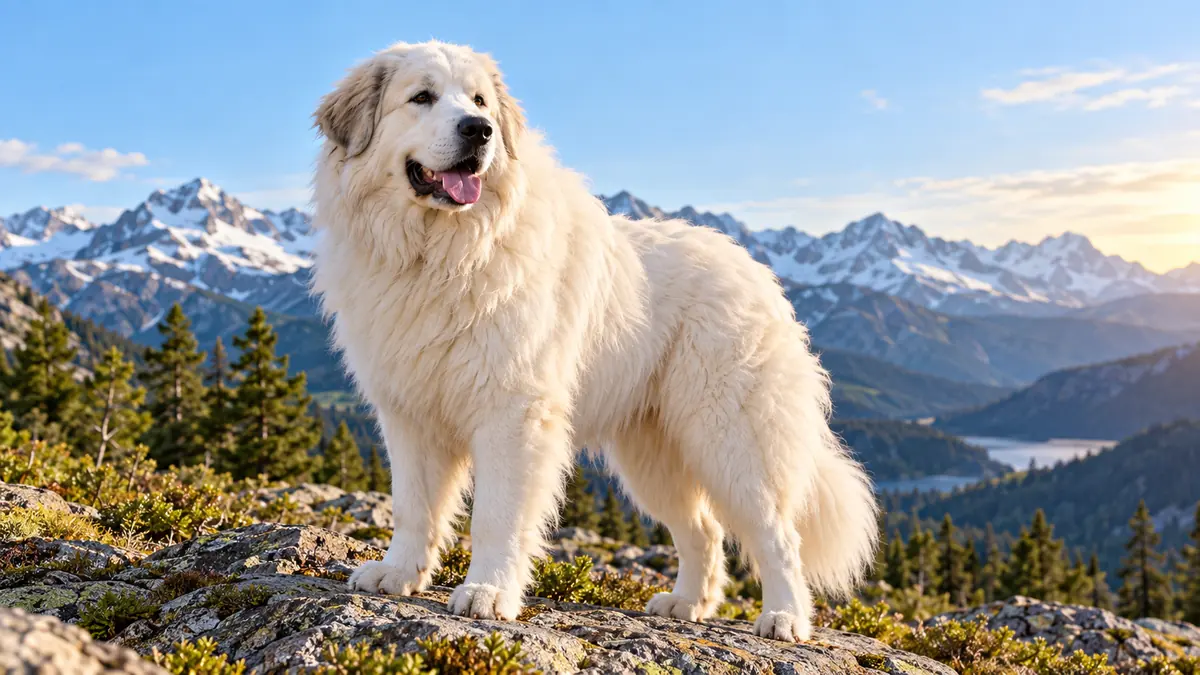
The great pyrenees is hard to overlook. With a massive frame, thick white coat, calm expression, and centuries-old guardian instinct, this dog combines an imposing appearance with a remarkably patient nature. But living with one involves much more than admiring a beautiful white dog.
The Great Pyrenees is a large livestock guardian breed developed to protect flocks from predators. Adults are typically calm, independent, protective, and devoted to their families. Males stand about 27–32 inches tall and weigh 100 pounds or more, while females generally stand 25–29 inches and weigh 85 pounds or more. American Kennel Club
Understanding the breed’s history explains many behaviors that surprise new owners—from nighttime barking and independent decision-making to patrolling the yard and appearing uninterested in repetitive obedience exercises.
Great Pyrenees at a Glance
| Trait | Typical Great Pyrenees |
|---|---|
| Breed group | Working Group |
| Original purpose | Livestock guardian |
| Male height | 27–32 inches |
| Female height | 25–29 inches |
| Male weight | 100+ pounds |
| Female weight | 85+ pounds |
| Life expectancy | 10–12 years |
| Coat | Long, weather-resistant double coat |
| Common color | White; markings may occur |
| Temperament | Calm, patient, independent, protective |
| Exercise needs | Moderate |
| Shedding | Heavy |
| Training difficulty | Moderate to challenging |
These figures describe the breed generally; individual dogs naturally vary. American Kennel Club
What Is a Great Pyrenees?
The Great Pyrenees is a giant livestock guardian dog closely associated with the Pyrenees Mountains between France and Spain. Rather than being developed primarily to herd sheep, these dogs protected livestock from threats.
That distinction matters.
A herding dog is typically expected to respond closely to a handler’s directions. A livestock guardian may need to assess a situation and act without waiting for instructions.
That heritage helps explain the Great Pyrenees personality today. The breed can be intelligent without being highly obedient, affectionate without constantly demanding attention, and relaxed while remaining remarkably alert to its surroundings.
The American Kennel Club places the Great Pyrenees in its Working Group and describes the breed as smart, patient, and calm. American Kennel Club
Great Pyrenees or Pyrenean Mountain Dog?
Different countries use different names for closely corresponding breed traditions. In the United States, Great Pyrenees is the familiar name. The term Pyrenean Mountain Dog is commonly encountered internationally.
It should not be confused with the Pyrenean Mastiff, another large livestock guardian associated with the Pyrenees region.
Great Pyrenees History and Original Purpose
The story of the Great Pyrenees begins with livestock protection.
Ancestors of European livestock guardian dogs accompanied people and their animals for centuries. Large guardian dogs eventually became established in the mountainous region between present-day France and Spain, where shepherds needed animals capable of defending flocks.
The environment helped shape the breed.
A successful guardian needed enough strength and courage to confront predators, but it also had to remain trustworthy around livestock. It needed endurance rather than constant high-speed activity and enough independence to make decisions without continual human supervision.
Great Pyrenees later became associated with French aristocracy as well as working shepherds. In the United States, organized efforts helped establish the modern breed, and the American Kennel Club recognized the Great Pyrenees in 1933. American Kennel Club
Those working roots remain visible in modern dogs. Even a Pyr that has never seen a sheep may instinctively patrol property, investigate noises, bark at unfamiliar activity, and position itself where it can observe its surroundings.
Great Pyrenees Size and Appearance
A full-grown Great Pyrenees is a substantial dog.
According to the AKC breed information, males typically stand 27–32 inches at the shoulder and weigh 100 pounds or more. Females generally stand 25–29 inches and weigh 85 pounds or more. American Kennel Club
Their size is balanced rather than cumbersome. A well-built Pyr should combine strength with the ability to move efficiently.
Coat and Colors
One of the breed’s defining features is its weather-resistant double coat.
The outer coat is long and relatively coarse, while the undercoat is soft and dense. This combination helped protect working dogs from harsh mountain weather.
White is the dominant color.
However, the official breed standard also allows white dogs with markings that can include gray, badger, reddish brown, or varying shades of tan. These markings may appear around the head, ears, tail, and portions of the body. Great Pyrenees Club of America
Males often develop especially noticeable hair around the neck and shoulders, producing the mane-like appearance associated with the breed.
Another distinctive feature is the presence of double dewclaws on the rear legs.
How Big Does a Great Pyrenees Get?
People sometimes underestimate what a 100-pound guardian dog means inside a house.
A Pyr occupies considerable floor space, requires appropriately sized equipment, can reach counters easily, and may unintentionally knock over a small child simply by turning around.
Potential owners should therefore consider strength and physical dimensions, not just the dog’s weight.
Great Pyrenees Temperament
The classic Great Pyrenees temperament can be summarized as confident, gentle, patient, independent, attentive, and protective.
The official Great Pyrenees Club of America standard emphasizes quiet composure while also describing the breed as strong-willed, independent, reserved, fearless, and loyal. Great Pyrenees Club of America
That combination creates an unusual personality.
A Pyr may spend hours peacefully resting and then become immediately attentive when something unfamiliar occurs outside.
Are Great Pyrenees Aggressive?
Aggression toward people is not a defining characteristic of a properly bred and socialized Great Pyrenees.
The official breed standard specifically treats excessive shyness, nervousness, or aggression toward humans as serious faults. Great Pyrenees Club of America
However, protectiveness should not be confused with aggression.
These dogs were created to notice possible threats. Some individuals are naturally reserved around unfamiliar people and animals. Early, thoughtful socialization helps teach puppies which everyday situations are normal.
Are Great Pyrenees Affectionate?
They can be extremely devoted to their families.
Their affection is often quieter than the behavior seen in highly attention-seeking breeds. Many Pyrs enjoy remaining close to their people without constantly asking for interaction.
That independence can be appealing, but someone wanting a dog that eagerly follows every command may find the breed frustrating.
Are Great Pyrenees Good Family Dogs?
Great Pyrenees can be excellent family companions in homes prepared for their size and guardian temperament.
They are often patient and affectionate with household members. Their protective heritage can also make them deeply attentive to the people and animals they regard as part of their family.
But supervision matters around children.
Even a gentle 100-pound dog can accidentally knock over a toddler. Children should also learn not to climb on dogs, disturb them while sleeping or eating, or treat them like oversized stuffed animals. The AKC likewise recommends supervision around young children. American Kennel Club
Great Pyrenees With Other Dogs and Pets
Many Great Pyrenees live successfully with other dogs and household animals.
Their livestock guardian background can even translate into patient behavior around animals they accept as part of their group.
Individual temperament still matters. Introductions should be controlled rather than assuming every Pyr will immediately accept every dog or pet.
Early socialization is particularly useful.
Great Pyrenees Training
Training is one of the most misunderstood parts of owning this breed.
Great Pyrenees are intelligent, but intelligence does not automatically mean obedience.
For generations, these dogs were expected to make decisions while guarding livestock with limited human direction. That independence remains deeply rooted in the breed.
A Pyr may understand exactly what you are asking and still appear to consider whether complying is worthwhile.
What Works Best?
Training should begin during puppyhood and remain consistent.
Short sessions generally work better than endless repetition. Positive reinforcement helps maintain cooperation without creating unnecessary conflict.
Focus particularly on practical behaviors such as:
- Coming when called.
- Walking calmly on a leash.
- Waiting at doors and gates.
- Accepting grooming and handling.
- Remaining calm around visitors.
- Leaving unwanted objects.
- Settling quietly when asked.
Early puppy classes can provide valuable controlled exposure to unfamiliar people, dogs, environments, surfaces, sounds, and situations.
AKC guidance emphasizes early socialization, consistency, patience, and positive reinforcement because the breed can become bored with repetitive exercises. American Kennel Club
Recall Can Be Challenging
Reliable recall deserves particular attention.
A Great Pyrenees may notice something beyond your property that it believes requires investigation. Guardian instincts and independence can suddenly become stronger than your request to return.
For this reason, a secure physical fence is extremely valuable.
Do not assume a calm dog has no desire to wander.
Why Do Great Pyrenees Bark So Much?
Barking is not simply a bad habit in this breed—it is connected to the job humans selected them to perform.
Imagine a guardian watching sheep at night.
It hears something beyond the flock.
Barking communicates presence and may discourage a predator from approaching. If the possible threat disappears, the dog has successfully performed its job without needing physical confrontation.
Modern suburban life changes the environment but not necessarily the instinct.
The “threat” might now be a delivery driver, neighbor, dog, raccoon, closing car door, or unfamiliar sound at night.
Training and management can reduce unnecessary barking, but prospective owners should have realistic expectations. Expecting a livestock guardian breed to become completely silent is rarely reasonable.
Great Pyrenees Exercise Needs
Their impressive size sometimes creates the assumption that Great Pyrenees require hours of intense exercise.
Usually, they don’t.
The breed was designed to patrol and conserve energy rather than run continuously. The AKC describes moderate exercise, including walks, as appropriate for keeping Pyrs healthy and content. American Kennel Club
Regular walks, time in a securely fenced area, exploration, and appropriate mental stimulation can provide a useful routine.
Activities can include walking, hiking at an appropriate pace, scent-based games, carting, and supervised outdoor exploration.
Are Great Pyrenees Good Apartment Dogs?
Physically, some calm adult Great Pyrenees can adapt to indoor living better than their size suggests.
The bigger problems are often practical.
A giant dog requires space. Heavy shedding becomes noticeable quickly. Frequent barking can create problems with neighbors, and elevators or stairs may complicate daily life.
A house with a securely fenced yard generally provides easier management, although a yard never replaces interaction, exercise, and training.
Great Pyrenees Grooming and Shedding
That magnificent white coat comes with one unavoidable reality:
Great Pyrenees shed.
And they can shed heavily.
Their double coat naturally releases old hair, with periods of particularly noticeable seasonal shedding.
Fortunately, the coat is more manageable than its appearance suggests. The outer coat has natural dirt- and tangle-resistant qualities, and routine brushing does much of the work.
How Often Should You Brush a Great Pyrenees?
A thorough brushing approximately once a week is a useful baseline. More frequent brushing may be necessary when the undercoat is shedding heavily. Both AKC and veterinary guidance recommend regular weekly coat care. American Kennel Club
Pay special attention to areas where friction encourages tangles, including behind the ears, around the neck, feathering, and hindquarters.
Routine care should also include:
- Nail trimming
- Dental care
- Ear checks
- Occasional bathing
- Skin checks
- Checking paws and coat after outdoor activity
The breed does not normally require constant bathing.
Should You Shave a Great Pyrenees?
Routine shaving is generally unnecessary for a healthy double-coated Great Pyrenees.
The coat serves a functional purpose, so normal maintenance should concentrate on removing loose undercoat, preventing mats, and maintaining cleanliness rather than eliminating the coat.
If severe matting, a skin condition, surgery, or another medical issue makes clipping necessary, follow veterinary or professional grooming guidance.
Feeding a Great Pyrenees
Nutrition needs change with age, body condition, activity, reproductive status, and health.
Great Pyrenees puppies require particular attention because they are developing into giant adults. Controlled, steady growth is preferable to trying to make a puppy grow as quickly as possible.
A veterinarian can help determine an appropriate large-breed diet and portion size.
Monitor body condition rather than relying exclusively on feeding instructions printed on packaging. Treats and training rewards count toward daily calorie intake as well.
Bloat and Feeding
Great Pyrenees can be susceptible to gastric dilatation-volvulus (GDV), commonly called bloat.
GDV is a potentially life-threatening emergency in which the stomach becomes distended and may twist. The AKC identifies bloat as an important health concern in the breed. American Kennel Club
Warning signs can include abdominal swelling, repeated unsuccessful attempts to vomit, restlessness, excessive salivation, weakness, or collapse.
Suspected GDV requires immediate emergency veterinary attention.
Owners of deep-chested and giant breeds should discuss individual risk factors and prevention strategies with their veterinarian.
Great Pyrenees Health Issues
Great Pyrenees are generally robust dogs, but no breed is free from inherited or acquired health concerns.
Conditions associated with the breed can include:
- Hip dysplasia
- Elbow dysplasia
- Patellar problems
- Certain eye disorders
- Neurological conditions
- Some cancers
- Gastric dilatation-volvulus
The AKC notes that responsible breeders screen breeding dogs for conditions relevant to the breed, including orthopedic and eye-related problems. American Kennel Club
Health screening matters because outward appearance alone cannot reveal many inherited problems.
Anyone obtaining a puppy should ask what health tests were performed on both parents and request documentation rather than relying solely on verbal assurances.
Regular veterinary examinations, appropriate nutrition, parasite prevention, dental care, exercise, and maintaining a healthy body condition remain important throughout the dog’s life.
How Long Do Great Pyrenees Live?
The typical Great Pyrenees lifespan is approximately 10–12 years according to the American Kennel Club and PetMD. American Kennel Club
Individual longevity varies according to genetics, veterinary care, body condition, environment, and disease.
Keeping a giant dog lean is especially important because excess body weight adds stress to joints and affects overall health.
Great Pyrenees Puppies: What to Expect
A Great Pyrenees puppy can look like an irresistibly fluffy white bear cub.
It won’t remain small for long.
Owners need to begin preparing for adult behavior while the puppy is still physically manageable.
Early priorities should include house training, leash manners, recall foundations, calm greetings, handling exercises, grooming tolerance, and exposure to normal household and community experiences.
Socialization Matters
Socialization does not mean forcing a puppy to greet everyone.
The objective is to create positive, controlled experiences that help the puppy learn what is normal.
Introduce different people, friendly animals, sounds, surfaces, vehicles, grooming procedures, veterinary handling, and environments gradually.
For a naturally protective breed, this foundation is especially valuable.
Don’t Encourage Guarding
Some owners make the mistake of deliberately encouraging protective behavior in young guardian breeds.
A Great Pyrenees already carries genetic guarding tendencies.
The more useful goal is teaching the puppy judgment, confidence, neutrality, and control.
A stable adult guardian should recognize ordinary life without treating everything unfamiliar as a threat.
Great Pyrenees as Livestock Guardian Dogs
This is where the breed’s original abilities become especially clear.
Great Pyrenees have historically protected sheep and other livestock rather than controlling their movement. They may patrol boundaries, observe from elevated locations, bark warnings, place themselves between livestock and a perceived threat, and confront predators when necessary.
Successful livestock guardians require appropriate upbringing.
Simply purchasing a Great Pyrenees puppy and putting it in a pasture does not guarantee an effective working dog. Genetics, early environment, livestock exposure, fencing, supervision, and maturity all matter.
Young dogs require guidance while they learn appropriate behavior around livestock.
Common Great Pyrenees Behavior Challenges
Several behaviors surprise people who choose the breed primarily because of its appearance.
Barking
Guardian dogs use barking as part of their protective toolkit. Nighttime alert barking can be particularly noticeable.
Wandering
A Pyr may view territory more broadly than its owner does. Secure fencing is important.
Independence
Commands can sometimes feel like suggestions to an independently minded livestock guardian.
Digging
Some individuals dig resting spots, especially outdoors.
Heavy Shedding
White fur on furniture, clothing, floors, and car interiors becomes part of everyday maintenance.
Protective Behavior
Poor socialization or management can turn normal vigilance into difficult behavior around visitors or unfamiliar dogs.
None of these automatically makes the Great Pyrenees a problematic breed. They simply demonstrate why matching a dog’s inherited traits to the household matters.
Male vs. Female Great Pyrenees
The most predictable difference is physical size.
Adult males are generally larger, with the AKC standard placing males at 27–32 inches and females at 25–29 inches. Males also typically weigh at least 100 pounds, compared with 85 pounds or more for females. American Kennel Club
Individual personality differences can be more significant than sex.
Genetics, early socialization, training, environment, reproductive status, and life experience all influence behavior. Choosing a puppy solely because of generalized claims that one sex is “better” usually oversimplifies the decision.
Great Pyrenees vs. Similar Guardian Breeds
Several large guardian breeds can appear similar at first glance.
| Breed | Traditional Role | Notable General Trait |
|---|---|---|
| Great Pyrenees | Livestock guardian | White coat, calm independence |
| Anatolian Shepherd | Livestock guardian | Athletic, territorial guardian |
| Maremma Sheepdog | Livestock guardian | White Italian guardian breed |
| Kuvasz | Guardian | Large white Hungarian breed |
| Pyrenean Mastiff | Livestock guardian | Massive Spanish mountain breed |
Shared working history does not make these breeds interchangeable.
Temperament, size, coat, activity, breed standards, and typical working styles differ, so anyone considering a guardian breed should research each one separately.
Is a Great Pyrenees Good for First-Time Owners?
A determined first-time owner can successfully raise a Great Pyrenees, but the breed can present a steep learning curve.
Size alone increases the consequences of weak training. Add independent thinking, territorial instincts, barking, shedding, and possible wandering, and inexperienced owners may find themselves managing much more dog than expected.
The AKC notes that the breed is often better suited to experienced owners who understand large, independent guardian dogs. American Kennel Club
For a first-time owner committed to the breed, puppy classes and guidance from a qualified trainer experienced with livestock guardian breeds can be especially useful.
What Kind of Home Suits a Great Pyrenees?
The breed tends to fit households that appreciate independence rather than expecting constant obedience.
A suitable owner should be comfortable with a very large dog, significant shedding, consistent training, moderate daily exercise, protective instincts, and barking.
Secure containment is especially important.
A Pyr may be a natural match for rural properties and farms, but rural living isn’t mandatory. What matters more is whether the environment allows the dog’s behavior to be managed responsibly.
Prospective owners should think carefully about nearby neighbors, fencing, available indoor space, other animals, young children, grooming tolerance, and local noise restrictions.
What Living With a Great Pyrenees Is Really Like
The striking coat attracts attention, but appearance should be one of the least important reasons to choose this breed.
Daily life is more likely to involve sweeping white fur from the floor, convincing a giant independent dog that your command deserves consideration, checking why it is barking outside, and watching it quietly position itself between the family and something unfamiliar.
Those behaviors make far more sense once you understand what the breed was created to do.
Great Pyrenees were not developed simply to be decorative companions. They were working guardians expected to think independently, tolerate harsh conditions, conserve energy, watch carefully, and react when necessary.
That heritage remains central to the modern great pyrenees. For households prepared for the size, shedding, barking, training challenges, and guardian instincts, the result can be a calm, deeply devoted companion whose quiet confidence is every bit as distinctive as its enormous white coat.