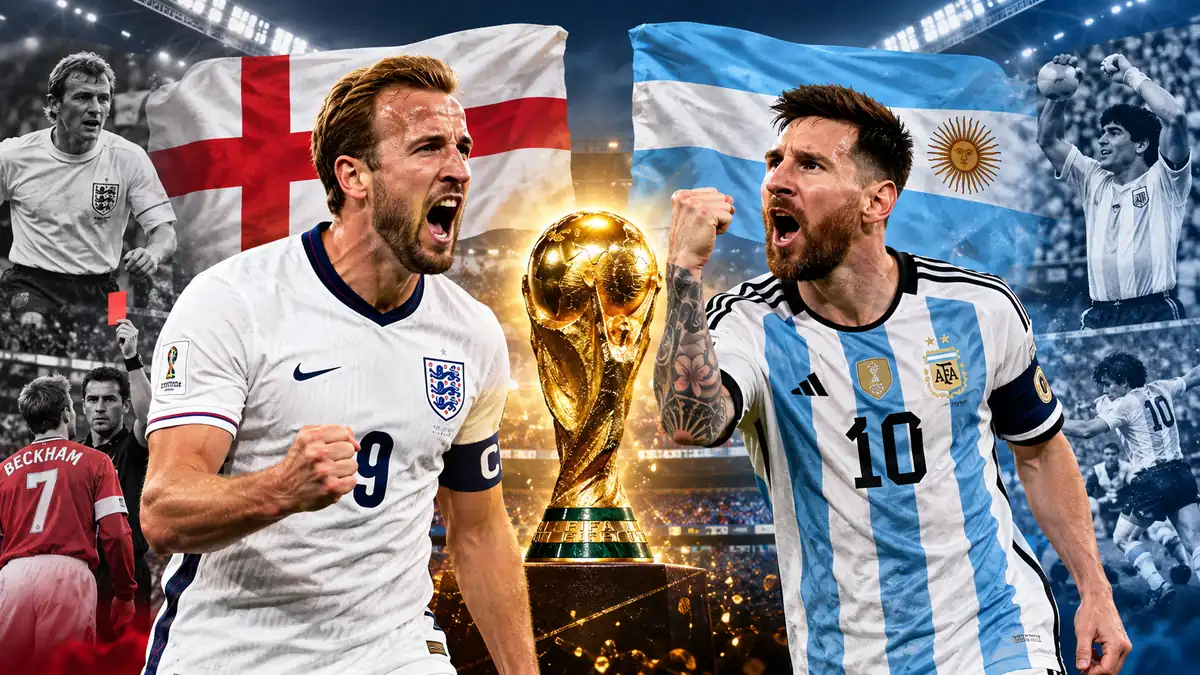
Few international football fixtures carry as much history as england vs argentina. Decades of World Cup drama, controversial decisions, unforgettable goals and penalty shootouts have turned meetings between the Three Lions and La Albiceleste into events that reach far beyond an ordinary international match.
The rivalry gained another major chapter on 15 July 2026, when Argentina came from behind to beat England 2-1 in the FIFA World Cup semifinal in Atlanta. Anthony Gordon put England ahead, but late goals from Enzo Fernández and Lautaro Martínez sent Argentina into the final.
Quick answer: Argentina defeated England 2-1 in their latest meeting, the 2026 FIFA World Cup semifinal. Gordon scored for England in the 55th minute before Fernández equalized in the 85th. Martínez then scored in stoppage time as Argentina completed a dramatic comeback and eliminated England.
england vs argentina 2026 World Cup Semifinal
The latest meeting between these football powers took place at Mercedes-Benz Stadium in Atlanta, Georgia, during the 2026 FIFA World Cup.
It was their first meeting since the memorable 3-2 England friendly victory in 2005 and their first World Cup encounter since 2002.
| Match detail | Information |
|---|---|
| Competition | FIFA World Cup 2026 |
| Round | Semifinal |
| Date | 15 July 2026 |
| Venue | Mercedes-Benz Stadium, Atlanta |
| Result | England 1-2 Argentina |
| Half-time | 0-0 |
| England scorer | Anthony Gordon, 55′ |
| Argentina scorers | Enzo Fernández, 85′; Lautaro Martínez, 90+2′ |
The semifinal began cautiously. England and Argentina gave each other very little room, and neither side produced a shot during the opening 30 minutes. Argentina gradually established greater control of possession, while England looked for opportunities to attack quickly when space appeared.
The match was still goalless at half-time.
That changed ten minutes after the restart.
Anthony Gordon Gives England the Lead
England struck in the 55th minute.
Morgan Rogers supplied the ball for Anthony Gordon, who converted to put Thomas Tuchel’s team 1-0 ahead. Suddenly, England were within reach of their first men’s World Cup final since winning the tournament in 1966.
The goal changed the nature of the game.
Rather than having to wait for counterattacking opportunities, Argentina now had to chase an equalizer. Lionel Scaloni’s side pushed increasingly high up the pitch while England concentrated more heavily on protecting their advantage.
That approach kept England ahead for half an hour, but it also allowed Argentina to establish sustained pressure.
How Argentina Turned the Match Around
The statistical picture explains why England’s one-goal advantage became increasingly difficult to protect.
Argentina finished with 64% possession and 15 shots, compared with England’s 36% possession and five attempts. Argentina also registered five shots on target to England’s two and won six corners compared with England’s one.
| Statistic | England | Argentina |
|---|---|---|
| Possession | 36% | 64% |
| Shots | 5 | 15 |
| Shots on target | 2 | 5 |
| Corners | 1 | 6 |
| Fouls | 11 | 15 |
England remained competitive defensively, but constantly defending against a technically strong Argentina team was a significant risk.
The breakthrough finally arrived in the 85th minute.
Enzo Fernández Makes It 1-1
With only five minutes of normal time remaining, Enzo Fernández scored Argentina’s equalizer.
Lionel Messi was involved in creating the opportunity, and Fernández’s finish finally broke England’s resistance. The goal completely changed the momentum of the semifinal.
England had spent much of the second half trying to protect their advantage. Now they suddenly needed to regain attacking control with very little time remaining.
Argentina sensed the opportunity.
Lautaro Martínez Scores the Winner
Argentina completed the comeback in the second minute of stoppage time.
Messi supplied the cross and substitute Lautaro Martínez headed in the decisive goal to make it 2-1.
The turnaround happened remarkably quickly: England had still been leading in the 84th minute, yet Argentina were ahead only minutes later.
England attempted late changes, including the introduction of Marcus Rashford and Ivan Toney, but Argentina held on.
The final whistle confirmed another painful World Cup elimination for the Three Lions.
Why England Lost to Argentina
The defeat was not simply the result of two isolated late goals.
England’s increasingly defensive approach after Gordon’s opener gave Argentina control of territory and possession. Instead of forcing Argentina to defend against regular counterattacks, England spent long periods protecting their penalty area.
The five-shot total underlined how limited England’s attacking output became. Argentina attempted three times as many shots and enjoyed almost two-thirds of possession.
Three factors were especially important.
Argentina Controlled Possession
Argentina’s 64% share of possession forced England to spend considerable time without the ball.
Possession alone does not decide football matches, but Argentina combined it with substantially more attacking activity.
Their 15 shots and six corners reflected sustained pressure rather than harmless possession.
England Dropped Deeper
England had successfully frustrated Argentina for much of the contest.
The problem came after taking the lead.
Protecting a narrow advantage against players such as Messi, Fernández and Argentina’s attacking substitutes meant England had very little margin for error. Once Fernández equalized, Argentina already had the momentum needed to search for another goal.
Messi Influenced the Decisive Moments
Lionel Messi did not need to score to determine the semifinal.
He contributed to both late Argentina goals, supplying Fernández for the equalizer and Martínez for the winner. That ability to influence decisive moments was crucial to Argentina’s comeback.
england vs argentina Head-to-Head Record
The precise overall head-to-head total can vary between statistical databases because some early encounters are classified differently.
For example, the 14 May 1953 match in Buenos Aires is sometimes listed separately because it was an unofficial encounter from England’s perspective. This explains why different websites can display slightly different overall totals.
What is much clearer is the extraordinary World Cup history between the teams.
Before the 2026 semifinal, England and Argentina had already met five times at the FIFA World Cup: 1962, 1966, 1986, 1998 and 2002.
The 2026 semifinal therefore became their sixth World Cup encounter.
| World Cup | Match | Result |
|---|---|---|
| 1962 | England vs Argentina | England 3-1 Argentina |
| 1966 | England vs Argentina | England 1-0 Argentina |
| 1986 | Argentina vs England | Argentina 2-1 England |
| 1998 | Argentina vs England | 2-2; Argentina won on penalties |
| 2002 | Argentina vs England | England 1-0 Argentina |
| 2026 | England vs Argentina | Argentina 2-1 England |
Those six games alone explain much of the rivalry’s reputation.
But several matches stand above the rest.
England 1-0 Argentina: 1966 World Cup
One of the earliest defining moments occurred in the 1966 World Cup quarterfinal at Wembley Stadium.
The match was physical and controversial.
Argentina captain Antonio Rattín was sent off during the first half following a dispute with German referee Rudolf Kreitlein. Rattín protested the decision and initially refused to leave the field.
England eventually took advantage.
With 12 minutes remaining, Martin Peters crossed for Geoff Hurst, whose header gave England a 1-0 victory.
England subsequently defeated Portugal in the semifinal and West Germany in the final to win their first—and so far only—men’s World Cup.
But the quarterfinal left considerable resentment and helped create the sporting rivalry that would intensify dramatically two decades later.
Argentina 2-1 England: 1986 and Maradona’s Two Famous Goals
No england vs argentina match is more famous than the 1986 World Cup quarterfinal at Estadio Azteca in Mexico City.
The match became inseparable from Diego Maradona.
Argentina won 2-1, and Maradona scored both goals—but they could hardly have been more different.
The Hand of God
Maradona’s first goal remains one of football’s most controversial moments.
He challenged England goalkeeper Peter Shilton for a high ball and used his hand to send it into the net.
The officials allowed the goal to stand.
The incident became universally known as the “Hand of God.”
The Goal of the Century
Only minutes later, Maradona produced something entirely different.
He collected the ball inside his own half and ran through England’s defense before scoring one of the most celebrated individual goals in World Cup history.
The contrast was remarkable: one goal was controversial; the other showcased extraordinary technical ability.
Gary Lineker pulled one back for England late in the match, but Argentina held on for a 2-1 victory. They eventually won the 1986 World Cup.
That quarterfinal transformed an already tense football rivalry into one recognized around the world.
Argentina vs England 1998: Beckham’s Red Card and Penalties
Twelve years later, another World Cup produced another classic.
Argentina and England met in the Round of 16 at France 1998.
The match finished 2-2 after extra time.
Three goals arrived within the opening 17 minutes, and the teams entered half-time level following another goal in first-half stoppage time.
Then came the incident that shaped the match.
Why Was David Beckham Sent Off?
Early in the second half, David Beckham was fouled by Argentina midfielder Diego Simeone.
While lying on the ground, Beckham kicked out at Simeone.
The referee showed Beckham a red card, leaving England with ten players.
England survived the remainder of normal time and extra time, taking the match to a penalty shootout.
Argentina won the shootout 4-3, with England’s Paul Ince and David Batty failing to convert.
For Beckham, the consequences extended well beyond the tournament. His dismissal became one of the defining episodes of his early England career.
Four years later, he would receive the perfect opportunity for redemption.
England 1-0 Argentina: Beckham’s 2002 Redemption
England and Argentina were drawn together in Group F at the 2002 World Cup in Japan and South Korea.
Once again, Beckham became central to the story.
Argentina defender Mauricio Pochettino fouled Michael Owen inside the penalty area, giving England a first-half penalty.
Beckham stepped forward.
Four years after his red card against the same opponent, he converted the penalty and gave England a 1-0 victory.
The result had major consequences.
England progressed from the group, while Argentina—one of the pre-tournament favorites—were eliminated during the group stage.
For England supporters, Beckham’s winning penalty became one of the most satisfying moments of the rivalry.
Argentina 2-3 England: The 2005 Friendly
The teams met again on 12 November 2005 in Geneva.
Although it was only an international friendly, the match delivered the type of drama associated with the fixture.
Argentina led 2-1 before England produced a late comeback to win 3-2.
It became their final meeting for more than two decades.
When England and Argentina finally faced each other again in 2026, an entirely new generation of players inherited the rivalry.
Why Is England vs Argentina Such a Major Football Rivalry?
Unlike England’s neighboring rivalries with Scotland or Germany, England and Argentina do not play each other regularly.
That rarity actually adds to the fixture’s appeal.
Almost every major competitive meeting has produced a story remembered long after the final whistle.
The sequence is remarkable:
- 1966 produced Rattín’s controversial dismissal and England’s narrow quarterfinal win.
- 1986 produced Maradona’s Hand of God and Goal of the Century.
- 1998 produced Beckham’s red card and Argentina’s penalty-shootout victory.
- 2002 produced Beckham’s redemption from the penalty spot.
- 2026 produced Argentina’s dramatic late semifinal comeback.
The rivalry also features two countries with enormous football traditions.
England is the birthplace of the modern codified game and won the 1966 World Cup. Argentina entered the 2026 tournament as reigning world champion after winning its third title in Qatar in 2022.
Players such as Geoff Hurst, Diego Maradona, Gary Lineker, David Beckham, Diego Simeone, Michael Owen and Lionel Messi have all become part of the fixture’s history.
Few international matchups can offer a comparable collection of iconic names and moments.
How Often Have England and Argentina Played at the World Cup?
Following the 2026 semifinal, England and Argentina have met six times at the FIFA World Cup.
England won the matches in 1962, 1966 and 2002.
Argentina won in 1986 and 2026, while the 1998 encounter finished 2-2 before Argentina advanced through the penalty shootout.
That makes their World Cup rivalry remarkably balanced.
It also means a significant percentage of their most memorable encounters have happened on football’s biggest stage rather than in ordinary friendlies.
What the 2026 Match Added to the Rivalry
Before 2026, discussions about england vs argentina naturally centered on Maradona, Beckham and the World Cups of previous generations.
The Atlanta semifinal created a modern chapter.
Instead of Maradona against Lineker or Beckham against Simeone, the focus shifted to a generation featuring Lionel Messi, Enzo Fernández, Lautaro Martínez, Harry Kane, Jude Bellingham, Declan Rice and Anthony Gordon.
The circumstances made the match even more significant.
Argentina were defending world champions. England were attempting to reach their first men’s World Cup final since 1966.
For 30 minutes after Gordon’s goal, England appeared close to achieving that objective.
Then Argentina overturned the semifinal in seven dramatic minutes.
Fernández’s 85th-minute equalizer changed the match, and Martínez’s stoppage-time header completed the comeback. Argentina advanced with a 2-1 victory.
That result ensured future discussions of the rivalry will no longer stop at 2002 or 2005.
Most Memorable england vs argentina Moments
Choosing one defining moment is difficult because different generations associate the rivalry with different matches.
For supporters who remember 1966, Geoff Hurst’s quarterfinal winner stands out.
For the next generation, Maradona’s two goals in 1986 are impossible to separate from the fixture.
Fans who grew up during the 1990s remember Michael Owen’s youthful brilliance, Beckham’s dismissal and England’s penalty-shootout defeat in 1998.
The 2002 generation remembers Beckham standing over the penalty spot in Sapporo and converting England’s winner.
And supporters watching in 2026 saw another dramatic reversal: England leading a World Cup semifinal with five minutes of normal time remaining before Argentina scored twice.
That is what gives the rivalry its lasting power.
The matches are relatively rare, but when they happen, they repeatedly produce moments that become part of World Cup history.
england vs argentina: A Rivalry That Keeps Producing Drama
The england vs argentina rivalry has stretched across generations without requiring frequent meetings to remain compelling.
From Wembley in 1966 to Mexico City in 1986, Saint-Étienne in 1998, Sapporo in 2002 and Atlanta in 2026, their World Cup encounters have featured controversy, exceptional individual performances and dramatic finishes.
The latest chapter belongs to Argentina.
Anthony Gordon’s 55th-minute goal put England ahead in the 2026 World Cup semifinal, but Enzo Fernández equalized in the 85th minute before Lautaro Martínez scored the stoppage-time winner. Argentina’s 2-1 victory extended one of international football’s most storied rivalries with another match that will be remembered for years.