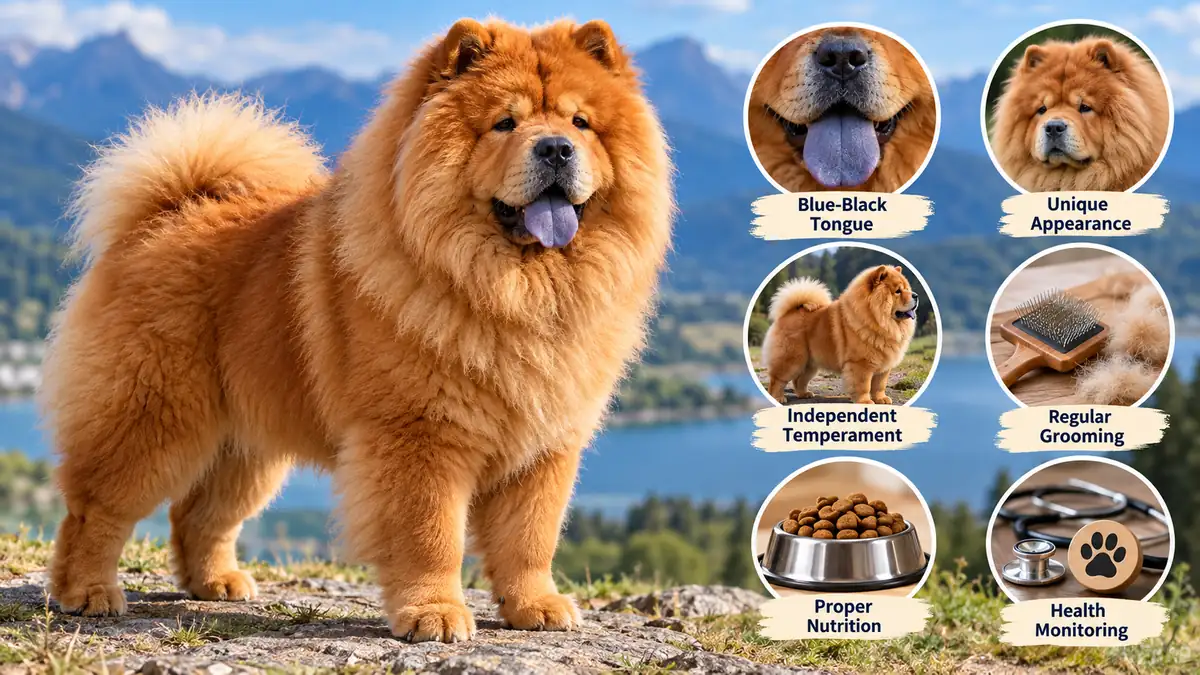
The chow chow looks a little like a lion, a little like a bear, and behaves unlike many of the dogs people meet every day. Behind that dense coat and serious expression is an independent, dignified breed with a long history in China.
A chow chow is a sturdy, compact dog known for its blue-black tongue, thick double coat, lion-like ruff, straight rear legs, and reserved temperament. The breed is intelligent and deeply loyal but often aloof with strangers. Early socialization, patient training, regular grooming, moderate exercise, and careful health monitoring are essential.
Understanding this breed before bringing one home matters. Its teddy-bear appearance can create expectations of a cuddly, easygoing pet, while its actual personality tends to be much more independent.
chow chow Breed Overview
The chow chow originated in China and is recognized by the Fédération Cynologique Internationale (FCI) as an Asian Spitz and related breed. The FCI lists China as its country of origin and Great Britain as its country of patronage.
The breed has been used historically for several purposes, including guarding and hunting. Evidence associated with ancient China also suggests dogs resembling modern Chows existed during the Han Dynasty.
| Characteristic | Typical Chow Chow |
|---|---|
| Size | Medium to large, sturdy and compact |
| Height | About 46–56 cm (18–22 inches) |
| Weight | Roughly 20–32 kg (44–70 pounds) |
| Coat | Dense double coat |
| Coat varieties | Rough and smooth |
| Common colors | Red, black, blue, cinnamon/fawn and cream |
| Temperament | Loyal, independent, reserved, dignified |
| Exercise | Moderate |
| Grooming | High |
| Trainability | Intelligent but independent |
| Distinctive feature | Blue-black tongue |
Exact size varies by sex, genetics, conditioning and breed standard. AKC information describes Chows as compact dogs standing around 20 inches and commonly weighing 45–70 pounds, while PDSA gives a broader approximate height of 46–56 cm and weight of 20–30 kg.
What Does a chow chow Look Like?
Few breeds are as instantly recognizable.
A mature Chow has a broad head, small ears, deep-set eyes and a heavy ruff of hair around the neck and shoulders. This ruff creates the famous lion-like silhouette.
Its body is powerful and compact rather than long and athletic. The tail is carried over the back, while the relatively straight hind legs contribute to the breed’s characteristic stiff or “stilted” gait.
The Famous Blue-Black Tongue
The tongue is one of the breed’s defining characteristics.
Adult Chows normally develop distinctive blue-black pigmentation. Interestingly, puppies do not necessarily start life with a fully blue-black tongue; the darker pigmentation develops as they mature. The Chinese Shar-Pei is another AKC-recognized breed noted for this unusual tongue coloration.
Rough vs. Smooth Coat
There are two coat varieties.
The rough-coated chow chow has abundant, stand-off hair with a particularly noticeable ruff around the neck. This is the classic fluffy appearance most people associate with the breed.
The smooth-coated Chow has shorter outer hair while retaining the dense double-coat structure. It may require somewhat less grooming than the rough variety, but it is by no means a maintenance-free dog.
chow chow Temperament and Personality
A Chow’s personality is one of the most important things prospective owners need to understand.
These dogs are commonly described as:
- Independent
- Loyal
- Calm
- Intelligent
- Reserved
- Serious
- Watchful
- Protective of their home and family
They generally do not behave like extremely outgoing breeds that want attention from every person they encounter.
A well-socialized Chow may calmly accept strangers while showing little interest in interacting with them. That reserve should not automatically be interpreted as fear or aggression. Individual temperament still varies considerably from dog to dog.
The breed often develops a particularly strong bond with its household. At the same time, Chows can remain surprisingly self-contained, sometimes earning comparisons with cats because of their independence.
Are chow chow Dogs Aggressive?
A Chow should not simply be labeled aggressive because it is naturally reserved.
However, its combination of independence, guarding instincts and uncertainty around unfamiliar people or animals makes responsible socialization particularly important. Poorly socialized dogs can become difficult to manage.
Owners should expose puppies gradually and positively to different people, environments, sounds, surfaces and appropriate dogs.
Forcing interactions is counterproductive. A Chow that does not want a stranger touching it should not be treated like a public teddy bear.
Learning canine body language is equally valuable. Recognizing discomfort before it escalates allows an owner to manage situations safely.
Are chow chow Dogs Good Family Pets?
They can be excellent companions in the right household, but they are not an ideal match for every family.
Chows tend to suit calm homes where people respect a dog’s personal space and understand independent breeds. They may be particularly rewarding for experienced owners who prefer a quiet, dignified companion over an intensely social dog.
Households with young, energetic children require more caution. PDSA advises that the breed may be better suited to adult households or families with older children who understand appropriate interactions with dogs. AKC likewise notes that their reserved personality can make experienced homes and older children a better match.
Children should never climb on a dog, pull its coat, disturb it while eating or sleeping, or repeatedly hug it when it tries to move away.
Adult supervision remains essential whenever children and dogs interact, regardless of breed.
Can a chow chow Live With Other Dogs?
It is possible, particularly when appropriate introductions and socialization begin early.
Still, Chows are not famous for being highly social with unfamiliar dogs. Their historical hunting and guarding roles may also contribute to behaviors that require careful management around other animals.
If a household already contains pets, compatibility should be assessed individually rather than assuming every Chow will respond the same way.
Training a chow chow
Training is where many new owners discover how different this breed can be.
Chows are intelligent, but intelligence does not automatically mean obedience. They can understand what a person wants and still be less motivated to repeat a command than highly handler-focused working breeds.
The most effective approach is generally calm, consistent and reward-based.
Start with:
- Name recognition.
- Comfortable handling.
- Leash skills.
- Sit and stay.
- Recall foundations.
- Leave-it and drop-it cues.
- Calm greetings.
- Settling quietly around distractions.
Positive reinforcement using food, toys or another reward the individual dog values can make training more productive.
Harsh punishment and confrontational handling are poor choices, particularly for an independent dog. PDSA recommends consistent positive, reward-based training from an early age.
Why Early Socialization Matters
Socialization does not mean making a puppy interact with everyone.
The real objective is teaching the dog that unfamiliar experiences do not automatically represent danger.
Introduce a young Chow to people of different appearances, normal household sounds, vehicles, veterinary handling, grooming equipment and appropriate dogs in controlled circumstances.
Quality matters more than simply maximizing the number of encounters.
A frightened puppy forced into overwhelming situations may learn exactly the opposite lesson.
chow chow Exercise Requirements
Despite their substantial appearance, Chows are not typically high-energy endurance dogs.
They still need regular physical activity.
PDSA recommends around an hour of daily exercise, which can be divided into walks and other activities. Mental stimulation through training and puzzle-based activities can complement physical exercise.
A practical routine might include a morning walk, a shorter evening walk and several brief training or enrichment sessions.
Running for long periods is unnecessary for most Chows.
Be Careful in Hot Weather
The dense double coat deserves special consideration when temperatures rise.
Chows can struggle in hot conditions, so strenuous exercise during the hottest part of the day should be avoided. AKC specifically notes that their heavy coat makes them poorly suited to high heat.
Provide shade and fresh water, choose cooler walking times and watch closely for signs of overheating.
chow chow Grooming and Coat Care
Anyone attracted to the breed’s spectacular coat should also understand the work required to maintain it.
Chows have dense double coats and shed. Seasonal coat changes can produce especially large amounts of loose undercoat.
Regular brushing helps:
- Remove loose hair
- Prevent tangles and mats
- Keep the undercoat manageable
- Allow inspection of the skin
- Identify lumps, irritation or parasites early
Grooming recommendations vary with coat type and the individual dog. AKC advises regular brushing, while PDSA recommends daily brushing because of the breed’s heavy coat and shedding. Purina similarly suggests daily grooming for rough coats and several sessions per week for smooth coats.
Pay particular attention behind the ears, around the neck ruff, legs and other areas where dense hair can tangle.
Should You Shave a chow chow?
Routine shaving is generally not the answer to managing a dense double coat.
Regular brushing and appropriate professional grooming are better strategies for normal coat maintenance. If severe matting, surgery or a medical condition creates a reason to clip the coat, discuss the situation with a veterinarian or experienced professional groomer.
Bathing frequency depends on lifestyle and coat condition. What matters most is thoroughly drying the dense coat afterward rather than leaving moisture trapped close to the skin.
Nails, ears, teeth and eyes also require routine attention.
chow chow Health Problems Owners Should Know
Like every pedigree breed, the Chow has health risks prospective owners should investigate.
Important conditions associated with the breed include hip dysplasia, elbow dysplasia, entropion, cruciate ligament disease and hypothyroidism. PDSA also identifies gastric dilatation-volvulus (GDV), panosteitis and other concerns that owners should recognize.
Hip and Elbow Dysplasia
Hip dysplasia occurs when the hip joint develops abnormally, potentially contributing to pain and arthritis.
Elbow dysplasia involves abnormal development of the elbow joint and can similarly result in lameness and degenerative joint disease.
Responsible breeding decisions and appropriate screening of breeding animals can reduce avoidable risk.
Entropion
Entropion occurs when an eyelid rolls inward, allowing hair or eyelashes to irritate the surface of the eye.
Signs can include excessive tearing, squinting, redness, discomfort or discharge. Because persistent irritation can damage the eye, suspicious symptoms deserve veterinary assessment rather than home treatment.
Cruciate Ligament Disease
Damage or degeneration affecting the knee’s cruciate ligament can cause pain and limping.
Owners should not dismiss persistent lameness as simple stiffness, particularly if a dog suddenly avoids placing weight on a leg.
Gastric Dilatation-Volvulus
GDV, commonly called bloat, is a veterinary emergency in which the stomach becomes distended and can twist.
PDSA lists it among conditions that can affect Chows. Suspected bloat requires urgent veterinary care rather than waiting to see whether symptoms resolve.
Choosing a Healthier Puppy
Appearance should never be the only criterion when choosing a puppy.
Ask a responsible breeder about health screening performed on the parents, veterinary records and the temperament of both the puppies and adult dogs.
PDSA specifically recommends choosing breeders who health-test breeding animals for relevant inherited problems.
Be cautious when sellers focus almost entirely on unusual colors, exaggerated physical features or claims that a puppy is “rare” while providing little information about health and temperament.
Feeding and Weight Management
A Chow needs a nutritionally complete diet appropriate for its age, size, activity and health status.
Portion control matters because an overweight dog places additional strain on its joints.
Rather than judging healthy weight by appearance alone—the thick coat can hide body shape—learn to assess body condition by touch and ask a veterinarian to establish an appropriate target weight.
Puppies also have different nutritional needs from adults. Rapid or poorly controlled growth in a medium-to-large breed can be undesirable, so puppy diets should be chosen appropriately.
Fresh drinking water should always be available.
Living With a chow chow Day to Day
Life with a well-adjusted Chow is often quieter than people expect.
They generally do not need constant entertainment or endless games of fetch. Many enjoy routine, predictable walks and simply being near their household.
That independence does not mean they should be ignored.
Regular interaction, enrichment, training, grooming and companionship remain part of responsible ownership.
Secure outdoor spaces are valuable. Reliable recall should never simply be assumed with an independent breed; the Chow Chow Club’s AKC educational material specifically cautions about allowing Chows off leash outside securely fenced areas.
Is a chow chow Good for First-Time Owners?
For many first-time owners, there are easier breeds.
A Chow requires someone willing to understand canine behavior, establish consistent boundaries, socialize carefully and maintain substantial grooming.
The challenge is rarely that the dog cannot learn. Rather, its independent temperament means training may require more patience and consistency than inexperienced owners expect.
AKC breed guidance similarly describes Chows as better suited in many cases to experienced owners.
A committed first-time owner is not automatically incapable of succeeding, especially with professional training support. But choosing the breed purely because it looks like a fluffy bear is a poor starting point.
What Makes the chow chow So Unique?
Its appearance receives most of the attention, but the combination of physical and behavioral traits makes this breed genuinely unusual.
The blue-black tongue immediately distinguishes it from most dogs. The dense ruff creates its lion-like profile. Its stiff-legged movement is another recognizable characteristic, while its reserved temperament differs markedly from the enthusiastic friendliness associated with many popular companion breeds.
The breed also has considerable historical depth. The FCI officially identifies China as its country of origin, while AKC historical material connects Chow-type dogs with ancient China and the Han Dynasty.
That history helps explain why describing a Chow simply as a “fluffy family dog” misses much of what the breed actually represents.
Who Should Get a chow chow?
The breed is most likely to thrive with someone who appreciates independence rather than expecting constant affection.
A suitable owner should be comfortable with:
- Consistent training
- Extensive early socialization
- Regular coat maintenance
- Seasonal shedding
- Moderate daily exercise
- Managing interactions with strangers and unfamiliar animals
- Veterinary expenses and breed-related health risks
- Providing structure without harsh handling
People seeking an extremely outgoing dog that happily greets everyone may find another breed more compatible.
For the right household, however, the Chow’s reserved nature is part of its appeal. Its loyalty tends to be understated rather than exuberant.
Final Thoughts on the chow chow
The chow chow is an ancient, distinctive dog with far more to offer than its striking teddy-bear appearance. Its blue-black tongue, lion-like ruff, compact build and dignified personality make it immediately recognizable, but responsible ownership depends on understanding the temperament beneath all that fur.
A well-bred, properly socialized Chow can become a calm and loyal companion. Success requires patient positive training, regular grooming, sensible exercise, careful health monitoring and respect for the dog’s naturally independent personality.
Before bringing one home, spend time around adult Chows, learn about responsible breeding and health screening, and consider whether the breed’s real temperament—not simply its appearance—fits your household and lifestyle.