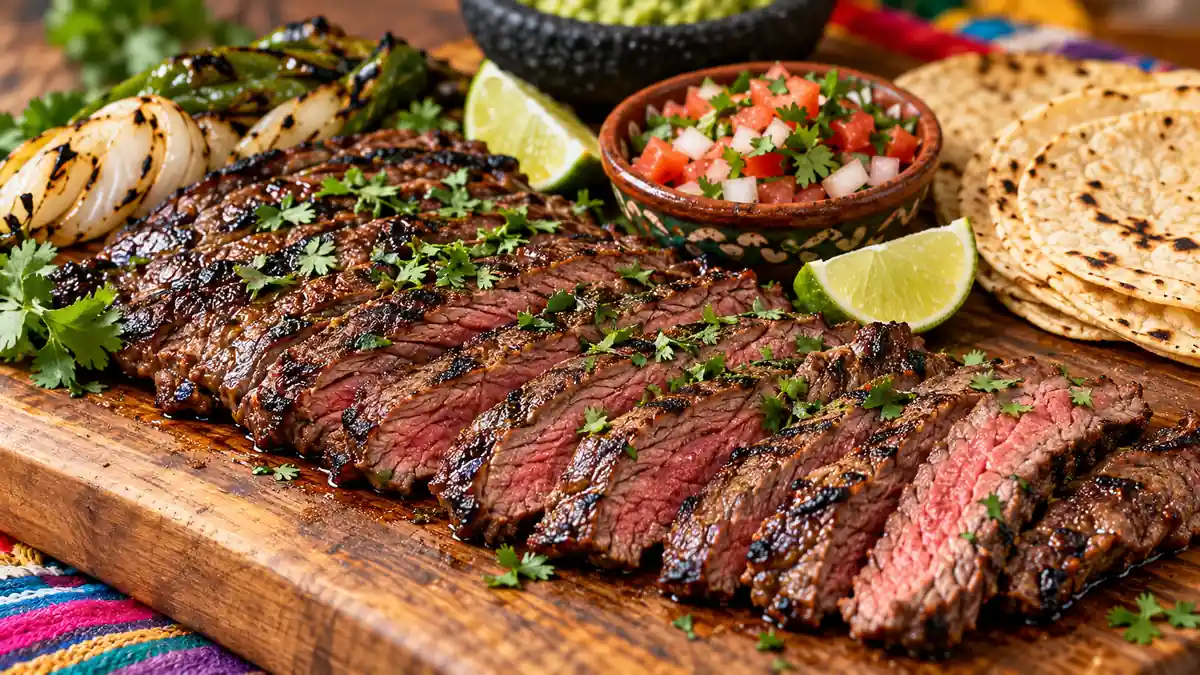
Few foods capture the appeal of live-fire cooking as well as carne asada. At its simplest, it is beef cooked over high heat and sliced for serving. Done well, the outside develops a smoky, deeply browned crust while the inside remains juicy and tender.
Carne asada means “grilled” or “roasted meat” in Spanish. In Mexican cooking—particularly in northern Mexico—it commonly refers to beef grilled over charcoal or another intense heat source. Skirt steak, flank steak, flap meat, and other beef cuts can be used, with seasonings ranging from simple salt to citrus, garlic, chile, and herb marinades.
The technique sounds simple, but small details make a major difference. The cut of beef, amount of marinade, grill temperature, resting time, and even the direction in which you slice the steak can determine whether the finished meat is tender or chewy.
What Is Carne Asada?
The literal translation of carne asada is roasted or grilled meat. In everyday Mexican food culture, however, the term usually refers to grilled beef.
There is no single recipe that defines every plate of carne asada. Mexican preparations vary by region and household, and related styles of grilled meat appear throughout Latin America. Traditional accompaniments can also change from one region to another.
In northern Mexico, where cattle ranching has played an important role in local food culture, carne asada is especially significant. It may be served as the centerpiece of a meal or chopped and tucked into tortillas.
The phrase can even describe the gathering itself. Inviting people to a carne asada can mean getting family or friends together for an outdoor cookout centered on grilled meat.
That social aspect helps explain why the dish cannot be reduced to one standardized marinade.
Some cooks season excellent beef primarily with salt. Others use lime, orange, garlic, chile, cilantro, pepper, or other seasonings. What ties the different approaches together is the combination of beef, intense heat, browning, and direct grilling.
Where Does Carne Asada Come From?
Carne asada is strongly associated with northern Mexico, including regions with long-established ranching traditions.
Mexican culinary references describe carne asada as beef cooked over charcoal or on a griddle and note substantial regional variation. In Baja California, for example, it may be accompanied by corn tortillas, salsa, and beans. In Coahuila, charro beans or potatoes may appear alongside it, while Sonoran preparations reflect that state’s particularly strong beef culture.
This matters because recipes labeled “authentic carne asada” can look surprisingly different.
A heavily marinated skirt steak may be authentic to one family’s tradition, while simply salted beef grilled over charcoal may be closer to another.
Carne asada also exists within the broader tradition of Latin American grilled meat. Countries across Central and South America have their own preparations, cuts, seasonings, sauces, and terminology.
So it is better to think of carne asada as a cooking tradition rather than a rigid formula.
What Meat Is Best for Carne Asada?
One of the most common questions is whether carne asada requires a particular cut of steak.
It does not.
Mexican culinary sources note that various beef cuts can be used. Contemporary recipes commonly choose relatively thin, flavorful cuts because they cook quickly over high heat.
Skirt Steak
Skirt steak is one of the most popular choices.
It has a loose, visible grain and strong beef flavor. Its relatively thin shape makes it excellent for fast cooking over a very hot grill.
Because skirt steak’s muscle fibers are prominent, slicing it correctly is crucial. Cutting across those fibers shortens them and produces a much easier bite.
Flank Steak
Flank steak is another excellent option.
It is leaner and usually thicker than skirt steak, so cooking time may be slightly longer. It accepts marinades well and can produce attractive thin slices for tacos, burritos, and platters.
Bon Appétit, for example, recommends both skirt and flank steak for its version of the dish.
Flap Meat
Flap meat is also well suited to carne asada.
Its coarse grain, rich beef flavor, and ability to brown aggressively make it particularly good for grilling. Depending on where you live, it may be sold under different butcher or regional names.
Other Beef Cuts
There is no rule saying you cannot use another cut.
Sirloin, flat iron, chuck-based cuts, and other steaks can work when handled appropriately. Mexican culinary tradition itself does not limit carne asada to skirt steak.
The practical goal is more important: choose flavorful beef that can develop good browning without becoming unpleasantly tough.
Does Carne Asada Need a Marinade?
Not necessarily.
This is one of the areas where online recipes can create unnecessary confusion.
A marinade is extremely common, especially in Mexican-American and restaurant-style recipes, but it is not what makes grilled beef carne asada. Some preparations rely primarily on the flavor of beef, salt, and charcoal.
When a marinade is used, common ingredients include:
- Lime or orange juice
- Garlic
- Fresh cilantro
- Jalapeño or other chiles
- Black pepper
- Salt
- Oil
- Vinegar
- Cumin or other spices
Food Network’s version, for example, combines lime and orange juice with garlic, jalapeño, cilantro, oil, vinegar, sugar, salt, and pepper before grilling skirt steak.
Other recipes take completely different approaches.
Bon Appétit uses a dry seasoning mixture before grilling and applies a citrusy garlic-cilantro dressing afterward, illustrating just how flexible carne asada can be.
What Does Citrus Do to Carne Asada?
Citrus contributes acidity and bright flavor.
It can complement rich beef beautifully, but more is not always better. Leaving relatively thin steak in a strongly acidic marinade for too long can change its exterior texture.
Food Network’s recipe marinates skirt steak for approximately two to four hours and specifically cautions against excessive time with its citrus-heavy mixture.
That is a useful practical rule: treat citrus primarily as a flavoring tool rather than assuming an overnight acidic soak will automatically make the meat better.
A Simple Carne Asada Marinade
If you want a balanced home version rather than a strictly regional recipe, a useful marinade can be built around citrus, garlic, chile, cilantro, and oil.
For about 2 pounds of beef, use:
| Ingredient | Suggested Amount |
|---|---|
| Skirt or flank steak | 2 lb |
| Fresh lime juice | 3 tbsp |
| Fresh orange juice | ¼ cup |
| Olive or neutral oil | 3 tbsp |
| Garlic | 3–4 cloves |
| Cilantro | ¼ cup chopped |
| Jalapeño | 1, finely chopped |
| Ground cumin | ½ tsp |
| Black pepper | ½ tsp |
| Kosher salt | To taste |
These amounts are flexible rather than traditional requirements.
Combine the ingredients, coat the steak evenly, cover it, and refrigerate it for roughly two to four hours.
If you prefer a more beef-forward flavor, simplify the mixture. Salt, pepper, garlic, and a little citrus may be all you need.
Quick Takeaway: The best marinade is not necessarily the one with the longest ingredient list. Good beef, enough salt, strong heat, and correct slicing matter more.
How to Make Carne Asada
The cooking process can be broken into a few straightforward steps.
1. Prepare the Beef
Trim away unusually thick pieces of surface fat or tough silver skin.
If a long skirt steak is difficult to handle on your grill, cut it into several manageable sections. Avoid cutting it into serving-size strips before cooking because larger pieces are easier to brown without overcooking.
2. Season or Marinate
Apply your chosen seasoning or marinade evenly.
For a citrus-heavy marinade, a few hours is generally enough. For a simpler dry seasoning, you can season the meat in advance and refrigerate it until cooking.
3. Preheat the Grill
Carne asada benefits from strong heat.
A charcoal grill is particularly effective because it combines high heat with the smoky character associated with outdoor grilling. Wood-fired cooking can work beautifully as well.
Let the grill become properly hot before adding the steak.
Trying to compensate for a lukewarm grill by leaving thin beef on it longer tends to cook the interior before the exterior develops enough browning.
4. Remove Excess Marinade
Take the steak from the marinade and allow the excess liquid to drip away.
The surface does not need to be completely dry, but it should not be carrying a thick layer of watery marinade.
Excess liquid can slow browning, while small pieces of garlic or herbs may burn over very high heat.
5. Grill Over High Heat
Place the steak on the hot grill.
Thin skirt steak cooks quickly, while thicker flank steak takes longer. Instead of relying exclusively on a fixed number of minutes, pay attention to thickness and internal temperature.
Bon Appétit’s tested recipe notes that skirt steak generally cooks faster than flank steak because of the difference in thickness.
You want pronounced browning and some char on the surface without unnecessarily drying out the center.
6. Rest the Steak
Do not immediately start chopping.
Move the grilled steak to a cutting board and allow it to rest for several minutes. Many tested recipes use approximately 5–15 minutes depending on the cut and preparation.
Resting also gives you time to prepare warm tortillas, salsa, onions, cilantro, and other accompaniments.
7. Slice Against the Grain
This may be the most important final step.
Look carefully at the lines running through the steak. Those are the muscle fibers—the grain.
Turn your knife so you are cutting across those lines rather than parallel to them.
Slice thinly.
Both Bon Appétit and Food Network emphasize slicing the finished steak against the grain.
That simple technique can make a substantial difference in perceived tenderness.
How Long Should You Grill Carne Asada?
There is no universal cooking time because steak thickness, grill temperature, starting temperature, and preferred doneness all matter.
Thin skirt steak may need only a few minutes per side on a properly heated grill. A thicker flank steak will generally need longer.
Food Network’s skirt-steak recipe uses roughly three to four minutes per side for medium-rare, while other recipes vary according to the thickness and cooking setup.
An instant-read thermometer is more reliable than the clock when precise doneness matters.
For food safety, USDA guidance recommends cooking whole cuts of beef to a minimum internal temperature of 145°F (62.8°C), followed by at least a three-minute rest.
If following a particular recipe that targets a different level of doneness, understand that culinary preferences and official food-safety guidance are not always identical.
How to Cook Carne Asada Without a Grill
No outdoor grill? You can still make excellent carne asada.
The goal is to reproduce the intense surface heat that creates rapid browning.
Cast-Iron Skillet
A heavy cast-iron skillet is one of the best alternatives.
Heat the pan thoroughly before adding the steak. Remove excessive marinade first, especially loose herbs and garlic that can scorch.
Cook in batches rather than crowding the skillet.
If several steaks are packed together, the temperature drops and released moisture accumulates. Instead of searing, the beef starts steaming.
Grill Pan
A grill pan is another option.
It can produce attractive charred areas, although it generally will not create the same smoky flavor as charcoal.
Bon Appétit specifically suggests a very hot cast-iron grill pan when an outdoor grill is unavailable.
Broiler
A broiler can also provide the high heat needed for thin steak.
Position the beef relatively close to the heat source and watch it carefully. Thin meat can move from nicely browned to overcooked quickly.
None of these methods perfectly duplicates charcoal, but all can produce flavorful results.
Why Is My Carne Asada Tough?
Tough carne asada usually comes down to technique rather than one missing ingredient.
You Sliced With the Grain
This is one of the biggest mistakes.
Skirt and flank steak contain obvious long muscle fibers. Leave those fibers intact and your teeth have to do much more work.
Always identify the grain and slice across it.
You Overcooked the Steak
Thin steak cooks rapidly.
Leaving it over intense heat for too long can remove too much moisture, particularly with lean cuts.
Use high heat to brown the outside quickly rather than low heat for an unnecessarily long cooking period.
Your Slices Are Too Thick
Even properly cooked steak can feel chewier when cut into large chunks.
Thin slices across the grain are particularly useful for tacos and burritos.
Your Grill Wasn’t Hot Enough
Low heat often means the steak stays on the grill longer while you wait for browning.
Preheating thoroughly solves much of this problem.
You Expected Marinade to Fix Everything
Marinade adds flavor, but it cannot compensate for poor cooking and slicing.
A beautifully marinated steak can still be tough if it is overcooked and then cut with the grain.
Carne Asada vs. Steak: What’s the Difference?
Carne asada is steak, but not every steak is carne asada.
A steak can be pan-seared, broiled, grilled, roasted, or prepared using many other methods and seasonings.
Carne asada describes a style of grilled beef rooted in Latin American—and especially Mexican—culinary traditions.
The defining qualities are more about preparation and context than a particular cattle breed or single beef cut.
Carne Asada vs. Fajitas
Carne asada and fajitas can look similar because both may involve grilled beef served with tortillas.
They are not interchangeable terms.
Carne asada focuses on grilled meat itself. It may be eaten as a main dish or used in tacos, burritos, tortas, and numerous other foods.
Fajitas are generally served as a composed Tex-Mex dish and are strongly associated with strips of grilled meat accompanied by cooked peppers and onions.
The overlap in cuts such as skirt steak does not make the two dishes identical.
Carne Asada vs. Asado
These terms are related linguistically but can refer to different culinary traditions.
Carne asada literally describes grilled or roasted meat and is especially associated with Mexico and parts of Central America.
In countries such as Argentina, Uruguay, and Paraguay, asado has its own highly developed barbecue tradition, including distinct cuts, grilling methods, accompaniments, and social customs.
Food Network notes that preparations of grilled meat vary considerably across Latin America.
Treating every Latin American barbecue tradition as the same dish misses those regional distinctions.
What to Serve With Carne Asada
One reason carne asada remains so useful is its versatility.
Traditional and popular accompaniments include:
- Warm corn or flour tortillas
- Salsa roja or salsa verde
- Guacamole
- Chopped white onion
- Fresh cilantro
- Lime wedges
- Grilled onions
- Grilled chiles
- Beans
- Rice
- Potatoes
Mexican culinary references specifically mention combinations involving salsa, guacamole, beans, tortillas, potatoes, and other regional sides.
For a simple meal, serve sliced steak alongside tortillas, salsa, beans, grilled onions, and lime. Diners can build their own tacos at the table.
How Carne Asada Is Used
Carne asada does not have to be served as an intact steak.
Once grilled, it can become the foundation of many dishes.
Carne Asada Tacos
Chop or thinly slice the steak and place it in warm corn tortillas.
Onion, cilantro, salsa, and lime are enough to make an excellent taco. Guacamole can add richness.
Avoid overloading the tortilla with toppings if you want the grilled beef to remain the dominant flavor.
Carne Asada Burritos
Carne asada is also a popular burrito filling.
Depending on the regional style, it can be paired with beans, rice, salsa, guacamole, cheese, or other fillings.
Carne Asada Fries
Carne asada fries are especially associated with San Diego-style Mexican-American food.
French fries are topped with chopped grilled beef and commonly accompanied by ingredients such as cheese, guacamole, sour cream, or salsa.
Nachos and Quesadillas
Leftover chopped carne asada works well on nachos or inside quesadillas because the beef has already developed substantial grilled flavor.
Tortas
The meat can also be used in Mexican sandwiches.
Food Network highlights tortas among the dishes that can feature seasoned carne asada.
Other uses include tostadas, sopes, gorditas, and similar tortilla- or masa-based dishes.
How Much Carne Asada Should You Make Per Person?
The answer depends heavily on how you are serving it.
If carne asada is the centerpiece of the meal, plan a larger portion than you would for small tacos accompanied by beans, rice, guacamole, and other sides.
A practical starting point is around 6–8 ounces of raw boneless beef per adult when there are several accompaniments. Increase the amount for large appetites or meat-focused meals.
For tacos, remember that a modest quantity of sliced beef can go surprisingly far once tortillas and toppings are included.
It is usually better to grill a little extra. Leftover carne asada is versatile and easy to reuse.
How to Store and Reheat Carne Asada
Cool leftovers promptly and refrigerate them in an airtight container.
USDA food-safety guidance generally recommends using cooked beef leftovers within three to four days when properly refrigerated.
For longer storage, freeze portions in well-sealed freezer-safe containers or bags.
The main challenge with reheating carne asada is avoiding overcooking it.
A blazing-hot pan is excellent for raw steak but can dry already cooked slices quickly. Reheat only until the meat is hot enough for serving.
If possible, store larger pieces rather than slicing all the steak immediately. Larger pieces retain moisture better during storage, and you can slice them after gentle reheating.
Common Carne Asada Mistakes
A few corrections can noticeably improve the finished dish.
Using a cold grill: Give the cooking surface enough time to preheat. Carne asada needs fast, aggressive browning.
Leaving too much wet marinade on the beef: Excess surface liquid works against immediate searing.
Over-marinating in strong citrus: More time does not always produce more tenderness. Acid can eventually alter the meat’s surface texture.
Constantly cutting into the steak: Repeatedly slicing the beef open to check doneness is unnecessary. Use an instant-read thermometer when accuracy matters.
Skipping the resting period: Give the steak several minutes before slicing.
Cutting with the grain: This is one of the fastest ways to turn good skirt or flank steak into a chewy meal.
Hiding the beef under toppings: Salsa and guacamole should complement the smoky meat rather than overwhelm it.
What Makes Great Carne Asada?
There is no secret ingredient.
Excellent carne asada is usually the result of getting several fundamentals right at the same time.
Start with flavorful beef. Season it adequately. If using a marinade, use it to complement rather than disguise the meat. Cook over strong heat so the surface develops deep browning and char. Let the steak rest, identify the direction of its muscle fibers, and slice thinly against the grain.
Charcoal adds another dimension. Gas and cast iron can produce excellent browning, but burning charcoal or wood contributes the smoky aroma people often associate with an outdoor carne asada.
Most importantly, avoid becoming trapped by the idea that there is one universal “authentic” recipe. Mexican regional traditions demonstrate the opposite: cuts, seasonings, sides, and cooking styles vary.
The constants are simpler—good beef, strong heat, careful cooking, and food meant to be shared.
Final Thoughts on Carne Asada
Carne asada is much more than steak covered in a citrus marinade. It is a broad grilled-beef tradition with particularly deep roots in northern Mexican food culture, where cooking meat can be both a meal and a social occasion.
Skirt steak, flank steak, flap meat, and other cuts can all work. Marinades can be complex or minimal. Charcoal is excellent, but a very hot cast-iron pan can produce impressive results indoors.
For tender carne asada at home, focus on the fundamentals: choose flavorful beef, season it well, avoid excessive acidic marinating, use intense heat, rest the steak after cooking, and always slice across the grain.
Get those details right, and the meat will work just as well on a platter with beans and tortillas as it does chopped into tacos, burritos, tortas, quesadillas, nachos, or carne asada fries.