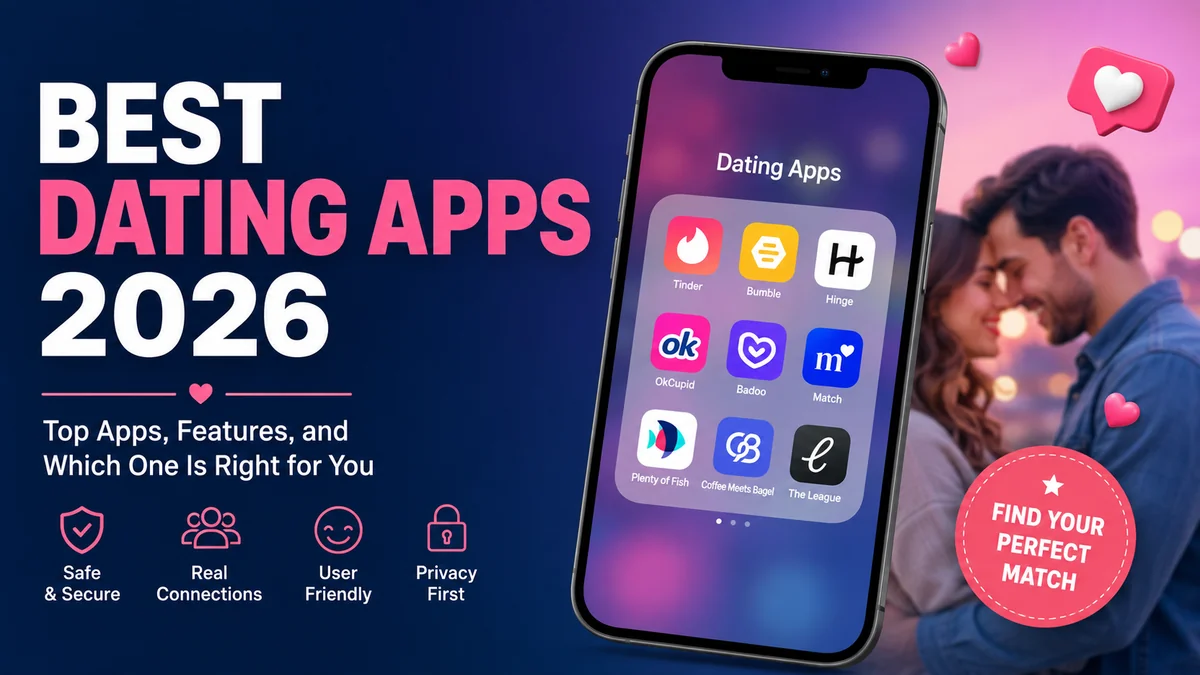
Dating apps have become more specialized. The biggest question in 2026 is no longer simply, “Which dating app is best?” It is which app has the right people, relationship intentions, features, safety tools, and matching style for you.
The best dating apps 2026 include Hinge for relationship-focused dating, Tinder for a large and varied dating pool, Bumble for a more intentional mainstream experience, Facebook Dating for free dating, and specialist platforms such as HER, Grindr, Feeld, Stir, and SilverSingles for particular communities or relationship needs. The right choice depends heavily on your goal and location.
This guide explains how the leading apps differ, what their free versions actually offer, where niche dating platforms make more sense, and what to check before paying for a subscription.
best dating apps 2026 at a Glance
There is no credible universal ranking that works for every dater. Someone looking for marriage has different needs from someone interested in casual dating, and an app with a huge user base may still be ineffective if few people use it locally.
Here is a practical starting point based on the strengths repeatedly identified across current 2026 comparisons.
| Dating app | Particularly useful for | Main strength | Free option |
|---|---|---|---|
| Hinge | Serious relationships | Detailed profiles and compatibility-focused matching | Yes |
| Tinder | Large dating pool and casual dating | Reach and fast discovery | Yes |
| Bumble | Intentional mainstream dating | Conversation-focused experience | Yes |
| Facebook Dating | Dating without a separate subscription | Free core experience | Yes |
| OkCupid | Detailed preferences | Extensive profile questions | Yes |
| Match | Relationship-focused adults | Detailed search and established platform | Yes, limited |
| Coffee Meets Bagel | Curated dating | Smaller batches of suggested matches | Yes |
| Stir | Single parents | Parent-focused scheduling and matching | Yes |
| HER | Queer women and nonbinary people | Dating plus community features | Yes |
| Grindr | Gay, bisexual, trans and queer users | Location-based discovery | Yes |
| Feeld | Non-monogamous and alternative relationships | Flexible relationship structures | Yes |
| SilverSingles | Adults 50+ | Age-focused dating community | Limited/free entry |
The table should be treated as a use-case guide rather than an absolute leaderboard. Dating outcomes depend heavily on geography, demographics, profile quality, activity level, and what other people in your area are seeking.
1. Hinge: Best Starting Point for Serious Relationships
Hinge has become one of the strongest mainstream choices for people who want conversations with more context than a photo-first swipe provides.
Its profiles are structured around photos, personal information and prompts. Instead of simply liking an entire profile, users can respond to a particular photo or answer, giving conversations a natural starting point.
Hinge also uses personalized recommendations, including its compatibility-focused matching system. Current 2026 comparisons consistently position it toward people seeking meaningful or longer-term relationships rather than pure match volume.
What Hinge does well
The biggest advantage is profile depth. A funny or thoughtful prompt can communicate considerably more than another carefully edited selfie.
That makes Hinge particularly useful when compatibility matters more than collecting matches.
The app also offers tools intended to improve conversations and reduce negative interactions. Current features referenced in 2026 testing include Match Notes, Comment Filters and reminders intended to encourage ongoing conversations.
Where Hinge can disappoint
Its free tier limits how aggressively you can browse, while premium subscriptions can be expensive. Your experience also depends on local density. An excellent matching system cannot compensate for a tiny pool of active users in your area.
Quick takeaway: Start with Hinge if you want a committed relationship and prefer learning something meaningful about a person before matching.
2. Tinder: Best for the Broadest Range of Matches
Tinder remains one of the defining names in online dating.
Its swipe-based interface is simple: profiles are shown according to factors such as age, location, gender and preferences, and mutual interest creates a match.
Tinder can be associated with casual dating, but treating it exclusively as a hookup app is too simplistic. Its broad audience means people use it for casual connections, relationships, meeting new people and other forms of dating.
Current testing continues to identify reach and match volume as major Tinder strengths.
Why Tinder still matters in 2026
User density matters enormously.
A specialized dating platform can have perfect features but still be useless if only a handful of suitable people use it within reasonable traveling distance. Large mainstream apps have an advantage here, particularly outside major metropolitan areas.
Tinder also provides profile verification and other safety-related functionality, while its free tier gives newcomers enough functionality to understand the platform before deciding whether premium features are worthwhile.
The downside of a huge dating pool
More profiles do not automatically mean better matches.
Large platforms can produce more low-effort profiles, incompatible intentions and conversations that disappear quickly. Filters and a clearly written profile therefore matter.
Quick takeaway: Tinder makes the most sense when you value a broad dating pool, quick discovery or casual dating and do not mind doing more filtering yourself.
3. Bumble: Best for a More Structured Mainstream Experience
Bumble sits between Tinder’s high-volume environment and Hinge’s relationship-oriented profile experience.
It has historically differentiated itself through women-first communication features in heterosexual matching, although its messaging system has evolved over time.
The result is a mainstream platform that often appeals to people who want a familiar matching interface but prefer more structure around starting conversations.
Current 2026 comparisons commonly place Bumble alongside Tinder and Hinge as one of the primary mainstream choices.
Who should consider Bumble?
Bumble can work well for users who:
- want a mainstream dating pool;
- appreciate profile prompts and preference filters;
- want something more intentional than endless swiping;
- prefer more control over how conversations begin.
Its weakness is similar to most large dating platforms: experience varies significantly by city, age group and preferences.
Quick takeaway: Bumble is a sensible middle ground when Tinder feels too broad but you do not want the more relationship-heavy atmosphere associated with Hinge.
4. Facebook Dating: Best Fully Free Mainstream Option
For people who do not want another expensive dating subscription, Facebook Dating deserves attention.
It operates through Facebook rather than requiring a completely separate social account, and Forbes Health’s August 2026 evaluation ranked it as its best overall dating platform, emphasizing its free access and integration with Facebook.
One notable feature is Secret Crush, which lets users identify people from their broader social ecosystem whom they may be interested in.
The trade-off
The obvious limitation is equally important: you need to be comfortable using Facebook and connecting another aspect of your digital life to the Meta ecosystem.
It also may not have the same dating-first culture as Hinge, Tinder or Bumble in every area.
Quick takeaway: Facebook Dating is worth investigating if subscription cost is your main concern and you already use Facebook.
5. OkCupid: Best for Detailed Preferences and Compatibility Questions
OkCupid takes a question-heavy approach to compatibility.
Instead of depending mainly on photos and basic filters, users can answer questions about lifestyle, values, relationships and personal preferences. Those responses contribute to compatibility information presented between potential matches.
Forbes Health’s 2026 testing specifically highlighted OkCupid for the breadth of its profile questions and noted support for a wide variety of relationships and identity tags.
That makes it particularly useful when certain beliefs, lifestyles or relationship preferences are genuine dealbreakers.
The disadvantage is effort. People who want to create a profile in two minutes and start swiping may find the experience unnecessarily detailed.
Quick takeaway: OkCupid is most useful when compatibility, identity and personal values matter enough that you want to filter on more than age, distance and photos.
6. Match: Best for a More Traditional Online Dating Experience
Match predates the modern swipe era and remains relevant for people who prefer detailed profiles and relationship-focused dating.
Its broader approach includes search and matching tools as well as in-person events in selected markets. Forbes Health highlighted those events when evaluating Match in 2026, while PCMag selected Match as one of its Editors’ Choice services.
Match can be particularly attractive to adults who are comfortable investing more time in profiles and search criteria rather than rapidly cycling through hundreds of cards.
Who is Match best for?
Consider it if you:
- want a committed relationship;
- prefer detailed profiles;
- are comfortable with a more traditional dating-site structure;
- want more filtering than basic swipe apps provide.
The biggest consideration is cost. Some of the features that make established dating sites appealing are tied to paid memberships.
Quick takeaway: Match remains relevant for intentional daters who value established online-dating features more than a swipe-first experience.
7. Coffee Meets Bagel: Best for Curated Matches
Coffee Meets Bagel takes a slower approach.
Instead of encouraging endless browsing, it emphasizes curated potential matches delivered in smaller batches.
That can help people who experience swipe fatigue or find themselves spending too much time browsing profiles without actually speaking to anyone.
Forbes Health identifies curated matches as the platform’s main differentiator, although its tester also found engagement slower than on major platforms such as Tinder and Bumble.
That captures the trade-off well: fewer profiles can make dating feel manageable, but it can also reduce opportunities.
Quick takeaway: Coffee Meets Bagel suits people who would rather evaluate a smaller number of matches carefully than spend an hour swiping.
8. Stir: Best Dating App for Single Parents
Dating while raising children creates practical problems that generic apps rarely address.
Stir focuses specifically on single parents. Its audience already understands that childcare, custody arrangements, school schedules and limited free time can affect dating.
One particularly relevant feature is StirTime, which helps users communicate dating availability. Forbes Health selected Stir as its single-parent specialist in its current comparison.
The main drawback of any niche platform is scale. A smaller, more relevant pool can be better than a huge irrelevant one, but in less populated areas there may simply be fewer active users.
Quick takeaway: Single parents should compare Stir with at least one mainstream platform rather than assuming the largest general dating app will automatically be better.
9. HER, Grindr and Feeld: When a Specialist App Makes More Sense
Mainstream platforms have improved identity and orientation options, but specialized communities remain valuable.
HER is built around queer women, lesbian, bisexual and nonbinary communities and combines dating with social and community-oriented features.
Grindr is designed around gay, bisexual, trans and queer users, particularly men, and uses proximity-based discovery.
Feeld serves a different need. It is designed for people exploring ethical non-monogamy, polyamory, open relationships and other relationship structures that can be awkward to communicate on general-purpose apps.
Current 2026 comparisons repeatedly identify these specialist platforms as stronger choices within their respective communities.
Why niche dating apps can outperform larger apps
Suppose an app has ten times as many users, but only a tiny percentage fit your orientation or desired relationship structure.
A smaller specialist platform may provide fewer total profiles while producing more relevant potential matches.
This is one of the most useful principles when comparing the best dating apps 2026: relevant local users matter more than headline user counts.
10. Dating Apps for People Over 50
Dating priorities can change considerably with age.
People returning to dating after divorce or bereavement may want a slower experience and clearer relationship intentions than younger swipe-heavy platforms typically provide.
SilverSingles is specifically aimed at older singles, while mainstream alternatives such as Match, Hinge and Facebook Dating may provide larger pools depending on location.
Specialist comparisons in 2026 continue to identify SilverSingles as a dedicated 50+ option.
Do not assume, however, that being over 50 automatically means using a senior-only platform. Check activity where you live.
A mainstream service with thousands of relevant local users may work better than a theoretically perfect niche platform with very little nearby activity.
Which Dating App Is Best for Serious Relationships in 2026?
For many people, Hinge is the logical mainstream starting point.
Its prompt-based profiles, personalized recommendations and relationship-oriented positioning encourage users to reveal more than they would through a photo-only profile.
But it is not the only reasonable option.
People seeking marriage may also prefer eharmony, which uses an extensive compatibility approach, or Match, particularly if they prefer established dating-site features and detailed profiles.
Current 2026 research broadly supports separating apps by purpose rather than naming one service as universally superior.
A practical relationship-focused shortlist
For serious dating, consider:
- Hinge — strong mainstream starting point.
- eharmony — compatibility-oriented and marriage-focused.
- Match — traditional relationship-focused dating.
- Coffee Meets Bagel — curated, slower matching.
- Bumble — mainstream alternative with mixed but often intentional dating goals.
What matters most is whether people in your local pool share your intentions.
What Is the Best Dating App for Casual Dating?
Tinder remains the obvious place to start because its broad user base accommodates many different dating intentions.
The key is transparency.
If you want something casual, say enough in your profile to avoid creating false expectations. “Casual” does not mean ignoring boundaries or being deliberately vague about what you want.
Feeld can be more suitable when casual dating overlaps with non-monogamy or alternative relationship structures because its interface provides more context for those preferences.
The distinction matters: casual dating, hookups, polyamory and ethical non-monogamy are not interchangeable terms.
Are Free Dating Apps Actually Free?
Usually, yes—but with limitations.
Many dating platforms use a freemium model. Basic matching is available without payment, while subscriptions unlock convenience or visibility features.
Common premium features include:
- unlimited likes;
- advanced filters;
- seeing who already liked you;
- profile boosts;
- rewinds;
- priority recommendations;
- additional discovery controls;
- incognito or privacy options.
Facebook Dating stands out because its central dating functionality is free. Most other major apps offer free access alongside optional subscriptions.
Forbes Health’s 2026 research found substantial variation in dating-service costs, with paid subscriptions commonly falling around $10–$40 per month in its analysis, although actual pricing can vary with plan length and other factors.
Should you pay for a dating app?
Do not subscribe immediately.
Create a complete profile first and use the free version long enough to determine whether the platform has a healthy pool of relevant users nearby.
Premium access cannot fix poor local availability.
Paying becomes more rational when you already know the platform works for your demographic and the locked feature solves a specific problem—for example, advanced dealbreaker filters or viewing existing likes.
Quick takeaway: Pay for functionality, not hope.
How to Choose Among the best dating apps 2026
Rather than downloading whichever app is trending, evaluate six factors.
1. Define what you actually want
Start with relationship intent.
Are you seeking:
- marriage;
- a long-term relationship;
- casual dating;
- new people without a fixed outcome;
- LGBTQ+ dating;
- ethical non-monogamy;
- dating as a single parent;
- age-specific dating?
Choosing an app before answering this question is backwards.
2. Check the local dating pool
Location may matter more than rankings.
An app that performs brilliantly in New York, London or Los Angeles may have limited activity in a smaller city.
Give a free account enough time to evaluate the number and relevance of profiles before purchasing anything.
3. Compare profile depth
Apps sit on a spectrum.
At one end are fast, visual discovery systems. At the other are detailed questionnaires, prompts and compatibility information.
If attraction is your main initial filter, a photo-forward experience may feel natural.
If values, lifestyle and personality are essential, Hinge, OkCupid, Match or eharmony may provide better information before a conversation begins.
4. Look at communication tools
Matching is only step one.
Ask what happens afterward.
Does the platform encourage comments on prompts? Can users communicate before matching? Are there conversation starters? Does it support voice or video features?
PCMag’s current comparison notes video functionality across several major services, reflecting the continuing usefulness of virtual interaction before an in-person date.
5. Review privacy and safety features
Look for:
- photo or identity verification;
- reporting and blocking;
- unmatching;
- privacy controls;
- location protections;
- moderation systems;
- tools for handling unwanted content.
No verification system completely eliminates fake profiles or malicious users.
Safety features reduce risk; they do not remove it.
6. Understand the paywall
Before subscribing, determine exactly what remains available without payment.
A platform advertising itself as “free” may provide basic matching while reserving its most useful filters or visibility features for subscribers.
Subscription prices also change, so check the price displayed inside the service rather than relying on an old comparison article.
How to Make a Dating Profile That Actually Helps Matching
Choosing the right app solves only half the problem.
A weak profile can perform badly everywhere.
Use a clear first photo
Your primary photo should make it easy to identify you.
Avoid making the first image:
- a large group photograph;
- heavily filtered;
- extremely dark;
- several years old;
- dominated by sunglasses;
- cropped so tightly that context disappears.
Recent, representative photographs prevent awkward surprises later.
Show more than one part of your life
A useful set of photographs might include a clear portrait, a full-body image, an activity you genuinely enjoy and a social or travel photograph.
The objective is not to manufacture an exciting life.
It is to provide enough context for another person to imagine having a conversation with you.
Write prompts people can answer
“Love travel and food” gives a match almost nothing to work with.
Specificity works better.
Mention the obscure meal you learned to cook, the city you would revisit tomorrow or the ridiculous opinion your friends always debate with you.
Good prompts create openings for messages.
State your intentions clearly
If you want a relationship, saying so helps filter out people who do not.
The same principle applies to casual dating and alternative relationship structures.
Clarity can reduce the number of matches while improving their relevance—which is usually a good trade.
Dating App Safety: What to Check Before Meeting Someone
Dating platforms can introduce you to strangers. Treat that fact seriously without assuming every unfamiliar person is dangerous.
Profile verification is useful but should never be treated as a complete background check.
Watch for common online dating red flags
Be cautious when someone:
- refuses reasonable video or voice interaction for a long period;
- immediately attempts to move communication to an obscure platform;
- tells inconsistent personal stories;
- asks for money, cryptocurrency or financial assistance;
- claims an emergency requires your payment;
- pressures you for intimate photographs;
- pushes you to meet somewhere isolated;
- becomes aggressive when you establish boundaries.
Romance scams often depend on emotional urgency.
A genuine romantic interest does not need access to your bank account.
Before a first date
For an initial meeting:
- Choose a public place.
- Arrange your own transportation if possible.
- Tell someone you trust where you are going.
- Keep control of your phone and personal belongings.
- Do not share sensitive financial information.
- Leave if the situation feels unsafe.
Video chatting before meeting can provide additional context, but it still does not guarantee that someone is trustworthy.
Is Hinge Better Than Tinder or Bumble?
It depends on what “better” means.
For relationship-focused dating, Hinge has a strong argument because its prompts and profile structure encourage more detailed interaction.
Tinder has the advantage when reach and match volume matter most.
Bumble occupies useful territory between the two, combining a large mainstream audience with a more structured communication experience.
Current comparisons show exactly this split: Hinge frequently leads for serious dating, Tinder for reach or casual connections, and Bumble for its distinctive mainstream experience.
Instead of asking which company won an overall ranking, ask:
Which platform has enough compatible people near me who want the same kind of relationship I do?
That is the more useful question.
Should You Use More Than One Dating App?
Using two platforms can make sense when they serve different purposes.
For example, someone seeking a relationship might use Hinge as the primary app while maintaining a Tinder profile for broader reach.
A queer dater might combine a mainstream platform with HER or Grindr.
A single parent might compare Stir with Hinge or Match.
Using five apps simultaneously usually creates a different problem: conversations become difficult to manage, profiles become neglected, and dating starts feeling like administration.
Some current 2026 testing similarly recommends focusing on one or two platforms rather than spreading attention across many services.
Start with one. Add a second only when it fills a genuine gap.
How Long Should You Try an App Before Switching?
Do not judge a dating platform after one evening.
Matching systems need activity, and local user pools vary throughout the week.
At the same time, months of zero relevant matches are useful information.
Before blaming the platform, review:
- your primary photo;
- profile completeness;
- age and distance filters;
- relationship-intention settings;
- whether your prompts invite conversation;
- how active the app appears locally.
If the profile is strong but the local pool remains poor, changing platforms is more sensible than purchasing boosts indefinitely.
Dating App Fatigue Is a Real Selection Problem
One gap in many “best dating app” rankings is that they optimize for features rather than the user’s attention.
Endless choice can turn dating into repetitive browsing.
If you notice yourself swiping automatically, maintaining conversations you do not care about or checking the app mainly for validation, reducing usage may produce better outcomes than adding another platform.
A practical system is simple:
- Keep one primary app.
- Set clear relationship intentions.
- Spend a limited amount of time browsing.
- Prioritize promising conversations.
- Suggest a safe real-world meeting when mutual interest is established.
- Pause the app periodically if it starts feeling exhausting.
The purpose of a dating app is to facilitate human connection—not to maximize screen time.
What Has Changed About Dating Apps in 2026?
Several trends are becoming more visible.
Matching is becoming more personalized
Recommendation systems increasingly consider behavioral signals, profile preferences and previous interactions rather than relying only on age and distance.
That does not mean an algorithm can calculate romantic compatibility perfectly.
It means discovery can become more selective.
Verification and moderation matter more
Photo verification, automated moderation, reporting systems and tools designed to detect problematic interactions have become important differentiators.
Forbes Health explicitly includes safety features in its dating-platform evaluation methodology, while PCMag highlights verification and unwanted-content controls across major services.
Dating intentions are becoming more explicit
Apps increasingly let users indicate whether they want a serious relationship, casual dating or another arrangement.
That small piece of profile information can save considerable time.
Specialized communities remain valuable
The growth of mainstream identity options has not eliminated the need for specialist platforms.
HER, Grindr, Feeld, Stir and age-focused services demonstrate why: sometimes the most useful dating pool is not the largest one but the one built around a shared situation or identity.
So, What Is the Best Dating App in 2026?
There is no single winner for everyone.
For most people comparing the best dating apps 2026, the useful starting points are straightforward:
- Hinge for relationship-focused mainstream dating.
- Tinder for reach, variety and casual dating.
- Bumble for a structured mainstream alternative.
- Facebook Dating for a free option.
- OkCupid for detailed compatibility preferences.
- Match or eharmony for a more traditional relationship-focused approach.
- Coffee Meets Bagel for curated matches.
- Stir for single parents.
- HER for queer women and nonbinary communities.
- Grindr for gay, bisexual, trans and queer users.
- Feeld for ethical non-monogamy and alternative relationship structures.
- SilverSingles for a dedicated 50+ dating environment.
The smartest way to choose is not to chase whichever service tops a generic ranking. Identify your relationship goal, test the local user pool with a free account, evaluate safety and privacy tools, and only consider paying once you know the platform actually contains people you want to meet.
The best dating app is ultimately the one that gives you a healthy pool of compatible people, enough information to make informed choices, and a comfortable path from profile to conversation to a safe real-world date.